
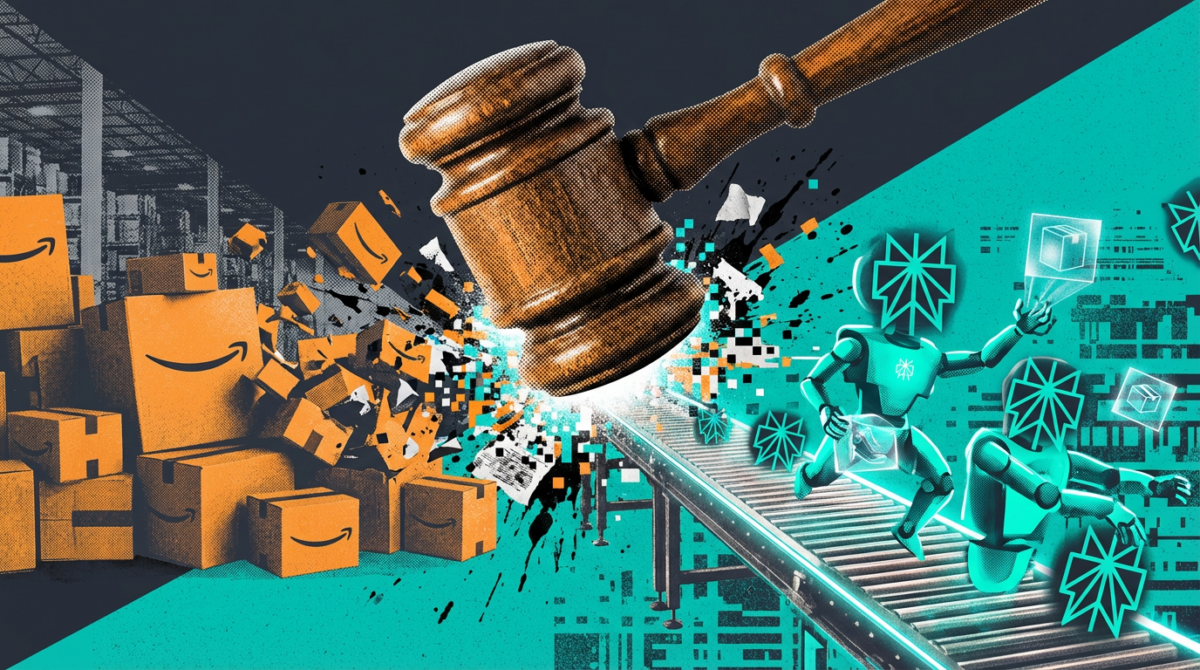
A US appeals court has overturned an injunction that blocked Perplexity's AI shopping agents from accessing Amazon, ruling that users, not the AI company, are the ones accessing the platform. The decision, handed down on Aug 5, 2026, by the 9th US Circuit Court of Appeals, found that Amazon is unlikely to succeed on its claim that Perplexity's AI agents violated federal computer fraud law.
The law in question prohibits accessing computers and obtaining information without permission. The court's reasoning centered on attribution: users, not the AI company, access the platform. This is the first ruling by a US federal appeals court on the legality of AI agents accessing online platforms on behalf of users. The underlying case remains unresolved.
The Dispute Begins
Amazon sued Perplexity in November, accusing the AI startup of covertly accessing private customer accounts via its Comet browser and built-in AI agent. The agent can log into shopping accounts and place orders on behalf of users. Amazon's complaint alleged security risks and claimed Perplexity ignored repeated demands to stop.
Perplexity called the lawsuit baseless and a "bald attempt" to keep Amazon customers away from Comet, because AI agents "don't have eyeballs to see the pervasive advertising Amazon bombards its users with." The startup argued that AI agents "don't have eyeballs to see the pervasive advertising Amazon bombards its users with." Perplexity CEO Aravind Srinivas called Amazon's actions "bullying" and argued for user rights.
In March, a federal court in California temporarily barred Perplexity from using agentic AI on Amazon. Judge Maxine Chesney found "strong evidence" that Perplexity accessed password-protected accounts with users' permission but without Amazon's authorization. The startup was ordered to delete copies of Amazon data.
The Appeals Court Ruling
The injunction is now void, but the underlying case is not decided. The appeals court concluded that users accessed Amazon, not Perplexity. That distinction proved decisive. The court found Amazon unlikely to succeed on its claim that Perplexity's AI agents violated federal computer fraud law.
Agentic AI systems plan, reason, and carry out tasks with limited human oversight. They browse, shop, and complete transactions across the web. The ruling matters for the entire field of agentic AI, as it sets a precedent for how courts view these systems.
Amazon argued that third-party AI must operate transparently and respect established APIs. The company pointed to its own tools, "Buy For Me" and the "Rufus" assistant. Amazon's argument about transparency and APIs was noted in the court's consideration.
Amazon's Response
An Amazon spokesperson said, "We respectfully disagree with today's decision on the preliminary injunction," and added, "We remain confident in our case and are evaluating our next steps." The company has not indicated whether it will appeal further or pursue other legal avenues.
The business relationship between Amazon and Perplexity adds complexity to the dispute. Perplexity is an AWS customer with commitments in the hundreds of millions of dollars. Jeff Bezos, Amazon's founder, is among Perplexity's investors. These ties create an unusual dynamic in a legal fight between a major cloud provider and one of its own customers.
Stay ahead of the AI curve
The most important updates, news, and content — delivered weekly.
No spam. Unsubscribe anytime.
Perplexity's Position
Perplexity spokesperson Jesse Dwyer said, "Perplexity will continue to fight for the right of internet users to choose whatever AI they want." The startup has consistently argued that AI agents should have the same rights as human users when accessing online platforms.
The company's argument is simple: if a user can log into Amazon and place an order, an AI agent acting on that user's behalf should be able to do the same. The appeals court agreed, at least for now, that this argument is likely to prevail.
The decision does not end the case. Amazon can still pursue its claims in the lower court, and the legal questions around AI agents and computer fraud law remain open. But the ruling gives Perplexity and other AI companies a significant early victory.
What Comes Next
The case will return to the lower court for further proceedings. Amazon said it remains confident in its case, while Perplexity said it will continue to fight for users' rights. The outcome could shape how AI agents interact with online platforms for years to come.
For now, Perplexity's Comet browser and built-in AI agent can resume operating on Amazon. The injunction that barred them is gone. The broader legal questions, however, are far from settled.
The ruling is a landmark for agentic AI, a field that has grown rapidly as companies build systems that can act independently on the web. The court's focus on user attribution could influence how other courts handle similar disputes. It also raises questions about how platforms can protect their systems from automated access.
Amazon's argument that third-party AI must respect established APIs remains part of the case. The company has its own AI tools, and it argues that outside agents should follow the same rules. Perplexity counters that its agents are simply tools for users, no different from a browser or an app.
The legal fight is likely to continue for months, if not longer. Both sides have strong incentives to prevail. Amazon wants to control how its platform is accessed. Perplexity wants to prove that users have the right to choose their own AI tools.
The appeals court has spoken, but the final word is not yet in.