
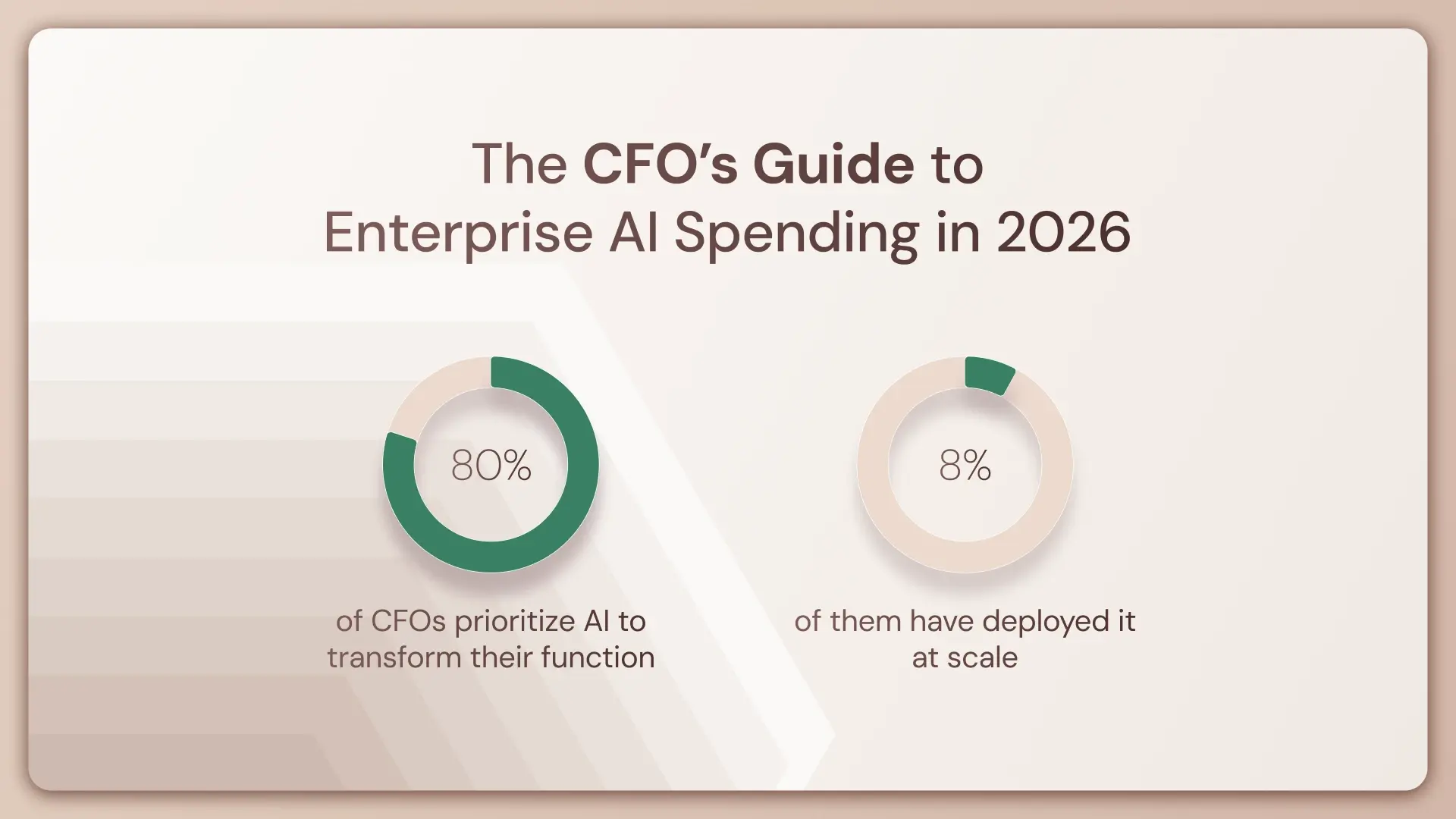
Chief financial officers are shifting their approach to enterprise AI spending, moving from experimental funding to disciplined, infrastructure-like management as 2026 approaches. The change marks a significant departure from the previous year, when many companies treated artificial intelligence as a novelty rather than a core operational expense.
A year ago, AI budgets mostly lived inside innovation teams, isolated from the rest of the business. Now, every department wants access. Sales, support, finance, legal, and HR teams are all requesting AI tools, from sales development representatives and agents to reporting systems, contract review platforms, and copilots. The demand has transformed AI from a side project into a central financial concern.
The Escalation Problem
AI spending compounds quickly, and most companies fail to anticipate how fast it grows. Pilots expand to multiple vendors and workflows within months, catching finance teams off guard. The escalation follows a predictable path: Pilot, Team Expansion, Production Rollout, Governance Phase, and Scale Stage. Each phase brings new costs and new complexity.
Departments often buy AI systems independently, leading to overlapping vendors, duplicate tooling, inconsistent governance, and hidden recurring costs. Finance teams struggle to answer a basic question: "How much are we actually spending on AI?" The lack of visibility creates real problems for budgeting and forecasting.
The issue is not just the number of tools. AI infrastructure expands much faster than expected, and model cost is just the beginning. The full cost structure includes models for API and inference, storage for vector databases, operations for monitoring, security for access control, governance for audit trails, deployment for runtime and orchestration, and compliance for policy enforcement. Each layer adds to the bill.
Why AI Is Not SaaS
AI spending behaves like infrastructure spending, not traditional SaaS. Traditional software subscriptions follow predictable patterns, but AI costs scale with usage, data volume, and system complexity. That difference matters for CFOs who are used to managing software budgets with clear annual contracts.
In 2025, enterprises made the biggest AI spending mistake: underestimating infrastructure expansion. The consequences of that error are now visible in budgets across industries. Finance teams realized that a single pilot can spawn dozens of dependent systems, each with its own vendor relationship and cost profile.
CFOs are now asking sharper ROI questions. They want to know which systems reduce costs, improve margins, impact revenue, or just add a software layer. The scrutiny reflects a broader shift in how executives evaluate AI investments. The core question has become: "How do we scale AI spending without losing financial control?"
High-ROI AI Areas
Not every AI purchase makes sense, and CFOs are separating experimentation from measurable business value. Three areas stand out for their return on investment.
Operational automation produces the clearest ROI because it reduces manual overhead directly. Reporting, procurement, knowledge systems, support, and compliance all benefit from automation that cuts labor costs and speeds up processes.
Revenue operations ties AI directly to revenue outcomes instead of vague productivity claims. Sales intelligence, forecasting, prospect research, expansion analysis, and marketing tools all connect to measurable business results. These systems help companies understand where growth comes from and how to optimize it.
AI governance and infrastructure represent the third high-ROI area. Governance, deployment controls, auditability, observability, approval workflows, and policy enforcement may not generate revenue directly, but they protect the organization from operational exposure. Unmanaged AI systems create risk, and risk has a cost.
Governance Becomes Mandatory
Stay ahead of the AI curve
The most important updates, news, and content — delivered weekly.
No spam. Unsubscribe anytime.
Governance spending is now part of the AI budget, especially in regulated industries. Financial services, healthcare, insurance, enterprise SaaS, and government contracting all face higher governance requirements for AI. These sectors cannot afford unmanaged systems or shadow AI deployments.
Enterprises often run fragmented AI infrastructure: separate copilots, APIs, orchestration systems, and vendors. That fragmentation creates visibility issues and makes it difficult to enforce consistent policies. The problem is compounded by department-level purchasing, which bypasses central oversight and creates budget blind spots.
Smart CFOs focus on platform consolidation, governance-first deployment, infrastructure standardization, ROI-based prioritization, and centralized AI oversight. They ask "Where does AI create measurable operational leverage?" instead of "How do we use AI everywhere?" The distinction matters because it forces discipline and accountability.
One critical question captures the scale of the problem: "How Many AI Systems Are We Actually Running?" Most finance leaders cannot answer this accurately, and that lack of knowledge undermines their ability to control costs.
Winning Versus Struggling Companies
Companies winning with AI treat it like infrastructure. They maintain centralized governance, operational accountability, controlled deployment, measurable outcomes, and standardized infrastructure. These organizations treat AI as a core business system, not a collection of experiments.
Struggling companies have fragmented ownership, tooling, and accountability. Their AI initiatives grow without coordination, creating duplicate costs and inconsistent governance. The difference between success and failure often comes down to organizational discipline rather than technical capability.
The AI spending conversation is becoming operational finance, not technology. CFOs are taking ownership of AI budgets and applying the same rigor they use for other capital investments. This shift reflects a maturation of the market as companies move from experimentation to production.
Companies managing AI spending with discipline will likely see the strongest long-term returns. Those that fail to impose structure will face rising costs, compliance risks, and operational inefficiencies. The stakes are high, and the window for getting this right is narrowing.
As 2026 approaches, the pattern is clear. AI is no longer an experimental line item; it is operational infrastructure. CFOs who embrace this reality and build the necessary governance structures will position their companies for sustainable growth. Those who treat AI as a passing trend will struggle to keep pace with competitors who have already made the transition.
The shift also reflects a broader change in enterprise technology management. Infrastructure spending requires long-term planning, centralized oversight, and clear accountability. AI now demands the same treatment, and CFOs are stepping up to provide it.
The message from finance leaders is consistent: AI spending must be managed with the same discipline as any other major investment. That means asking hard questions, demanding measurable outcomes, and refusing to let fragmented purchasing undermine financial control.
For companies in regulated industries, the urgency is even greater. Governance is no longer optional; unmanaged AI systems create operational exposure that can lead to fines, reputational damage, and lost customer trust. The cost of inaction far exceeds the cost of building proper controls.
The path forward is clear. Centralize oversight, standardize infrastructure, prioritize investments based on ROI, and hold departments accountable for their AI spending. Companies that follow this playbook will turn AI from a cost center into a competitive advantage.
The transition from experimental to operational AI spending is well underway, and CFOs are leading the charge. Their focus on discipline and governance will define the next phase of enterprise AI adoption.