
Back to Blog gcp
gcp
 gemma
gemma community
 ai
ai ai
ai githubactions
 ai
ai
Multi-Region Resilience on GKE: Combining Multi-Cluster Gateways with Istio Ambient Mesh
Miguel Moreno June 30, 2026
0 views
In the current landscape of hyper-distributed systems, resilience is no longer an infrastructure...
In the current landscape of hyper-distributed systems, resilience is no longer an infrastructure checkbox—it is a competitive moat. As organizations scale across global boundaries, the challenge is to provide seamless connectivity while maintaining regional autonomy.
A strong architectural pattern for regulated, multi-region platforms is the strategic fusion of GKE Multi-cluster Gateways and Istio Ambient Mesh. This combination creates a baseline for stability that is both operationally resilient and transparent to developers.
North-South: A Unified Entry Point Across Regions
Managing disparate load balancers for every region creates operational debt. The modern North-South strategy requires a unified logical entry point that respects physical regional constraints.
Using the gke-l7-cross-regional-internal-managed-mc GatewayClass, architects can deploy a single internal Gateway resource that requests VIPs across multiple regions. While it provides a "single entry point" abstraction, traffic is intelligently directed by the Google Cloud backbone to the closest healthy backend GKE cluster.

The Fleet Machinery:
This resilience is not "magic"; it is powered by GKE’s Fleet and Multi-cluster Services (MCS).
- Config Cluster: Gateway and HTTPRoute resources are applied once to a designated config cluster, acting as the control center for the entire fleet.
- Service Discovery: The Gateway controller leverages
ServiceImportresources to discover backends across different clusters, ensuring that routing is global while execution is regional.
East-West: Zero Trust Without the Sidecar Tax
Once traffic enters the VPC, the focus shifts to secure service-to-service communication. For years, sidecars were the only answer, but they came with a heavy "tax" on CPU and memory. Istio Ambient Mesh provides a lower operational and resource overhead than per-pod sidecars by splitting the mesh into two layers.
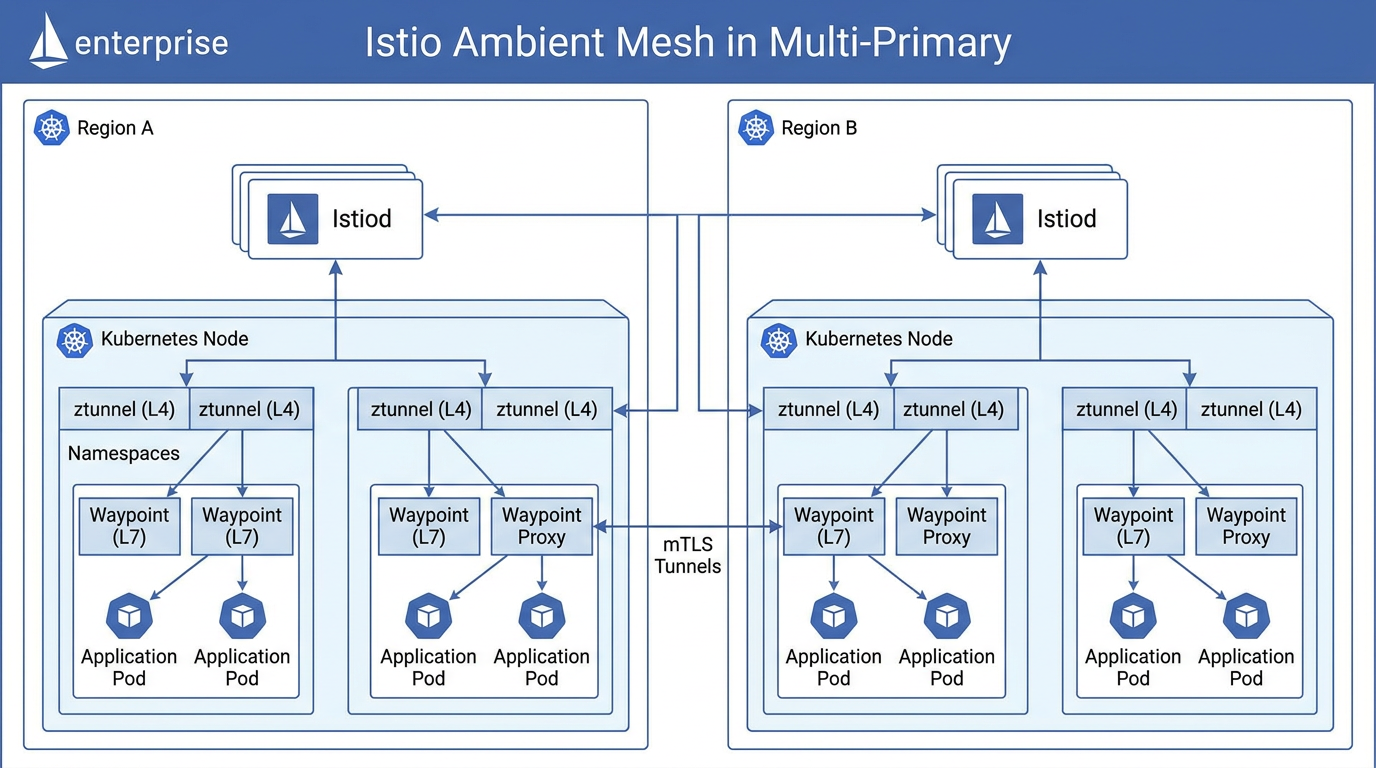
Precise Policy Enforcement:
- ztunnel (L4 Layer): A per-node proxy focused strictly on L3/L4 connectivity, mTLS, authentication, and basic telemetry. It does not interpret HTTP, keeping the footprint minimal.
- Waypoint Proxies (L7 Layer): Waypoints are mandatory whenever L7 logic is required—such as header-based routing, HTTP-level authorization, or complex traffic splitting. By deploying Waypoints only where needed (per namespace or service account), resource consumption is optimized.
- Multi-Primary Resilience: In a multi-primary topology, each cluster runs its own istiod control plane, reducing the risk of a single control-plane failure cascading across regions. Cross-cluster discovery is still explicitly configured, but control-plane ownership remains distributed.
When to Use This Pattern
This pattern is especially useful when you need:
- Private multi-region entry points for internal workloads running on GKE.
- Health-based routing across multiple clusters without exposing each cluster independently.
- Regional autonomy while keeping a centralized and declarative traffic entry model.
- East-West mTLS between workloads without deploying sidecars everywhere.
- L7 policy enforcement only where required, using waypoint proxies selectively.
- A stronger baseline for regulated platforms, where resilience, segmentation, identity, and operational clarity are mandatory.
What This Architecture Does Not Solve Automatically
It is critical to recognize that infrastructure-level resilience is a foundation, not a complete solution. Implementing GKE Gateways and Istio Ambient does not replace disciplined service design.

This architecture improves connectivity, but the following challenges remain the responsibility of the application architect:
- Application State & DB Replication: Neither the Gateway nor the Mesh can solve for data consistency or replication lag across regions.
- Health-check Design: A shallow health check can lead to "zombie" backends that the Gateway continues to target.
- DNS & Failover Strategy: Global DNS management and the testing of regional failover scenarios remain vital for total business continuity.
The Result: A Stronger Baseline
The synergy between Google Cloud’s managed networking and the efficiency of Istio Ambient Mesh represents a significant evolution. By removing the sidecar tax and unifying regional entry points, we reduce the blast radius of failures and the cost of security.
The result is not a silver bullet, but a stronger baseline for regulated, multi-region platforms. It allows engineering teams to focus on the high-value application resilience patterns, knowing that the underlying network fabric is both robust and transparent.
Resources
Comments
More Blog
View allgemmaFive Gemma-4 models, one accelerator: what porting E2B 31B to AWS Inferentia2 taught me
I ported the whole Gemma-4 family — E2B, E4B, 12B, 31B, and the 26B-A4B MoE — to run on...
X
xbillcommunityHey DEV, I'm Tobore. Let's actually connect.
Hey DEV, I'm Tobore. Let's actually connect. I've been on here for a while now, mostly writing and...
L
Laurina AyarahaiI burned through thousands of AI tokens. Then a friend did it for free
(yep, kinda clickbait, just for the funsies 😊) At the beginning of the year, I relaunched my...
P
Paulo HenriqueaiClaude might be saturating your machine
My laptop was sitting idle with the fan at full tilt. Nothing was running that I knew of. The culprit...
S
Sidhant PandagithubactionsAutomated GitHub Code Reviews Using Google Gemini
I Built a Thing! TL;DR — Google Gemini-based Pull Request reviews and Issue Triaging for...
D
Darren "Dazbo" LesteraiWhat is an "agentic harness," actually?
I've been hearing the word "harness" thrown around a lot lately. I assumed it just meant "the IDE" or...
T
Tilde A. ThuriumReady-made automations for this
Workflows from the Neura Market marketplace related to this Midjourney resource
- Categorize Gmail Emails Using GPT-4 Mini with Multi-Label Analysisn8n · $9.99 · Related topic
- Automate Graphic Wallpaper Creation with Midjourney and Canvas APIsn8n · $9.99 · Related topic
- Automate DevOps Infrastructure Setup on Linux with Docker, K3s, Jenkins, and Grafanan8n · $9.99 · Related topic
- Automate Your Creative Process with Midjourney and GPT-4 Image APIn8n · $8.22 · Related topic