
Back to Blog typescript
 gemma
gemma community
 ai
ai ai
ai githubactions
 ai
ai
Why agents need workbook APIs instead of spreadsheet screenshots
Greg Konush May 7, 2026
0 views
A practical case for treating spreadsheet state as an API boundary for Node services and coding agents.
title: Why agents need workbook APIs instead of spreadsheet screenshots published: true description: A practical case for treating spreadsheet state as an API boundary for Node services and coding agents. tags: typescript, node, opensource, ai canonical_url: https://proompteng.github.io/bilig/dev-to-workbook-apis-post.html cover_image: https://raw.githubusercontent.com/proompteng/bilig/main/docs/assets/github-social-preview.png
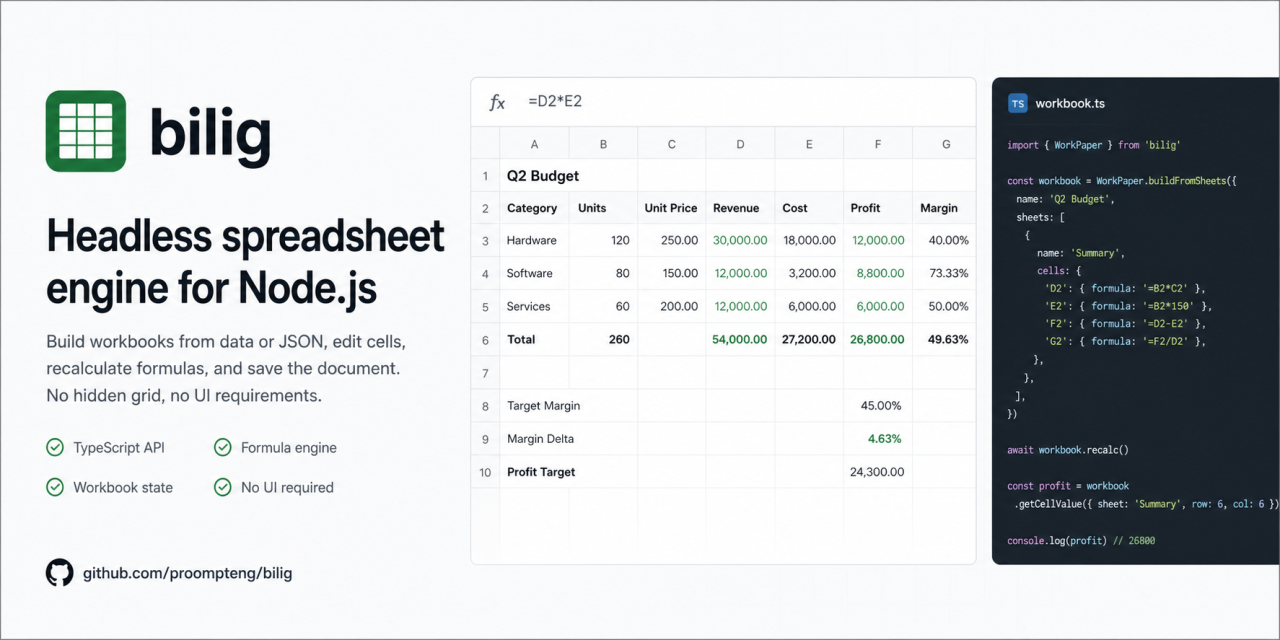
spreadsheets are still one of the most common ways teams encode business logic. pricing models, revenue plans, reconciliations, forecasts, data checks, and ad hoc operational tools often start in a workbook because the shape is flexible and everyone can inspect it.
that creates an awkward automation problem: the logic is structured like a workbook, but most programmatic workflows either drive a browser grid or rewrite the model in application code.
that is especially brittle for coding agents. a screenshot can show a grid, but it cannot give the agent a stable contract for formulas, structural edits, persistence, validation, or post-write readback.
i maintain an open-source typescript project called
bilig. the public package is
@bilig/headless, a
node-facing workbook runtime for programmatic spreadsheet automation.
this post is the practical argument for the API boundary. it is not a claim that the project is a finished excel clone.
screenshots are a weak runtime boundary
a spreadsheet UI is useful for humans. it is not enough as the main contract for an agent.
when an agent drives a grid by pixels, several facts become hard to verify:
- whether the displayed value came from a literal or a formula
- whether formulas recalculated after an edit
- whether an inserted row moved the intended references
- whether hidden sheets or named expressions changed
- whether the saved workbook still round-trips into the same state
- whether the agent actually verified the workbook or just saw plausible cells
screenshots are still useful for final inspection. they should not be the only evidence that a workflow did the right thing.
the better boundary is workbook state
a workbook API gives an agent explicit operations and explicit readback:
- create sheets and ranges from data
- write formulas as formulas
- evaluate values after edits
- apply structural operations through the engine model
- serialize and restore workbook documents
- validate behavior without opening a browser
that shape fits backend jobs and agent tools better than asking a model to infer state from a rendered grid.
the UI can stay a human-facing view. the API becomes the source of truth.
a small node example
install the package:
npm install @bilig/headless
build a workbook, evaluate a formula, and round-trip the document:
import {
  WorkPaper,
  createWorkPaperFromDocument,
  exportWorkPaperDocument,
  parseWorkPaperDocument,
  serializeWorkPaperDocument,
} from "@bilig/headless";

const workbook = WorkPaper.buildFromSheets({
  Revenue: [
    ["Region", "Customers", "ARPA", "Revenue"],
    ["West", 20, 1200, "=B2*C2"],
    ["East", 30, 250, "=B3*C3"],
    ["Central", 18, 300, "=B4*C4"],
  ],
  Summary: [
    ["Metric", "Value"],
    ["Total revenue", "=SUM(Revenue!D2:D4)"],
    ["West customers", '=SUMIF(Revenue!A2:A4,"West",Revenue!B2:B4)'],
  ],
});

const summary = workbook.getSheetId("Summary");
if (summary === undefined) {
  throw new Error("Summary sheet was not created");
}

const total = workbook.getCellValue({ sheet: summary, row: 1, col: 1 });
const saved = serializeWorkPaperDocument(
  exportWorkPaperDocument(workbook, { includeConfig: true }),
);
const restored = createWorkPaperFromDocument(parseWorkPaperDocument(saved));

console.log({
  total,
  sheets: restored.getSheetNames(),
});
that is the basic pattern i want from agent-facing spreadsheet tools:
- create or load workbook state
- make the edit
- recalculate through the workbook engine
- read back exact values
- persist and restore
- verify the same behavior without a browser session
what this gives an agent
an agent tool can expose a small set of reliable commands:
buildWorkbookFromSheetssetCellContentsgetCellValuereadRangelistSheetsexportWorkbookDocumentrestoreWorkbookDocument
those commands produce deterministic outputs that can be logged, tested, and replayed.
the important shift is that the agent no longer has to treat the grid as the database. it can operate on workbook state and use the rendered spreadsheet only when a human needs to inspect the result.
what bilig currently claims
the current public claim is intentionally narrow:
@bilig/headless exposes a WorkPaper API for programmatic workbook creation,
formula evaluation, structural operations, persistence, validation, and
readback.
the repo also includes checked-in benchmark evidence against
hyperformula-style workloads. the current artifact records 46/46 mean wins on
scorecard-eligible comparable workloads, with a p95 caveat documented instead
of hidden.
benchmark evidence: https://github.com/proompteng/bilig/blob/main/docs/headless-workpaper-benchmark-evidence.md
what it does not claim:
- not full excel compatibility
- not a finished spreadsheet application
- not faster on every p95 row
- not complete xlsx import/export fidelity for every workbook in the wild
i think those caveats matter. developer infrastructure gets more trust from clear boundaries than from broad compatibility claims.
try it
published package:
npm install @bilig/headless
maintained external example:
git clone https://github.com/proompteng/bilig.git
cd bilig/examples/headless-workpaper
npm install
npm start
useful links:
- repo: https://github.com/proompteng/bilig
- npm: https://www.npmjs.com/package/@bilig/headless
- package readme: https://github.com/proompteng/bilig/tree/main/packages/headless#readme
- runnable example: https://github.com/proompteng/bilig/tree/main/examples/headless-workpaper
- compatibility caveats: https://github.com/proompteng/bilig/blob/main/docs/where-bilig-is-not-excel-compatible-yet.md
- starter issues: https://github.com/proompteng/bilig/blob/main/docs/starter-issues.md
if this is relevant to a node service, spreadsheet engine, or coding-agent workflow you are building, the most useful feedback is concrete: api friction, missing formula semantics, import/export expectations, or a real workbook case that should become a fixture.
Comments
More Blog
View allgemmaFive Gemma-4 models, one accelerator: what porting E2B 31B to AWS Inferentia2 taught me
I ported the whole Gemma-4 family — E2B, E4B, 12B, 31B, and the 26B-A4B MoE — to run on...
X
xbillcommunityHey DEV, I'm Tobore. Let's actually connect.
Hey DEV, I'm Tobore. Let's actually connect. I've been on here for a while now, mostly writing and...
L
Laurina AyarahaiI burned through thousands of AI tokens. Then a friend did it for free
(yep, kinda clickbait, just for the funsies 😊) At the beginning of the year, I relaunched my...
P
Paulo HenriqueaiClaude might be saturating your machine
My laptop was sitting idle with the fan at full tilt. Nothing was running that I knew of. The culprit...
S
Sidhant PandagithubactionsAutomated GitHub Code Reviews Using Google Gemini
I Built a Thing! TL;DR — Google Gemini-based Pull Request reviews and Issue Triaging for...
D
Darren "Dazbo" LesteraiWhat is an "agentic harness," actually?
I've been hearing the word "harness" thrown around a lot lately. I assumed it just meant "the IDE" or...
T
Tilde A. ThuriumReady-made automations for this
Workflows from the Neura Market marketplace related to this Midjourney resource
- Automate Graphic Wallpaper Creation with Midjourney and Canvas APIsn8n · $9.99 · Related topic
- Create Animated Stories Using GP-4.0-mini, Midjourney, Kling, and Creatomate APIn8n · $24.99 · Related topic
- Automate n8n User Invitations from a Google Spreadsheetn8n · $9.99 · Related topic
- Add New Incoming Emails to a Google Sheets Spreadsheet as a New Rown8n · $4.99 · Related topic