
Back to Blog javascript
 gemma
gemma community
 ai
ai ai
ai githubactions
 ai
ai
Spread vs Rest Operators in JavaScript: Expand or Collect Like a Pro
Ritam Saha April 24, 2026
0 views
Introduction Imagine you're juggling arrays and objects in JavaScript, and suddenly you...
Introduction
Imagine you're juggling arrays and objects in JavaScript, and suddenly you need to copy, merge, or slice them without breaking a sweat.
Entry of the spread operator (...) and rest operator (...)—two syntactic superheroes that look identical buthave different jobs. They're game-changers for clean, readable code in modern JS and provide perfect Developer's experience, especially in React apps, Node.js backend applications.
But what's the difference between these two?
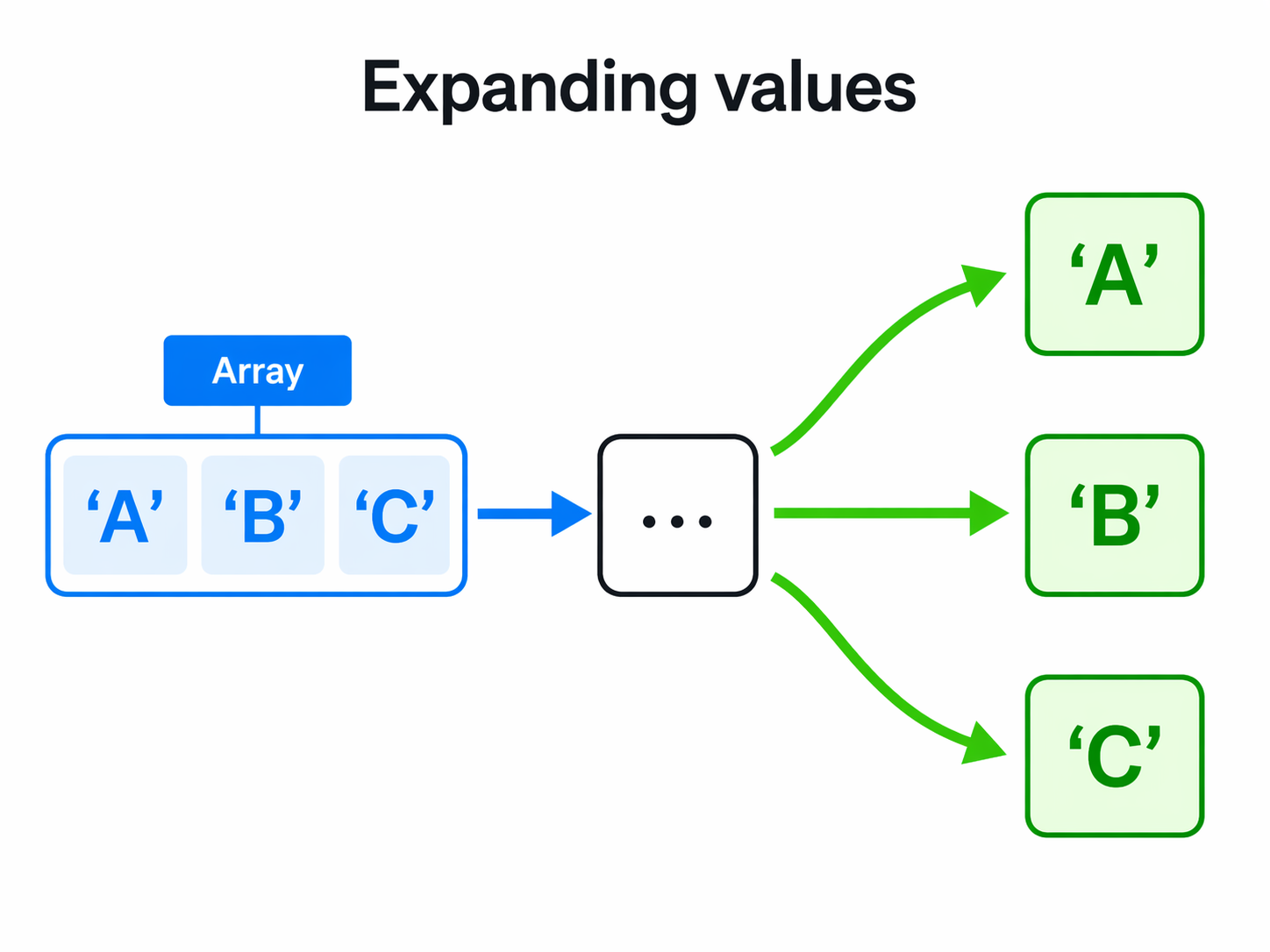
Spread expands values into individual elements; Rest collects them into a single array or object
Let's dive in with examples and see how they shine (or clash) in real scenarios.
What the Spread Operator Does: Expanding Values
The spread operator (...) is like dropping a glass from a height and it spreads down completely with so many broken parts; this takes an iterable—like an array or object—and spreads (expands) its elements into individual items. It's like unpacking a box: everything spills out for easy use.
const fruits = ['apple', 'banana'];
const moreFruits = ['orange', ...fruits, 'grape'];
// Result: ['orange', 'apple', 'banana', 'grape']
Here, ...fruits expands the array, letting you merge without messy loops.
const user = { name: 'Ritam', city: 'Kolkata' };
const updatedUser = { ...user, age: 20, hobby: 'coding' };
// Result: { name: 'Ritam', city: 'Kolkata', age: 20, hobby: 'coding' }
Spread creates shallow copies and merges—perfect for immutable updates in state management.
What the Rest Operator Does: Collecting Values
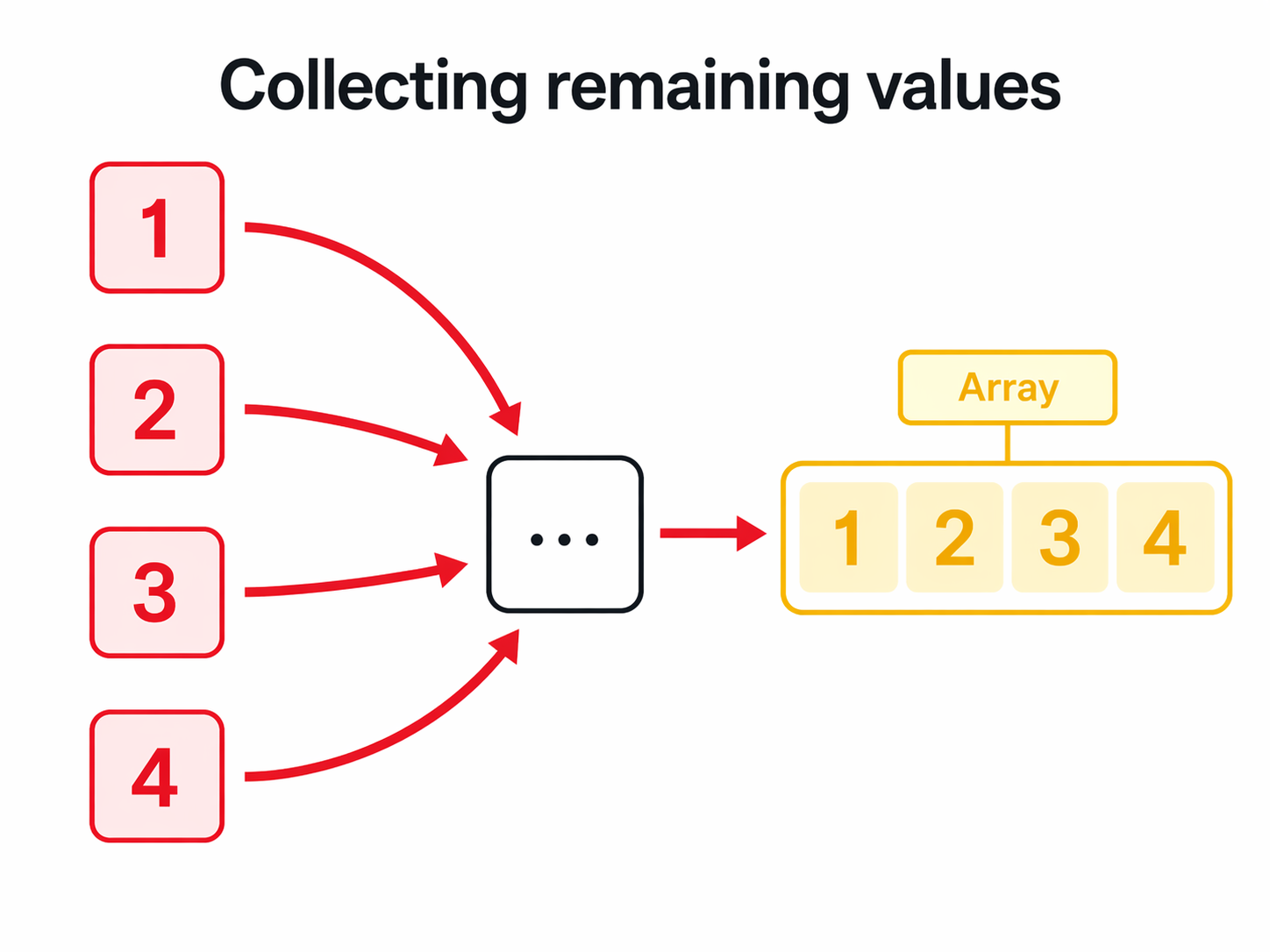
The rest operator (...) does the opposite: it gathers (collects) elements into a single array. It only works in function parameters depending on the passed arguments and for destrcturing, acting like a "vacuum" for leftovers.
function sum(...numbers) {
  return numbers.reduce((acc, num) => acc + num, 0);
}
sum(1, 2, 3, 4); // Result: 10 (numbers = [1, 2, 3, 4])
Rest collects all arguments into numbers.
const [first, ...rest] = ['apple', 'banana', 'orange']; //Array destructuring
console.log(first); // 'apple'
console.log(rest);  // ['banana', 'orange']
It grabs the first item, then collects the rest.
Key Differences: Spread Expands, Rest Collects
| Aspect | Spread (...) | Rest (...) |
|---|---|---|
| Direction | Expands (unpacks) | Collects (packs) |
| Context | Anywhere (arrays, objects, calls) | Function params or destructuring |
| Use Case | Copying, merging, passing args | Variable args, destructuring leftovers |
| Example | [...arr] clones array | function(...args) |
Spread is for spreading values outward; rest is for gathering them inward. Confuse them? Your code breaks—spread won't work in params!
Practical Use Cases: Real-World Wins
Cloning Arrays/Objects (Spread): Avoid mutations in React state.
const state = { users: [] };
const newState = { ...state, users: [...state.users, newUser] };
Function Arguments (Spread): Pass arrays dynamically.
const coords = [10, 20];
console.log(Math.max(...coords)); // 20
API Data Merging (Spread): Combine defaults with user input.
const defaults = { method: 'GET' };
const config = { ...defaults, url: '/api/users' };
fetch(config.url, config);
Variable Args in Node.js Utils (Rest): Build flexible helpers.
function log(...messages) {
  console.log(new Date(), ...messages);
}
log('User login:', userId, timestamp);
Destructuring Props (Rest): In React components.
function Button({ children, ...props }) {
  return <button {...props}>{children}</button>;
}
These patterns pop up everywhere—from your full-stack deploys on Vercel to interview coding rounds.
Wrapping Up: Master Both for Cleaner JS
Spread and rest operators turn clunky array/object ops into elegant one-liners, saving you headaches in full-stack dev. Remember: spread expands for copying/merging; rest collects for flexible params. Practice with small examples, and they'll become second nature for your portfolio projects. Next time you're refactoring Node.js routes or React components, reach for ...—your future self will thank you. What's your favorite use case? Drop it in the comments!
Comments
More Blog
View allgemmaFive Gemma-4 models, one accelerator: what porting E2B 31B to AWS Inferentia2 taught me
I ported the whole Gemma-4 family — E2B, E4B, 12B, 31B, and the 26B-A4B MoE — to run on...
X
xbillcommunityHey DEV, I'm Tobore. Let's actually connect.
Hey DEV, I'm Tobore. Let's actually connect. I've been on here for a while now, mostly writing and...
L
Laurina AyarahaiI burned through thousands of AI tokens. Then a friend did it for free
(yep, kinda clickbait, just for the funsies 😊) At the beginning of the year, I relaunched my...
P
Paulo HenriqueaiClaude might be saturating your machine
My laptop was sitting idle with the fan at full tilt. Nothing was running that I knew of. The culprit...
S
Sidhant PandagithubactionsAutomated GitHub Code Reviews Using Google Gemini
I Built a Thing! TL;DR — Google Gemini-based Pull Request reviews and Issue Triaging for...
D
Darren "Dazbo" LesteraiWhat is an "agentic harness," actually?
I've been hearing the word "harness" thrown around a lot lately. I assumed it just meant "the IDE" or...
T
Tilde A. ThuriumReady-made automations for this
Workflows from the Neura Market marketplace related to this Midjourney resource
- Create Animated Stories Using GP-4.0-mini, Midjourney, Kling, and Creatomate APIn8n · $24.99 · Related topic
- Automate Employee Data Tracking & Reminders for HR with JavaScriptn8n · $14.99 · Related topic
- Learn JavaScript Data Processing with CodeNode: Filtering, Analysis, & Export Examplesn8n · $9.99 · Related topic
- Learn JavaScript Coding with an Interactive RPG-Style Tutorial Gamen8n · $9.99 · Related topic