
Back to Blog claude
 gemma
gemma community
 ai
ai ai
ai githubactions
 ai
ai
Claude skills vs Commands
Neha Sharma April 14, 2026
0 views
If you are using Claude for “vibe coding”, you may have come across Skills and Commands. Both are...
If you are using Claude for “vibe coding”, you may have come across Skills and Commands. Both are mechanisms to automate workflows, but they differ significantly in how they are invoked and used.
AI usage for this blog: This blog was human written. I used AI for clarity, image creation, and Grammar check
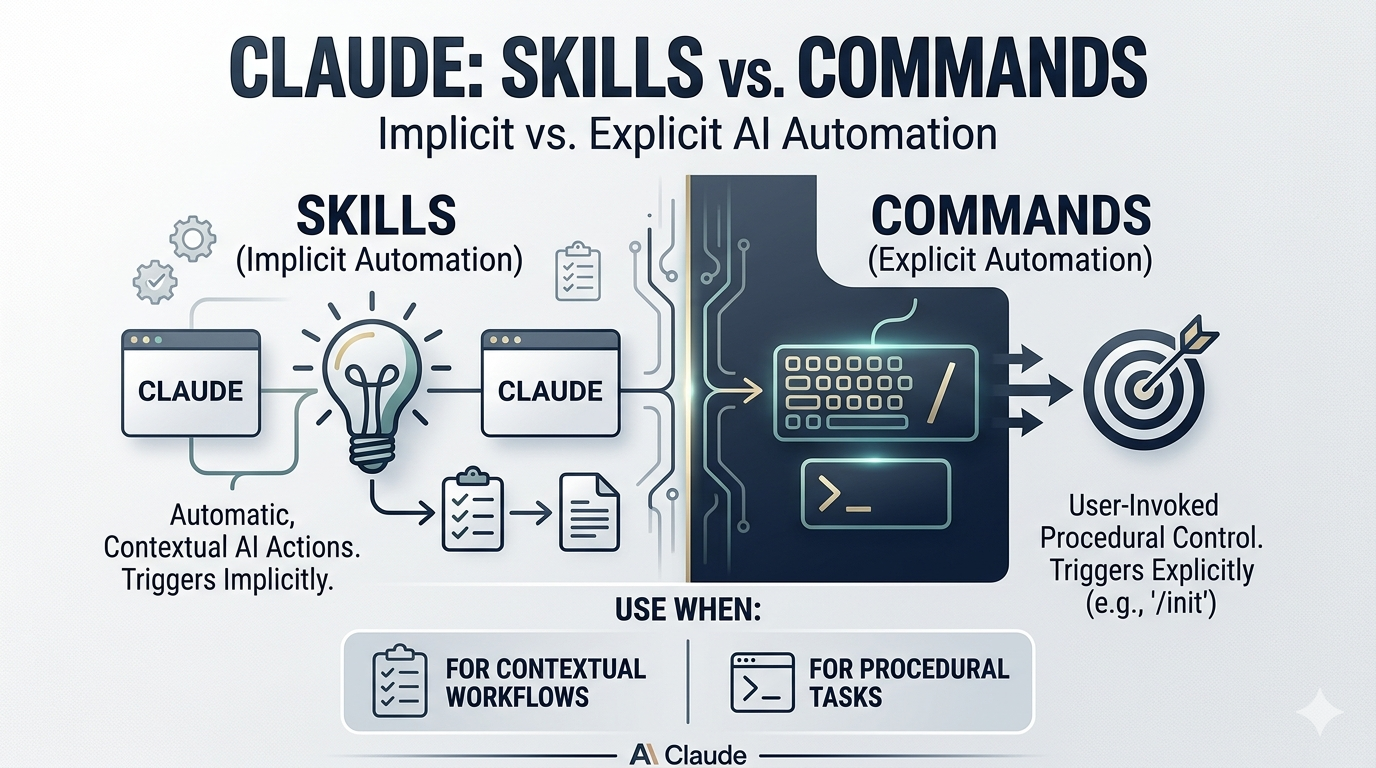
This blog provides a concise overview and a practical comparison.
Skills.md
Skills are reusable instruction sets that Claude can apply implicitly. They are typically defined as .md files containing structured instructions for specific tasks.
Skills characteristics:
-
Implicitly available: Claude loads and considers skills without explicit invocation
-
Context-driven execution: Triggered based on natural language prompts
-
Reusable patterns: Ideal for consistent workflows (e.g., accessibility reviews, code audits)
eg: If you define an accessibility skill, a prompt like: “Review this for accessibility” . will automatically trigger the skill without needing any special syntax.
Accessibility skill — https://github.com/Neha/check-fix-accessibility/blob/main/review-fix-a11y/SKILL.md
Skills are effectively preloaded context. They reduce the need for repeated prompt engineering. They can be scoped to avoid always being active (depending on configuration)
Starter template:
https://github.com/Neha/skill-starter-template
Commands
Commands are explicitly invoked automation scripts. They are also defined as .md files, but unlike skills, they are only executed when explicitly called. In Claude, there are inbuilt commands eg: /init, /compact, /clearetc. One can build own custom commands too.
Commands Characteristics
-
Explicit invocation: Triggered using /
-
Deterministic execution: Runs only when called
-
Scoped usage: Can be local, global, or system-level
Skills vs Commands
Now the question is which to use when? Both are MD files then what’s the difference between the both? The core distinction lies in how they are invoked and discovered by Claude.
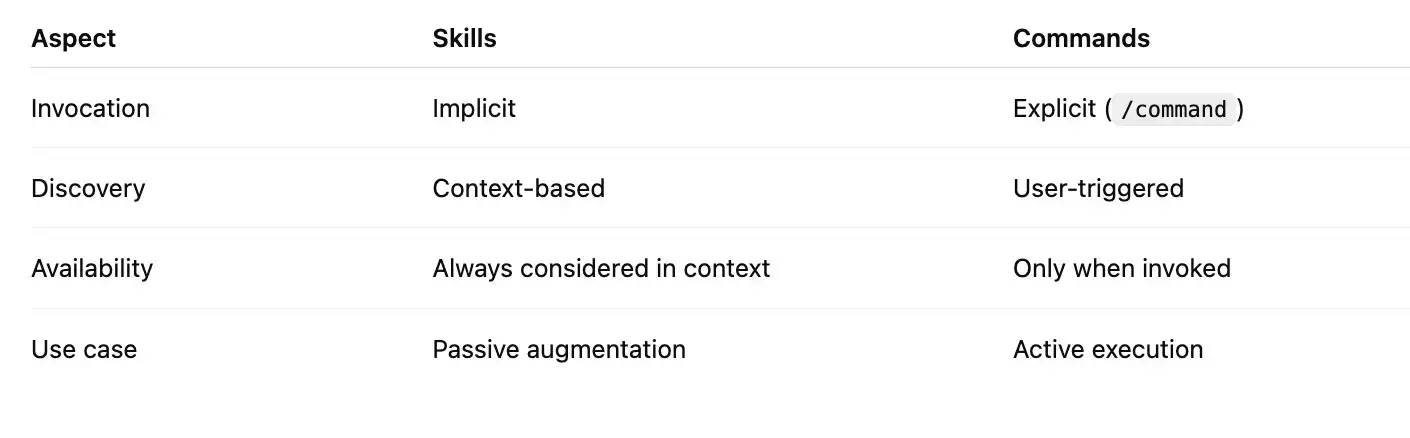
When to Use What?
Use Skills when:
You want automatic behavior
-
The task should be context-aware
-
You want to reduce prompt verbosity
-
eg: code review standards, accessibility checks
Use Commands when: You need explicit control
-
The task is procedural or multi-step
-
You don’t want it triggered unintentionally
-
eg: generating reports, running transformations
Happy learning!!
You can connect me with at Linkedln, Twitter, Medium, my website
Comments
More Blog
View allgemmaFive Gemma-4 models, one accelerator: what porting E2B 31B to AWS Inferentia2 taught me
I ported the whole Gemma-4 family — E2B, E4B, 12B, 31B, and the 26B-A4B MoE — to run on...
X
xbillcommunityHey DEV, I'm Tobore. Let's actually connect.
Hey DEV, I'm Tobore. Let's actually connect. I've been on here for a while now, mostly writing and...
L
Laurina AyarahaiI burned through thousands of AI tokens. Then a friend did it for free
(yep, kinda clickbait, just for the funsies 😊) At the beginning of the year, I relaunched my...
P
Paulo HenriqueaiClaude might be saturating your machine
My laptop was sitting idle with the fan at full tilt. Nothing was running that I knew of. The culprit...
S
Sidhant PandagithubactionsAutomated GitHub Code Reviews Using Google Gemini
I Built a Thing! TL;DR — Google Gemini-based Pull Request reviews and Issue Triaging for...
D
Darren "Dazbo" LesteraiWhat is an "agentic harness," actually?
I've been hearing the word "harness" thrown around a lot lately. I assumed it just meant "the IDE" or...
T
Tilde A. ThuriumReady-made automations for this
Workflows from the Neura Market marketplace related to this Midjourney resource
- Full Blog Content Automation with GPT-4, Claude & Ghost CMS Publishern8n · $24.99 · Related topic
- Create Animated Stories Using GP-4.0-mini, Midjourney, Kling, and Creatomate APIn8n · $24.99 · Related topic
- Display ServiceNow Incident Details in Slack Using Slash Commandsn8n · $9.99 · Related topic
- AI Blog Post Journalist: Perplexity for Research, Anthropic Claude for Blogn8n · $9.99 · Related topic