
Back to Blog rust
rust
 gemma
gemma community
 ai
ai ai
ai githubactions
 ai
ai
Deploying a Rust A2A Agent to Azure Container Apps (ACA)
xbill May 23, 2026
0 views
This article covers building Agent applications with the Agent to Agent (A2A) protocol using the Rust...
title: Deploying a Rust A2A Agent to Azure Container Apps (ACA) published: true series: Azure-Rust date: 2026-05-22 15:46:31 UTC tags: rust,aca,a2aprotocol,aiagent canonical_url: https://xbill999.medium.com/deploying-a-rust-a2a-agent-to-azure-container-apps-aca-5938e2c8f5de
This article covers building Agent applications with the Agent to Agent (A2A) protocol using the Rust programming language. A minimally viable A2A Rust Agent application was debugged and validated locally. Then- the entire solution is deployed to Azure Container Apps (ACA).
Rust A2A? Isn’t that a Python Thing?
The bulk of A2A Agents are in Python. The A2A protocol is language independent.
Python has traditionally been the main coding language for ML and AI tools. The goal of this article is to provide a test bed for building, debugging, and deploying cross language applications.
So where is the Beef?
So what is different about this lab compared to all the others out there?
This is one of the first deep dives into a Rust A2A agent leveraging the standard Rust crates.
What is Rust?
Rust is a high performance, memory safe, compiled language:
Rust provides memory safe operations beyond C/C++ and also can provide exceptional performance gains as it is compiled directly to native binaries.
Rust Setup
Instructions to install Rust are available here:
For a Linux like environment the command looks like this:
curl — proto ‘=https’ — tlsv1.2 -sSf https://sh.rustup.rs | sh
Rust also depends on a working C compiler and OpenSSL setup. For a Debian 12/13 system — install the basic tools for development:
sudo apt install build-essential
sudo apt install libssl-dev
sudo apt install pkg-config
sudo apt-get install libudev-dev
sudo apt install make
sudo apt install git
Antigravity CLI
Antigravity CLI is the follow-on successor to Gemini CLI- the terminal driven, agent assisted coding tool.
Full details on installing Antigravity CLI are here:
Getting Started with Antigravity CLI
Testing the Antigravity CLI Environment
Once you have all the tools in place- you can test the startup of Antigravity CLI.
You will need to authenticate with a Google Cloud Project or your Google Account:
agy
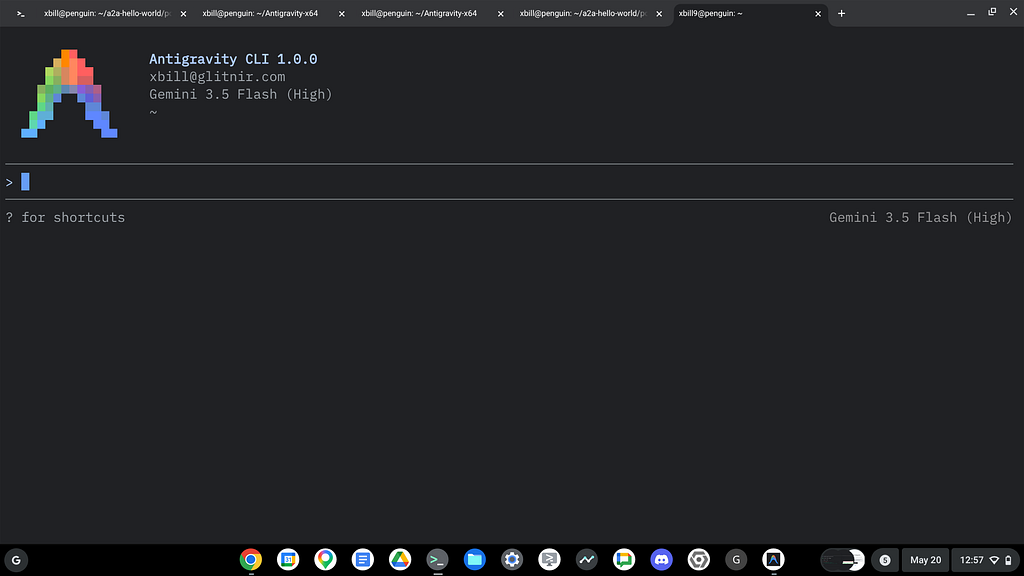
This will start the interface:
Azure Container Apps
Azure Container Apps is a fully managed, serverless Kubernetes-based application platform designed for building and deploying modern, containerized apps without managing complex infrastructure. It enables scaling from zero to high demand, supports microservices, and handles event-driven processing with built-in HTTPS and observability.
Full details are available here:
https://azure.microsoft.com/en-us/products/container-apps
Why would I want A2A with Azure? Isn’t that a Google Thing?
A2A is open source and platform agnostic. Many applications are already cross-cloud so this enables familiar tools to be run natively on Microsoft Azure.
Where do I start?
The strategy for starting Rust A2A development is a incremental step by step approach.
First, the basic development environment is setup with the required system variables, and a working Antigravity CLI configuration.
Then, a Rust A2A agent is built, debugged, and tested locally.
Setup the Basic Environment
At this point you should have a working Python environment and a working Antigravity CLI installation. All of the relevant code examples and documentation is available in GitHub.
The next step is to clone the GitHub repository to your local environment:
cd ~
git clone https://github.com/xbill9/a2a-hello-world
cd poly-aca-rust-azure
Then run init.sh from the cloned directory.
The script will attempt to determine your shell environment and set the correct variables:
source init.sh
If your session times out or you need to re-authenticate- you can run the set_env.sh script to reset your environment variables:
source set_env.sh
Variables like PROJECT_ID need to be setup for use in the various build scripts- so the set_env script can be used to reset the environment if you time-out.
Rust A2A Libraries
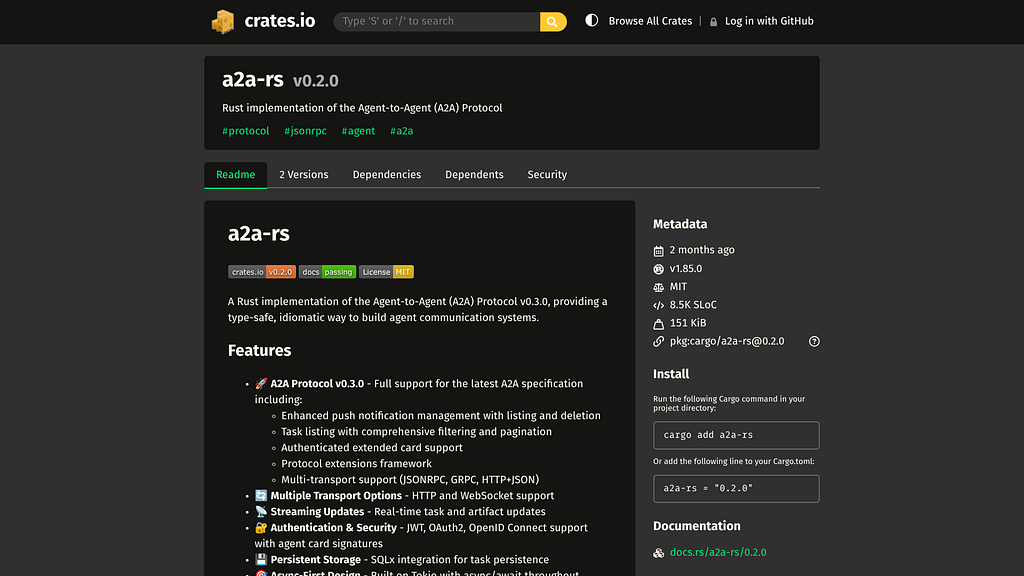
There are several crates that provide A2A support. This project uses the a2a-rs crate:
crates.io: Rust Package Registry
Here is a sample Cargo.TOML:
[dependencies]
tokio = { version = "^1.37.0", features = ["full"] }
anyhow = "1.0.86"
a2a-rs = { version = "0.2.0", features = ["full"] }
futures = "0.3"
async-trait = "0.1.80"
Minimal System Information Tool Build
The first step is to build the basic tool directly with Rust. This allows the tool to be debugged and tested locally before adding the MCP layer.
First build the tool locally:
xbill@penguin:~/a2a-hello-world/poly-aca-rust-azure$ make build
Building the Rust project...
    Finished `dev` profile [unoptimized + debuginfo] target(s) in 0.32s
xbill@penguin:~/a2a-hello-world/poly-aca-rust-azure$
then lint check the code:
xbill@penguin:~/a2a-hello-world/poly-aca-rust-azure$ make lint
Linting code...
    Finished `dev` profile [unoptimized + debuginfo] target(s) in 0.27s
Checking formatting...
and run local tests:
xbill@penguin:~/a2a-hello-world/poly-aca-rust-azure$ make test
Running tests...
   Compiling a2a-server-rust v0.2.0 (/home/xbill/a2a-hello-world/poly-aca-rust-azure)
    Finished `test` profile [unoptimized + debuginfo] target(s) in 1.39s
     Running unittests src/main.rs (target/debug/deps/a2a_server_rust-5d07a7739a477350)

running 2 tests
test tests::test_simple_agent_handler_creation ... ok
test tests::test_task_creation ... ok

test result: ok. 2 passed; 0 failed; 0 ignored; 0 measured; 0 filtered out; finished in 0.00s
The last step is to build the production version:
xbill@penguin:~/a2a-hello-world/poly-aca-rust-azure$ make release
Building Release...
    Finished `release` profile [optimized] target(s) in 0.26s
xbill@penguin:~/a2a-hello-world/poly-aca-rust-azure$
The A2A server can be started locally:
xbill@penguin:~/a2a-hello-world/poly-aca-rust-azure$ make start
Starting the A2A Rust server on port 8080...
    Finished `dev` profile [unoptimized + debuginfo] target(s) in 0.17s
     Running `target/debug/a2a-server-rust`
🚀 Starting A2A Rust Server
==============================
🌐 Starting HTTP server on 0.0.0.0:8080...
🔗 HTTP server listening on http://0.0.0.0:8080
2026-05-21T20:01:10.860135Z INFO main ThreadId(01) start{server.address=0.0.0.0:8080 server.has_auth=false}: a2a_rs::adapter::transport::http::server: Starting HTTP server
2026-05-21T20:01:10.860358Z INFO main ThreadId(01) start{server.address=0.0.0.0:8080 server.has_auth=false}: a2a_rs::adapter::transport::http::server: HTTP server listening on 0.0.0.0:8080
Check The Local Agent Status
The project has a target to verify that the A2A server started:
xbill@penguin:~/a2a-hello-world/poly-aca-rust-azure$ make status
Checking Azure Container App status for a2a-app-penguin...
Name ProvisioningState FQDN
--------------- ------------------- ---------------------------------------------------------------
a2a-app-penguin Succeeded a2a-app-penguin.icyplant-a768d75c.westus2.azurecontainerapps.io
--- Service Status ---
Local (8080): ONLINE (A2A Rust Agent)
A2A Inspector
The A2A Inspector provides a tool to verify A2A operations.
Background information is here:
Announcing the A2A Inspector: A UI tool for A2A protocol development
GitHub Repo is here:
GitHub - a2aproject/a2a-inspector: Validation Tools for A2A Agents
Verify The Local A2A Installation
Start the A2A Inspector and use localhost:8080:
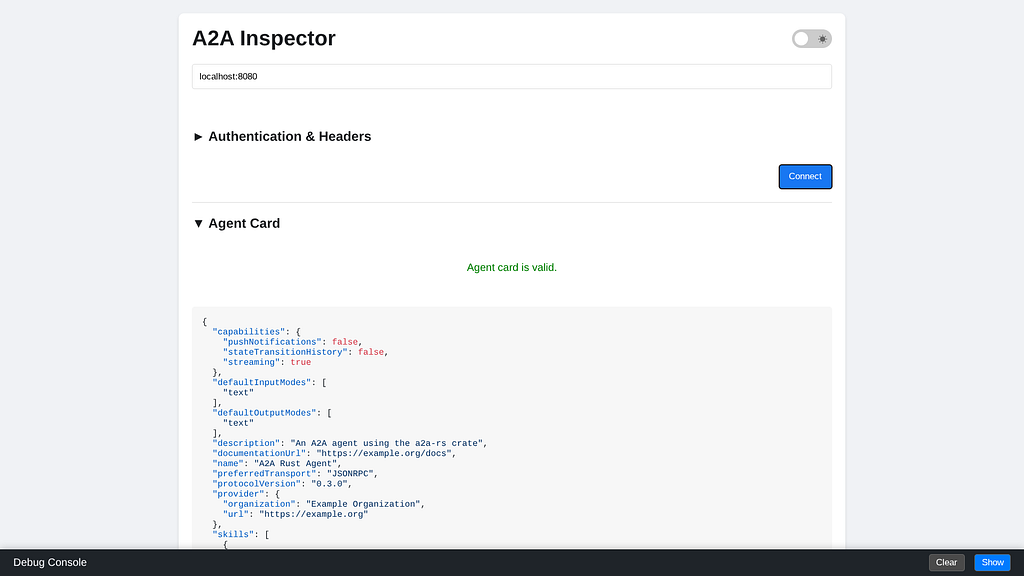
You should see the details of the Agent Card:
{
  "capabilities": {
    "pushNotifications": false,
    "stateTransitionHistory": false,
    "streaming": true
  },
  "defaultInputModes": [
    "text"
  ],
  "defaultOutputModes": [
    "text"
  ],
  "description": "An A2A agent using the a2a-rs crate",
  "documentationUrl": "https://example.org/docs",
  "name": "A2A Rust Agent",
  "preferredTransport": "JSONRPC",
  "protocolVersion": "0.3.0",
  "provider": {
    "organization": "Example Organization",
    "url": "https://example.org"
  },
  "skills": [
    {
      "description": "Echoes back the user's message",
      "examples": [
        "Echo: Hello World"
      ],
      "id": "echo",
      "inputModes": [
        "text"
      ],
      "name": "Echo Skill",
      "outputModes": [
        "text"
      ],
      "tags": [
        "echo",
        "respond"
      ]
    }
  ],
  "url": "http://0.0.0.0:8080",
  "version": "1.0.0"
}
Test the Local A2A Connection Locally
This step tests the A2A agent interactions with a test script:
xbill@penguin:~/a2a-hello-world/poly-aca-rust-azure$ make card
Fetching local agent card...
{
    "name": "A2A Rust Agent",
    "description": "An A2A agent using the a2a-rs crate",
    "url": "http://0.0.0.0:8080",
    "provider": {
        "organization": "Example Organization",
        "url": "https://example.org"
    },
    "version": "1.0.0",
    "protocolVersion": "0.3.0",
    "preferredTransport": "JSONRPC",
    "documentationUrl": "https://example.org/docs",
    "capabilities": {
        "streaming": false,
        "pushNotifications": false,
        "stateTransitionHistory": false
    },
    "defaultInputModes": [
        "text"
    ],
    "defaultOutputModes": [
        "text"
    ],
    "skills": [
        {
            "id": "echo",
            "name": "Echo Skill",
            "description": "Echoes back the user's message",
            "tags": [
                "echo",
                "respond"
            ],
            "examples": [
                "Echo: Hello World"
            ],
            "inputModes": [
                "text"
            ],
            "outputModes": [
                "text"
            ]
        }
    ]
}
and the A2A can be tested:
xbill@penguin:~/a2a-hello-world/poly-aca-rust-azure$ make a2a-local
Running local A2A echo test...
🚀 Testing A2A Echo Skill at http://localhost:8080
💬 Sending message: 'Hello from the test program!'
✅ Received echo: 'Echo: Hello from the test program!'
🌟 Success! The echo skill is working correctly.
xbill@penguin:~/a2a-hello-world/poly-aca-rust-azure$
So What Just Happened?
The Rust A2A agent was started locally. This agent provided a standard A2A agent card. Then, test scripts performed a A2A skills call against the locally running Rust A2A server. Because the A2A server in Rust provides standard tools- the A2A inspector could connect. The actual implementation language of the A2A code does not matter — as long as standard services are exposed.
Deploy to ACA Azure
Once the Agent has been validated and tested locally- the solution can be deployed to Azure ACA. Run the deploy target in the Makefile:
xbill@penguin:~/a2a-hello-world/poly-aca-rust-azure$ make deploy
Once the build is done — you can check the status:
xbill@penguin:~/a2a-hello-world/poly-aca-rust-azure$ make status
Checking Azure Container App status for a2a-app-penguin...
Name ProvisioningState FQDN
--------------- ------------------- ---------------------------------------------------------------
a2a-app-penguin Succeeded a2a-app-penguin.icyplant-a768d75c.westus2.azurecontainerapps.io
--- Service Status ---
Local (8080): ONLINE (A2A Rust Agent)
Remote (Cloud): ONLINE (A2A Rust Agent) - https://a2a-app-penguin.icyplant-a768d75c.westus2.azurecontainerapps.io
xbill@penguin:~/a2a-hello-world/poly-aca-rust-azure$
and get the endpoint:
xbill@penguin:~/a2a-hello-world/poly-aca-rust-azure$ make endpoint
a2a-app-penguin.icyplant-a768d75c.westus2.azurecontainerapps.io
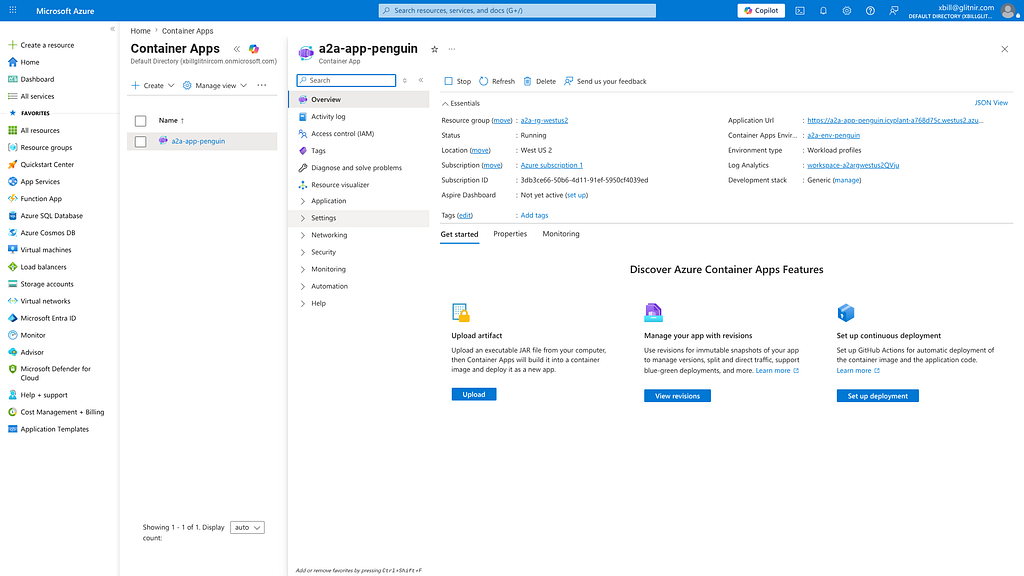
Verify the Cloud Run Service
The Rust A2A service will be visible from the Azure console:
Testing Azure Deployment
The Makefile has several tools for validating the remote A2A server.
First — you can get the remote Agent card:
xbill@penguin:~/a2a-hello-world/poly-aca-rust-azure$ make card-remote
Fetching remote agent card...
{
    "name": "A2A Rust Agent",
    "description": "An A2A agent using the a2a-rs crate",
    "url": "http://0.0.0.0:8080",
    "provider": {
        "organization": "Example Organization",
        "url": "https://example.org"
    },
    "version": "1.0.0",
    "protocolVersion": "0.3.0",
    "preferredTransport": "JSONRPC",
    "documentationUrl": "https://example.org/docs",
    "capabilities": {
        "streaming": false,
        "pushNotifications": false,
        "stateTransitionHistory": false
    },
    "defaultInputModes": [
        "text"
    ],
    "defaultOutputModes": [
        "text"
    ],
    "skills": [
        {
            "id": "echo",
            "name": "Echo Skill",
            "description": "Echoes back the user's message",
            "tags": [
                "echo",
                "respond"
            ],
            "examples": [
                "Echo: Hello World"
            ],
            "inputModes": [
                "text"
            ],
            "outputModes": [
                "text"
            ]
        }
    ]
}
and run a basic test:
xbill@penguin:~/a2a-hello-world/poly-aca-rust-azure$ make a2a-remote
Running remote A2A echo test...
🚀 Testing A2A Echo Skill at https://a2a-app-penguin.icyplant-a768d75c.westus2.azurecontainerapps.io
💬 Sending message: 'Hello from the test program!'
✅ Received echo: 'Echo: Hello from the test program!'
🌟 Success! The echo skill is working correctly.
xbill@penguin:~/a2a-hello-world/poly-aca-rust-azure$
Crates.io
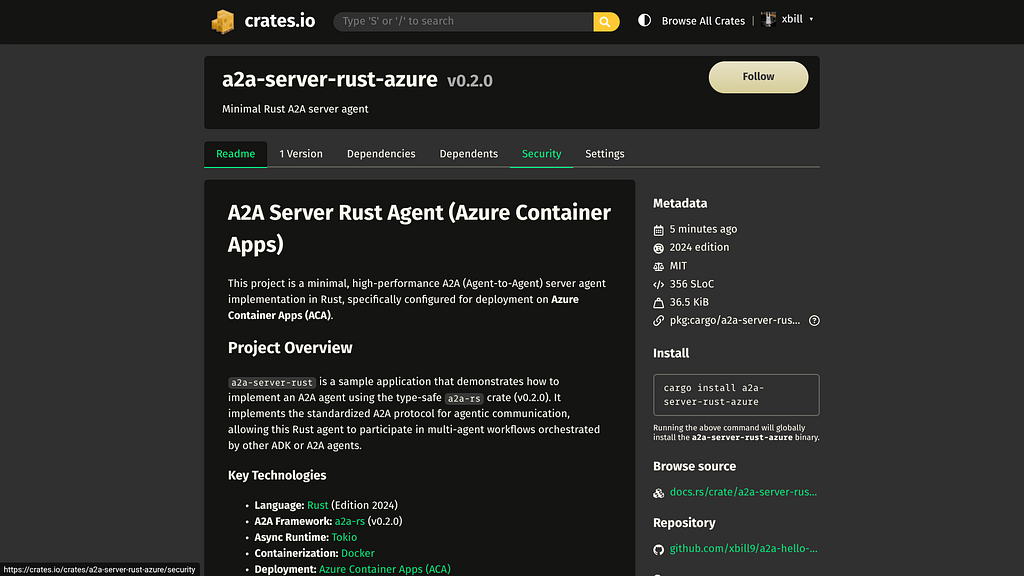
The full package is available on GitHub and crates.io:
https://crates.io/crates/a2a-server-rust-azure
The package details are here:
Summary
A complete A2A server was built using Rust. Basic validation was done with the A2A inspector. Next, test scripts were built that directly called the Rust A2A server. Finally, the complete solution was deployed to Azure ACA.
Comments
More Blog
View allgemmaFive Gemma-4 models, one accelerator: what porting E2B 31B to AWS Inferentia2 taught me
I ported the whole Gemma-4 family — E2B, E4B, 12B, 31B, and the 26B-A4B MoE — to run on...
X
xbillcommunityHey DEV, I'm Tobore. Let's actually connect.
Hey DEV, I'm Tobore. Let's actually connect. I've been on here for a while now, mostly writing and...
L
Laurina AyarahaiI burned through thousands of AI tokens. Then a friend did it for free
(yep, kinda clickbait, just for the funsies 😊) At the beginning of the year, I relaunched my...
P
Paulo HenriqueaiClaude might be saturating your machine
My laptop was sitting idle with the fan at full tilt. Nothing was running that I knew of. The culprit...
S
Sidhant PandagithubactionsAutomated GitHub Code Reviews Using Google Gemini
I Built a Thing! TL;DR — Google Gemini-based Pull Request reviews and Issue Triaging for...
D
Darren "Dazbo" LesteraiWhat is an "agentic harness," actually?
I've been hearing the word "harness" thrown around a lot lately. I assumed it just meant "the IDE" or...
T
Tilde A. ThuriumReady-made automations for this
Workflows from the Neura Market marketplace related to this CoPilot resource
- Building a RAG Chatbot for Movie Recommendations with Qdrant and OpenAIn8n · $14.99 · Related topic
- Create Secure Interactive Applications with WhatsApp Flows and End-to-End Encryptionn8n · $9.99 · Related topic
- Automate Job Applications with Multi-Board Search and AI Resume Craftingn8n · $19.99 · Related topic
- Automate Job Applications and Track Status with LinkedIn, Indeed, and Google Sheetsn8n · $14.99 · Related topic