
Back to Blog security
The scary one:
 gemma
gemma community
 ai
ai ai
ai githubactions
 ai
ai
Your dependencies are 48% unmaintained — and SCA tools can't see it
kotakanbe April 16, 2026
0 views
I analyzed 16,000 production packages. Half have lifecycle risk your scanner can't see. Here's uzomuzo — the open-source tool I built to find and fix it.
title: "Your dependencies are 48% unmaintained — and SCA tools can't see it" published: true description: "I analyzed 16,000 production packages. Half have lifecycle risk your scanner can't see. Here's uzomuzo — the open-source tool I built to find and fix it." cover_image: "https://dev-to-uploads.s3.amazonaws.com/uploads/articles/30j6dljugztycg0zn8ih.png" tags: security, opensource, supplychain, devops
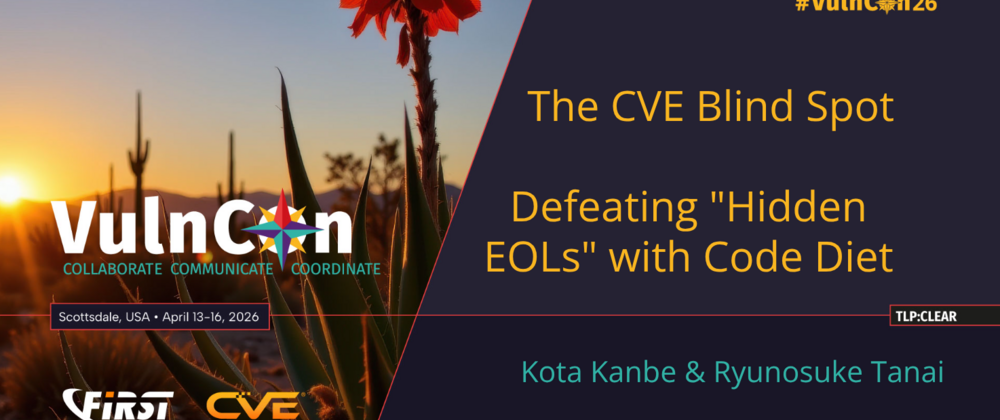
I just presented this at VulnCon 2026 (slides). Here's the tool and the data.
The blind spot
Your vulnerability scanner is excellent at finding CVEs. Trivy, Snyk, Grype — they do their job well.
But there's a category of risk they cannot see: packages that are no longer maintained.
No maintainer means no security patches. No bug fixes. No one watching. And because no one is looking — no CVEs get filed. Your scanner reports zero vulnerabilities, and you assume it's safe.
It's not safe. It's invisible.
I analyzed 16,000 packages across ~100 organizations running in production (published in Nikkei — Japan's largest business newspaper — March 2026):
| Status | % | Meaning |
|---|---|---|
| 🟢 Active | 40.6% | Someone is working on it |
| 🔵 Legacy-Safe | 10.9% | Dormant but stable |
| 🟡 Stalled | 34.6% | Activity declining |
| 🔴 EOL | 13.9% | End of life |
48.5% of production dependencies have lifecycle risk. Most of it is invisible.
What does this look like in practice?
I scanned HashiCorp Vault — the tool you trust with your secrets. 209 dependencies.
$ uzomuzo scan --file vault-go.mod

STATUS      PURL                                    LIFECYCLE
✅ ok        cloud.google.com/go/storage@v1.56.1     Active
✅ ok        Azure/azure-sdk-for-go/sdk/azcore       Active
🔴 replace   aws/aws-sdk-go@v1.55.8                  EOL-Confirmed
🔴 replace   mitchellh/copystructure@v1.2.0          EOL-Confirmed
     ... (209 deps total)
── Summary ──────────────────────────────────
│ 209 deps | ✅ 186 ok | ⚠️ 11 caution | 🔴 11 replace
11 packages are EOL. In a secrets management tool. Most have zero CVEs.
The scary one: copystructure
Mitchell Hashimoto — Vault's creator — left HashiCorp in 2023. He publicly announced: "I very rarely write Go anymore." He archived 15 libraries at once, including copystructure.
Unlike mapstructure (which has a community fork), copystructure has no successor. Nobody picked it up.
Where is it used? vault/acl.go — the access control layer. It deep-copies the deny rules for each security check.
If this package were compromised — deny rules silently disappear. No error. No log. No crash. Your scanner will never find this because there is no CVE to find.
The risk is not a bug. It's being abandoned.
From detection to analysis — with an LLM
Finding the EOL package is step one. But what exactly happens if it's compromised? I used an LLM to trace the data flow and build the attack scenario:
mitchellh/copystructure — Risk: CRITICAL
Lifecycle: Archived. Maintainer left HashiCorp in 2023. CVEs: 0

Data flow:
  IN:  ACL DeniedParameters, MFA methods, ClientToken
  OUT: Deep-copied structs for per-request isolation

Attack scenario:
  1. acl.go: deny rules silently disappear
  2. request.go: ClientToken shared across requests
  3. policy.go: MFA bypass via shared ControlGroup
  → NO errors. NO logs. NO crashes.
Verdict: CRITICAL. Action: self-implement with ~100 lines of reflect-based code, replacing the ~500-line archived dependency.
This analysis — tracing what data flows through a package, constructing attack scenarios, assessing severity — takes weeks to do manually across 209 dependencies. With uzomuzo + LLM, it takes minutes. I automated this as the /diet-assess-risk skill.
How I built a tool to find this
I built uzomuzo — an open-source tool that detects unmaintained packages that SCA tools miss. The name comes from a Buddhist concept: uzōmuzō (有象無象) — "the visible and the invisible." That's exactly what your dependency tree is.
What makes it different
1. Seven lifecycle stages, not binary.
Other tools give you "maintained or not." uzomuzo gives you a spectrum:
| # | Signal | Result |
|---|---|---|
| 1 | Archived / Disabled? | Yes → 🔴 EOL-Confirmed |
| 2 | Registry EOL? (npm deprecated, PyPI inactive) | Yes → 🔴 EOL-Confirmed |
| 3 | EOL announced? | Yes → 🟠 EOL-Scheduled |
| 4 | No recent human commits + HIGH/CRITICAL advisory? | ⚫ EOL-Effective |
| No recent human commits + LOW/MEDIUM advisory? | 🟡 Stalled | |
| No recent human commits + no advisory? | 🔵 Legacy-Safe | |
| 5 | Recent human commits + recent publish or VCS-direct? | 🟢 Active |
| Recent human commits + no publish + low Scorecard? | 🟡 Stalled |
Each check is evaluated top to bottom — first match wins. "Stalled" and "dead" require different responses. Stalled — you watch. EOL — you replace.
2. Multiple signal sources.
It combines data from deps.dev (Scorecard, releases, advisories), GitHub API (archive status, commit history), and registry heuristics (PyPI classifiers, npm deprecated flag, Packagist abandoned).
The judgment is ecosystem-aware. Go delivers via git — commits are releases. npm requires a registry publish. Same commits, different verdict.
3. Two-axis evaluation: lifecycle × build integrity.
Lifecycle alone isn't enough. A package can be actively maintained but have no signed releases, no reproducible builds, no provenance. uzomuzo evaluates both axes — so you can distinguish "healthy and well-built" from "active but risky."
4. Not just detection — all the way to removal.
This is the big one. Every other tool stops at detection. Scorecard gives you a score. Trivy gives you a CVE. Then you're on your own.
uzomuzo goes from detect → prioritize → remove:
uzomuzo scan— find EOL packages (every CI build)uzomuzo diet— rank by removal priority: graph impact × health risk × coupling effort/diet-*Claude Code skills — assess risk, evaluate removal, execute safely
Try it now (30 seconds)
Install
go install github.com/future-architect/uzomuzo-oss/cmd/uzomuzo@latest
Or download a binary from GitHub Releases.
Scan your project
# Go project
uzomuzo scan --file go.mod

# Any language (via SBOM)
trivy fs . --format cyclonedx | uzomuzo scan --sbom -

# GitHub Actions
uzomuzo scan --file .github/workflows/ci.yml

# Single package
uzomuzo scan pkg:npm/express@4.18.2
CI gate
# Fail the build if any EOL dependency is found
trivy fs . --format cyclonedx \
  | uzomuzo scan --sbom - --fail-on eol-confirmed
That's it. One pipeline command.
I used it on my own project
I ran uzomuzo on my own project — vuls, an open-source vulnerability scanner with 391 dependencies. Then I removed what I found.
Binary size: 106.6 MB → 34.1 MB (-68%). Dependencies: 352 → 144 (-59%). I reported my findings upstream — Grafana's maintainer closed the community PR and committed to replacing the archived Action internally using their own shared-workflows.
The full story of how I did it — in a follow-up post.
The blind spot is bigger than you think
I cross-checked SCA results against lifecycle status on real-world projects. The overlap was almost zero — most EOL packages had no CVEs at all. They are completely invisible to SCA tools.
"No CVE" doesn't mean "no vulnerability." It often means "no one is looking."
Full methodology and data — in a follow-up post.
Start today
- 30 seconds:
uzomuzo scan --file go.modoruzomuzo scan https://github.com/your/repo - 5 minutes: Add
--fail-on eol-confirmedto your CI pipeline - Quarterly: Run
uzomuzo dietfor a prioritized removal plan
You will be surprised what you find.
⭐ github.com/future-architect/uzomuzo-oss — Apache 2.0
Kota Kanbe — Creator of vuls (12K+ ⭐), presented at VulnCon 2026
Comments
More Blog
View allgemmaFive Gemma-4 models, one accelerator: what porting E2B 31B to AWS Inferentia2 taught me
I ported the whole Gemma-4 family — E2B, E4B, 12B, 31B, and the 26B-A4B MoE — to run on...
X
xbillcommunityHey DEV, I'm Tobore. Let's actually connect.
Hey DEV, I'm Tobore. Let's actually connect. I've been on here for a while now, mostly writing and...
L
Laurina AyarahaiI burned through thousands of AI tokens. Then a friend did it for free
(yep, kinda clickbait, just for the funsies 😊) At the beginning of the year, I relaunched my...
P
Paulo HenriqueaiClaude might be saturating your machine
My laptop was sitting idle with the fan at full tilt. Nothing was running that I knew of. The culprit...
S
Sidhant PandagithubactionsAutomated GitHub Code Reviews Using Google Gemini
I Built a Thing! TL;DR — Google Gemini-based Pull Request reviews and Issue Triaging for...
D
Darren "Dazbo" LesteraiWhat is an "agentic harness," actually?
I've been hearing the word "harness" thrown around a lot lately. I assumed it just meant "the IDE" or...
T
Tilde A. ThuriumReady-made automations for this
Workflows from the Neura Market marketplace related to this CoPilot resource
- AI Chatbot Call Center: Taxi Booking Worker (Production-Ready, Part 5)n8n · $24.99 · Related topic
- Build Production-Ready User Authentication with Airtable and JWTn8n · $14.99 · Related topic
- Generate Random Mock Data with No Code and Zero Dependenciesn8n · $9.99 · Related topic
- Automate Faceless Video Production with AI for YouTuben8n · $19.99 · Related topic