
Back to Blog antigravity
 gemma
gemma community
 ai
ai ai
ai githubactions
 ai
ai
Antigravity: My Approach to Deliver the Most Assured Value for the Least Money
Alexander Tyutin April 1, 2026
0 views
As I'm not a professional developer but a guy who needs to use automation to get things done, I...
As I'm not a professional developer but a guy who needs to use automation to get things done, I follow one main rule: keep it simple. Overengineering hurts. I use the Pareto rule—spend 20% of the effort to get 80% of the result.
When I use AI agents like Antigravity, my goal is not to let the AI write complex code that no one can read. My goal is to build simple, secure features fast. At the same time, I control costs by saving tokens. Here is the exact workflow I use.
You can listen a podcast generated based on this publication (thanks NotebookLM):
{% youtube DkDfPMzXDXk %}
The Token Economy Strategy
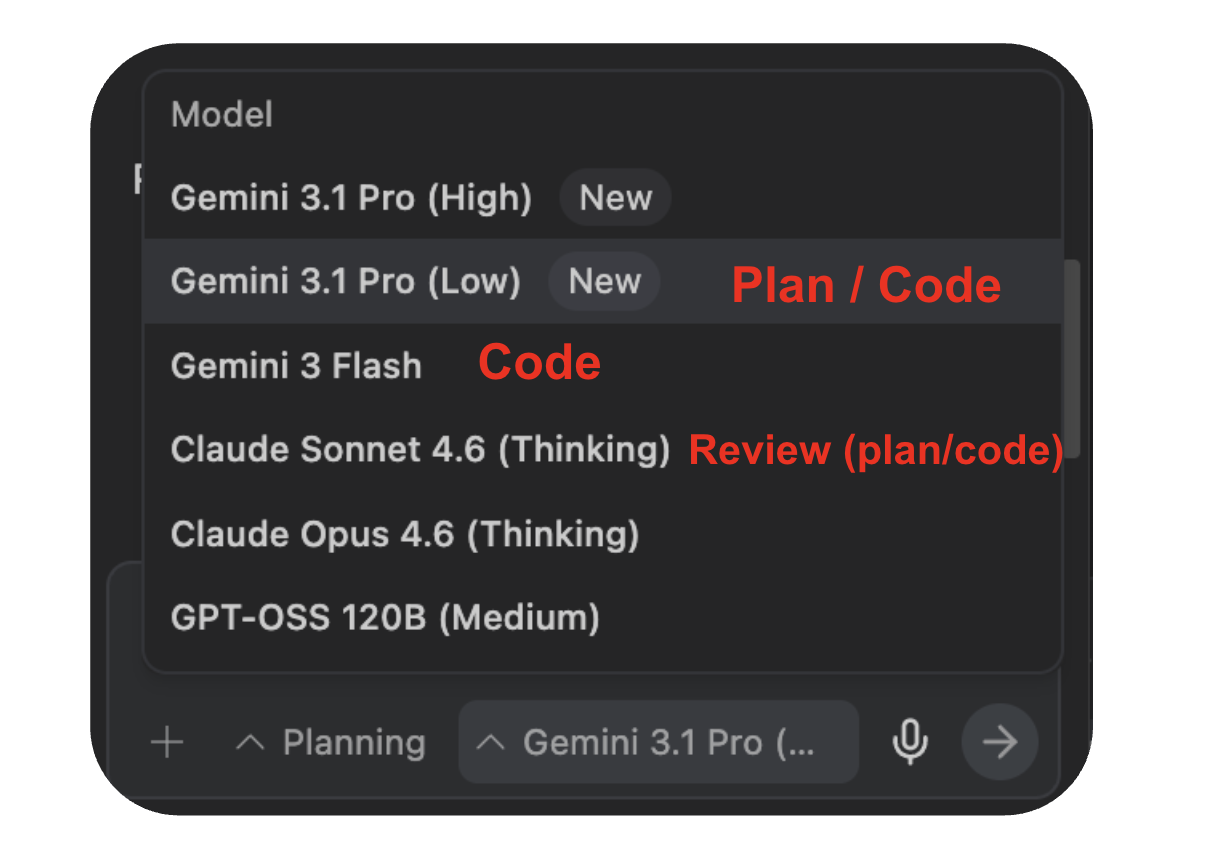
LLM tokens cost money. Using a smart, expensive model just to fix code spaces is not worth the cost. I change models based on how hard the task is.
- High-Tier Models: They are for the big tasks: planning architecture, writing complex business logic, checking security, and counting cloud costs.
- Low-Tier Models: These folks are for simple tasks: fixing syntax errors, aligning code to Pylint, and writing standard code pieces.
Task Decomposition & In-Repo Architecture
Large prompts can break LLMs. If a prompt has too much text, the AI gets confused and wastes tokens. To stop this, I break every task into small, separate pieces so the AI only sees what it needs.
I store all architecture plans and tasks inside the code repository (for example, ./docs). This keeps the instructions very close to the code for the AI.
Every task I write uses this strict four-part structure:
- Idea: The main business or tech goal. Why it matters: It proves the task is useful before I spend tokens for delivering a code to review.
- Plan: The technical blueprint. Why it matters: It locks down the plan, keeps security high, and stops the AI from inventing bad solutions.
- What Was Done: A short log of the work. Why it matters: It gives future AI tasks a quick summary, so the AI does not have to read every code file again.
- Debt: A list of any technical shortcuts or "crutches" used to save time. Why it matters: Hidden debt ruins the project. Important: My custom Quality Gate checks this section. If it finds unapproved shortcuts in the code, it blocks the release completely.
System Instructions for the AI
To keep the AI agent aligned with the goals, I pass strict system instructions on every run. It never lets the model guess my coding standards. Here are the core rules enforced:
- No Crutches: Any "crutch" or technical shortcut must be approved by me. Then, the AI must document it as technical debt in the project files.
- No Inventing Wheels: I try hard to avoid this. If a working approach already exists in another project, the AI reuses it.
- Learn from the Past: When building a new service, the AI must check the old tech debt to avoid repeating past mistakes.
- Simple Code Only: The code structure should just use standard classes. I avoid "genius-level" extreme one-line code tricks or overwhelming structures.
- Maintainability First: A middle-level, part-time developer must be able to read and maintain the code.
The Core Workflow
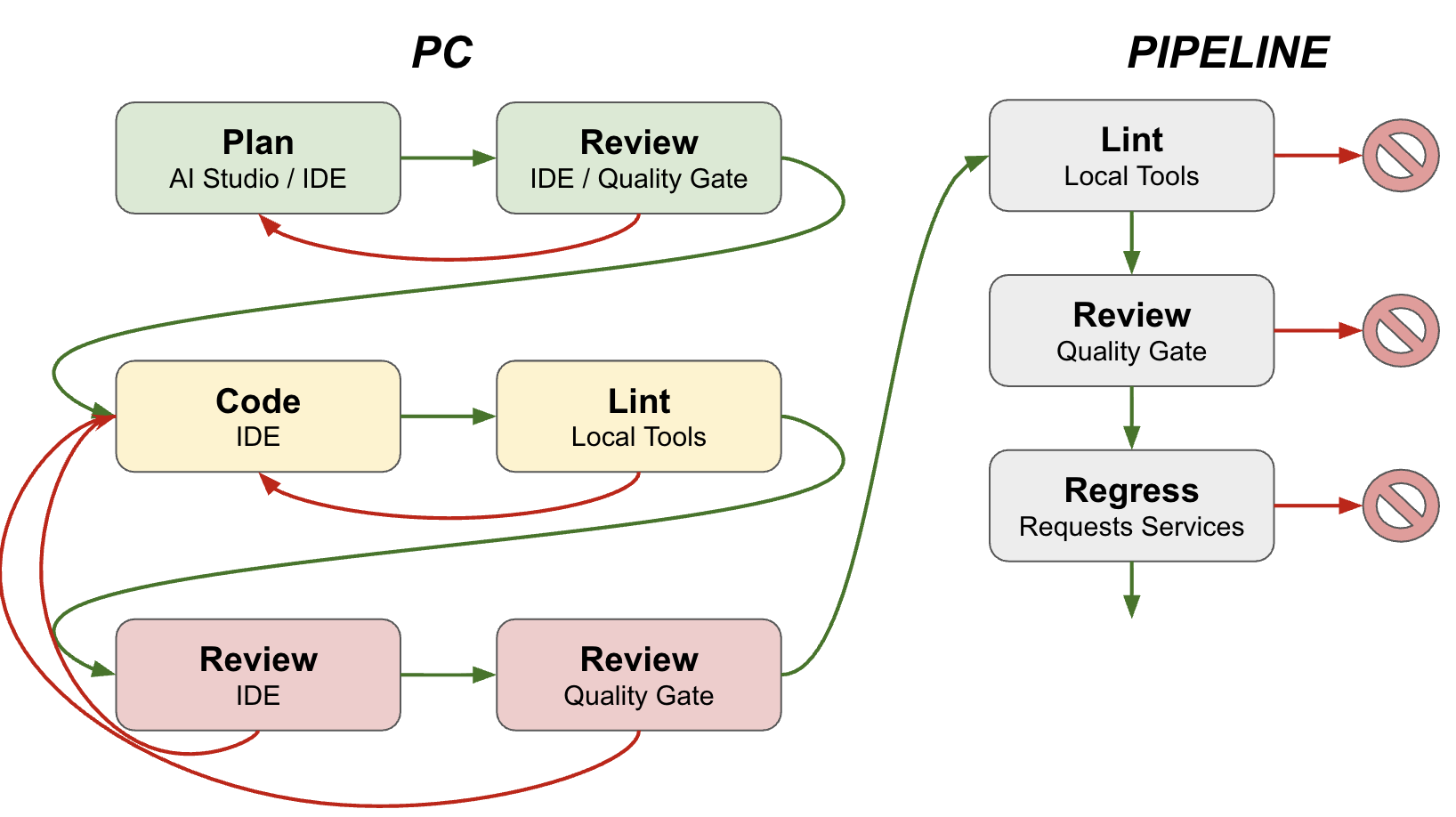
Every feature goes through a step-by-step process. I'm trying to keep security and simplicity as the main focus at each step.
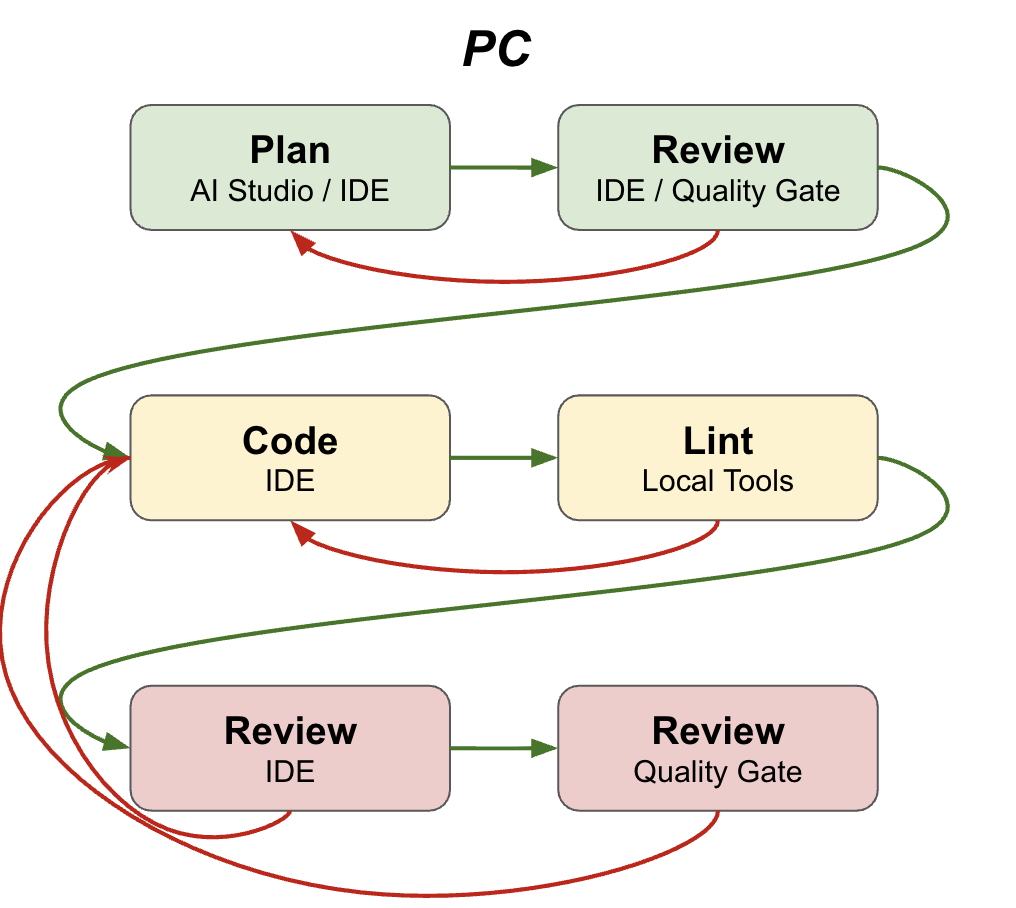
1. Plan & The Plan Review
Using a High-Tier Model.
- Plan: Defining the code structure, the security rules, the cost limits, etc. I make sure not to add to old technical debt.
- Review: I look at the plan with a "fresh eye." I do not start coding until the plan is clear with main code snippets planned.
2. Code & Code Review
Using a Low or Mid-Tier Model for code and Mid or High-Tier Model for review.
- Code: Implement the code exactly as planned. Use clear classes and avoid complex, one-line code tricks. A middle-level developer must be able to maintain it easily.
- Review: Make sure the code matches the rest of the project. I prefer another "person" to check it before I call it done.
3. Lint & Quality Gate
Using Free External Tools & A Custom Nanoservice.
- Lint: I do not pay LLMs to fix missing spaces. I use free tools like
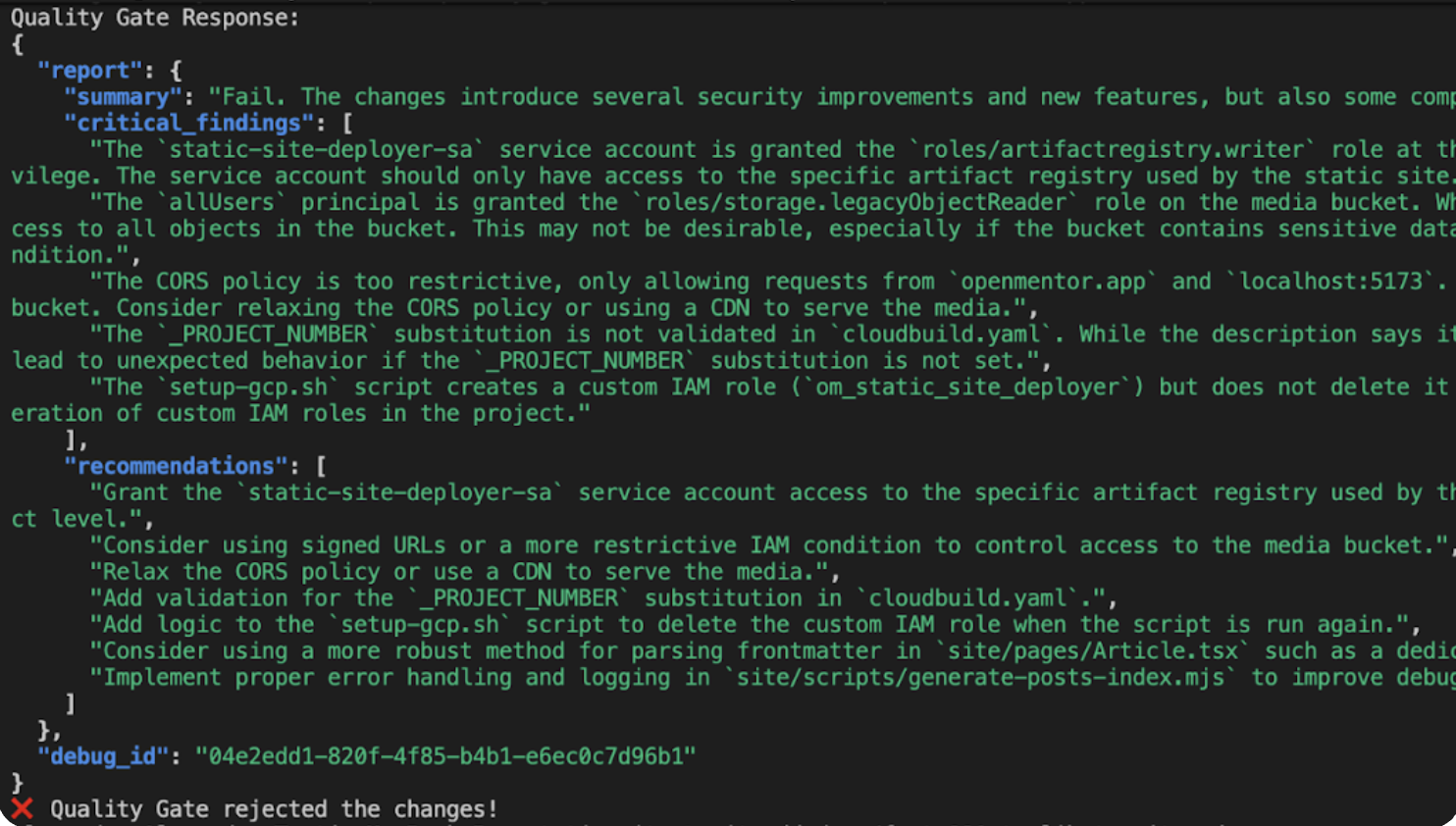
autopep8,ruff, andpylintto save tokens. - Quality Gate: I built a simple nanoservice using the Vertex API. It checks the code changes against the
mainbranch. It works like an automatic review from the CTO, CISO, and CFO. It checks every line for good architecture, proper security access, and cost impact before the code goes to production. Why is it so important? The Quality Gate is not overwhelmed by the full chat history inside the IDE. Its "fresh eye" often finds architectural and coding flaws that were missed by the IDE models, even after 6 to 9 rounds of review.
The Bottom Line
AI coding is not magic. In my experience, it requires a strict testing gate, smart model swapping, and simple design. By owning the process and letting the AI act as a typist, it is possible to ship secure code fast. I share this approach for an open discussion on how we can build better automation.
Comments
More Blog
View allgemmaFive Gemma-4 models, one accelerator: what porting E2B 31B to AWS Inferentia2 taught me
I ported the whole Gemma-4 family — E2B, E4B, 12B, 31B, and the 26B-A4B MoE — to run on...
X
xbillcommunityHey DEV, I'm Tobore. Let's actually connect.
Hey DEV, I'm Tobore. Let's actually connect. I've been on here for a while now, mostly writing and...
L
Laurina AyarahaiI burned through thousands of AI tokens. Then a friend did it for free
(yep, kinda clickbait, just for the funsies 😊) At the beginning of the year, I relaunched my...
P
Paulo HenriqueaiClaude might be saturating your machine
My laptop was sitting idle with the fan at full tilt. Nothing was running that I knew of. The culprit...
S
Sidhant PandagithubactionsAutomated GitHub Code Reviews Using Google Gemini
I Built a Thing! TL;DR — Google Gemini-based Pull Request reviews and Issue Triaging for...
D
Darren "Dazbo" LesteraiWhat is an "agentic harness," actually?
I've been hearing the word "harness" thrown around a lot lately. I assumed it just meant "the IDE" or...
T
Tilde A. ThuriumReady-made automations for this
Workflows from the Neura Market marketplace related to this CoPilot resource
- Automate Professional COE Blog Creation and Publishing with AI and Google Driven8n · $9.99 · Related topic
- Convert Telegram Messages to Professional LinkedIn Posts with Gemini AI & Approval Workflown8n · $24.99 · Related topic
- GitHub Automation Hub: Complete API Controls for AI Agentsn8n · $24.99 · Related topic
- AI-Powered Social Media Content Generator with Strategic Approach Using GPT-4 Modelsn8n · $14.99 · Related topic