
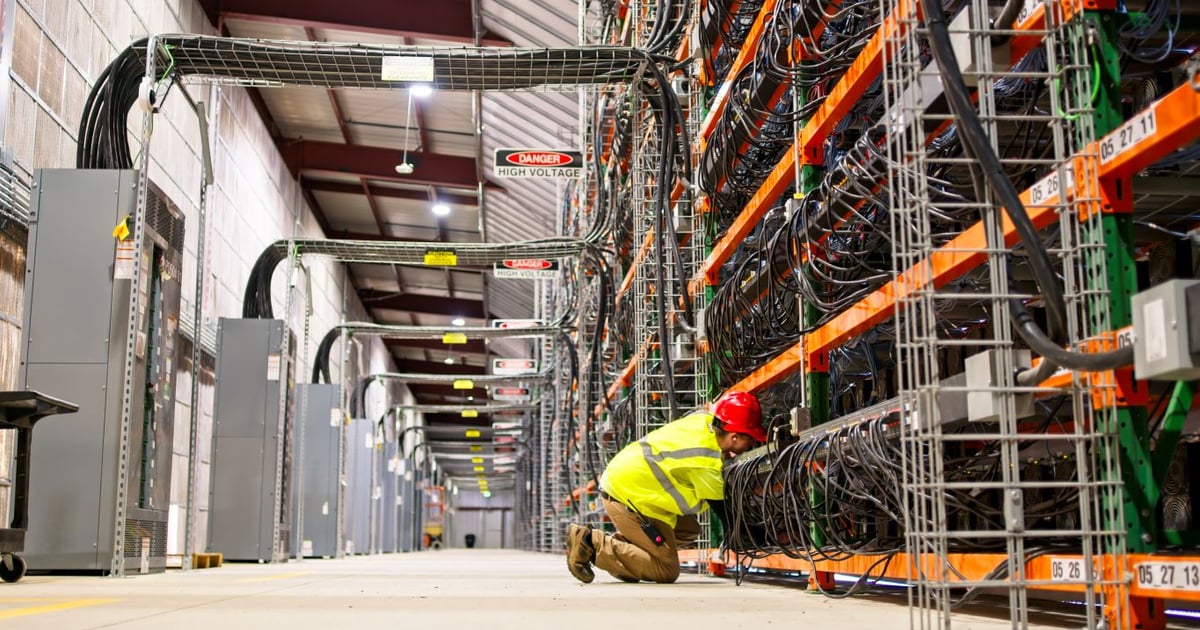
Volta Infra, an AI infrastructure startup founded at the start of 2026, emerged from stealth on Tuesday to announce a landmark $10 billion strategic partnership with an unnamed AI lab. The deal will build an AI factory in Norway, powered by Nvidia's Vera Rubin hardware system, with compute capacity supplied by crypto-mining firm Bitdeer. The company described the arrangement as a "landmark $10 billion strategic partnership with an AI lab to develop an AI factory in Europe alongside Bitdeer."
The company, which has offices in London, New York, and Palo Alto, says the facility will deliver 133 megawatts of power. Volta also raised $300 million in seed and Series A rounds, giving it a $2.4 billion valuation. The funding round was led by asset manager Azora, with participation from Andreessen Horowitz, Altimeter, and Nvidia.
A New Kind of AI Infrastructure Player
Volta's launch comes amid a surge in AI infrastructure providers. The last couple of years have seen an explosion in the number of companies building data centers and cloud services for AI workloads. Volta claims to be "the world's first fully vertically integrated AI infrastructure platform, extending beyond technology into capital formation," according to a statement confirming the launch.
The company's proposition goes beyond simply building data centers. Volta's team can secure power, structure billions of dollars of capital, develop data centers, and run a production cloud. That combination is rare in the neocloud market, according to investors.
Andreessen Horowitz, which invested in the Series A, published a blog post praising Volta's approach. The firm wrote: "There aren't many neocloud teams that can actually secure power, structure billions of dollars of capital, develop data centers and run a production cloud."
Ricard Boada, CEO of Volta Infra, framed the company's mission in historical terms. "Every technology revolution has run on a physical layer beneath it. Railways carried industrialization. Electricity lit manufacturing. Fiber carried the internet," he said.
Boada continued: "We founded Volta because compute should be financed, developed, and commercialized with the principles and scale of infrastructure." That vision extends to Volta's growth plans. The company targets multiple gigawatts of power capacity across North America and Europe by 2030.
Financing and Partnerships
Azora, the asset manager, will provide $5 billion in financing for the Norway project. That capital backs the $10 billion partnership with the unnamed AI lab. Volta will also use Nvidia's DSX platform to develop its sites, and the company is a member of Nvidia's Cloud Partner program.
The partnership with Bitdeer, a crypto-mining company, will provide compute capacity for the AI factory. Nvidia will supply the Vera Rubin hardware system, which powers the facility. The deal structure reflects a growing trend of AI infrastructure companies combining technology, real estate, and finance into single offerings.
Volta's fundraising success is notable. The $300 million raised in seed and Series A rounds is unusually successful for a new startup, according to the company's own description. The $2.4 billion valuation after those rounds places Volta among the most valuable early-stage AI infrastructure firms.
The company's claims extend beyond technology. "Extending beyond technology into capital formation" means Volta structures the financing for its projects, rather than relying solely on external lenders. Azora's $5 billion commitment is part of that strategy.
Market Context: A Rush to Build AI Compute
Volta's emergence reflects a broader race to build AI compute infrastructure. The article, published August 5, 2026, by AI Business, notes that the last couple of years have seen an explosion in the number of AI infrastructure providers. Related coverage includes the EU pledging $11.5 billion for seven AI gigafactories on July 31, 2026.
Another related article from August 3, 2026, reports the US Commerce Department awarding GlobalFoundries $300 million for photonics. These developments show governments and private companies investing heavily in the physical layer of AI.
Volta's $10 billion deal is among the largest private AI infrastructure commitments announced this year. The $5 billion financing from Azora is a significant portion of that total. The $300 million in equity funding, while smaller, gives Volta the balance sheet to begin development.
The company's $2.4 billion valuation reflects investor confidence in its model. Andreessen Horowitz's analysis suggests Volta occupies a unique position. Most neocloud teams focus on software or hardware, but few can handle the full stack of power, capital, construction, and operations.
The article's author, Graham Hope, has 26 years of automotive journalism experience in the U.K. His coverage of Volta places the company in the broader context of AI infrastructure investment. The EU's $11.5 billion commitment to seven AI gigafactories and the US Commerce Department's $300 million award to GlobalFoundries for photonics show the scale of public investment.
What Comes Next for Volta
Volta's immediate focus is the Norway AI factory. The facility will deliver 133 megawatts, a substantial but not massive amount of power. By 2030, the company aims to have multiple gigawatts of capacity across North America and Europe.
The unnamed AI lab in the partnership remains a mystery. Volta has not disclosed which lab will use the Norway facility's compute capacity. The partnership with Bitdeer suggests the factory will serve both AI and potentially crypto workloads, though the company has not detailed the split.
Stay ahead of the AI curve
The most important updates, news, and content — delivered weekly.
No spam. Unsubscribe anytime.
Volta's team brings experience from across the infrastructure and cloud sectors. The company's ability to secure power, structure billions of dollars of capital, develop data centers, and run a production cloud is central to its pitch. Investors like Azora, Andreessen Horowitz, Altimeter, and Nvidia have backed that vision with real money.
The AI factory in Norway will be powered by Nvidia's Vera Rubin hardware system. Volta will use Nvidia's DSX platform to develop the site. Being part of Nvidia's Cloud Partner program gives Volta access to Nvidia's ecosystem and technology roadmap.
The $10 billion partnership with the unnamed AI lab is the anchor deal. Volta will develop the Norway factory, Bitdeer will provide compute capacity, and Nvidia will supply the hardware. The facility's 133 megawatts will serve the AI lab's workloads.
Volta's target of multiple gigawatts by 2030 suggests significant expansion. The company has offices in three major financial and technology hubs, positioning it to raise capital and win customers. The $300 million raised so far, with a $2.4 billion valuation, gives it room to grow.
A Vertical Model for AI Compute
Volta's model contrasts with traditional data center operators. Most separate development, financing, and operations. Volta combines all three, plus cloud software and GPU operations. That vertical integration is what the company says makes it "the world's first fully vertically integrated AI infrastructure platform."
The timing is notable. Volta was founded at the start of 2026 and emerged from stealth in August of the same year. That rapid timeline reflects the urgency in the AI infrastructure market. Governments and companies are racing to build compute capacity, and Volta aims to be a leader.
Boada's railway analogy captures the company's ambition. Just as railways, electricity, and fiber enabled past revolutions, compute will enable the AI revolution. Volta wants to be the company that builds that physical layer.
Volta's private $10 billion deal, with $5 billion in financing from Azora, is comparable in scale to public investments. The company's $300 million in equity funding and $2.4 billion valuation round out the financial picture. The 133-megawatt Norway facility is the first project, with multiple gigawatts targeted by 2030.
The unnamed AI lab adds an element of mystery. Volta has not revealed which lab will use the factory's compute capacity. The partnership with Bitdeer, a crypto-mining company, suggests the facility may serve multiple purposes.
Volta's emergence is part of a larger trend. The explosion in AI infrastructure providers over the last couple of years has created a crowded market. Volta's vertical integration and capital formation capabilities set it apart, according to its investors.
Andreessen Horowitz's blog post provides the most detailed analysis of Volta's position. The firm's claim that "There aren't many neocloud teams that can actually secure power, structure billions of dollars of capital, develop data centers and run a production cloud" underscores the rarity of Volta's capabilities.
The company's fundraising success, described as "unusually successful for a new startup," reflects investor confidence. The $300 million raised and $2.4 billion valuation are strong for a company founded just months ago.
Volta's offices in London, New York, and Palo Alto give it a global reach. The company can raise capital in financial centers and develop technology in tech hubs. The Norway factory is the first test of its model.
By 2030, Volta aims to deliver multiple gigawatts of power capacity. That would make it a major player in AI infrastructure. The $10 billion partnership is the foundation, and the $5 billion in Azora financing provides the capital to build.
The AI factory in Norway will use Nvidia's Vera Rubin hardware system. Volta's membership in Nvidia's Cloud Partner program ensures access to Nvidia's latest technology. The DSX platform will help Volta develop its sites efficiently.
Volta's story is still early. The company emerged from stealth on Tuesday, August 4, 2026, with the article published the next day. The unnamed AI lab, the Bitdeer partnership, and the Norway location are all confirmed. The $10 billion deal value, $300 million in funding, $2.4 billion valuation, $5 billion in financing, and 133-megawatt capacity are all part of the record.
The company's claims of being "the world's first fully vertically integrated AI infrastructure platform" are bold. Whether Volta can deliver on that promise will depend on its execution. The Norway factory is the first test, and the 2030 target of multiple gigawatts is the long-term goal.
Boada's vision is clear. "Every technology revolution has run on a physical layer beneath it. Railways carried industrialization. Electricity lit manufacturing. Fiber carried the internet," he said. Volta aims to be the physical layer for AI.
"We founded Volta because compute should be financed, developed, and commercialized with the principles and scale of infrastructure," Boada added. That principle will guide the company as it builds the Norway factory and expands across North America and Europe.