
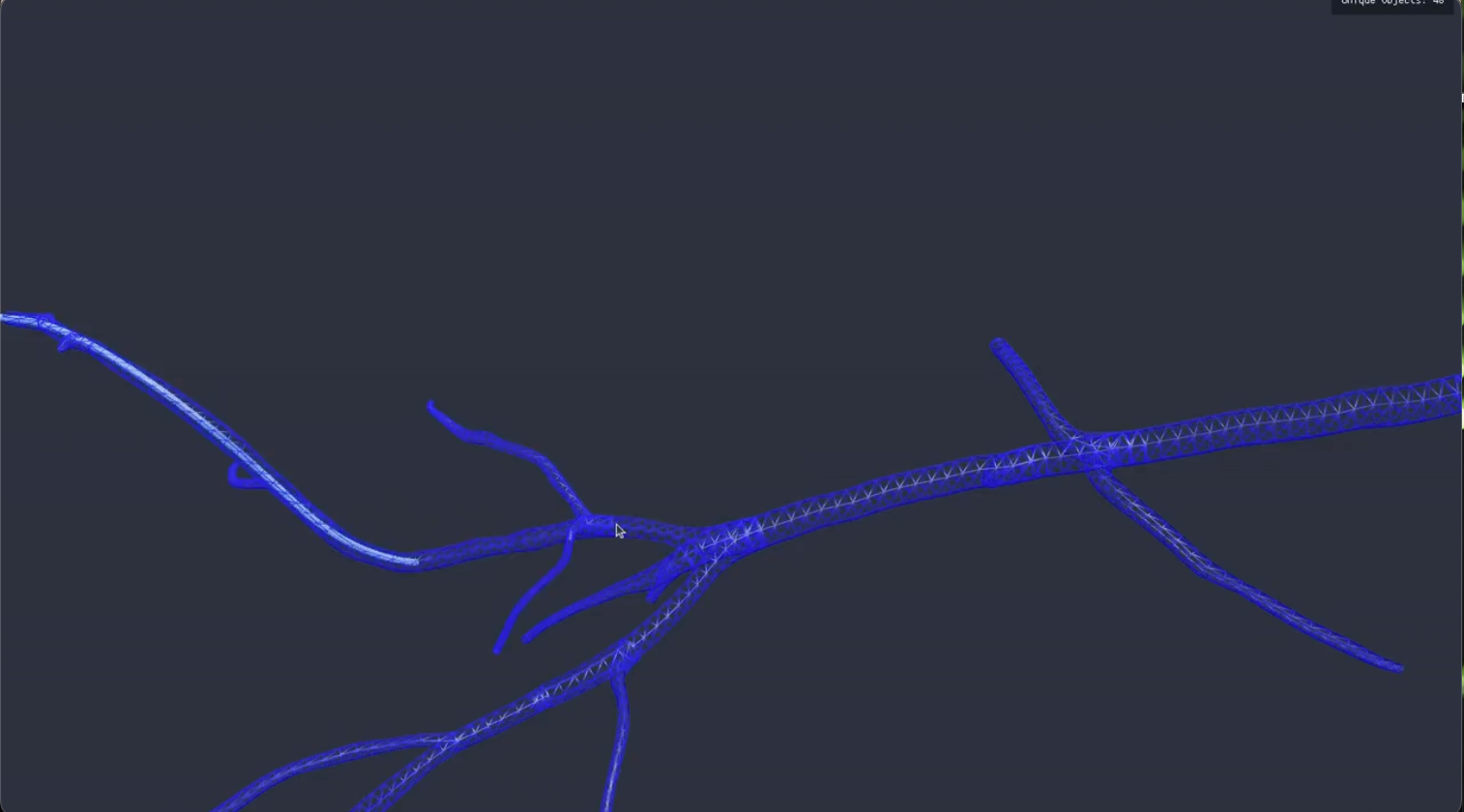
{ "title": "NVIDIA Releases Open-Source Medical Physics Simulation Framework to Accelerate Healthcare Robotics Training", "body": "NVIDIA today released an open-source, GPU-accelerated Medical Physics Simulation framework inside its Isaac for Healthcare platform, aiming to solve what the company calls the biggest bottleneck in healthcare robotics: obtaining the vast, varied data needed to train robots that operate inside the human body.\n\nThe framework, built on NVIDIA CUDA, Warp, Newton, and Cosmos technologies, lets developers model how medical devices interact with anatomy, generate realistic scenarios, and train robot policies. It combines classical physics simulation—which handles known rules like device contact, friction, and motion—with generative AI physics simulation from Cosmos-H Dreams, which models visual scene dynamics learned from procedural data. This hybrid approach allows the system to simulate both predictable physical interactions and complex, variable biological environments.\n\n## Training Time Slashed From Hours to Minutes\n\nNVIDIA says the framework can run hundreds of parallel simulation environments. In one benchmark, 8,192 robot-training environments ran in parallel using GPU-native simulation, cutting training time from over five hours to under two minutes. The company says this turns simulation from bespoke engineering into reusable infrastructure, saving developers time and helping identify failure modes earlier in development.\n\nThe framework can be used standalone or alongside digital twin pipelines, medical sensor simulation, the open robot-learning framework Isaac Lab, and NVIDIA’s open models and policies. Developers can connect vascular anatomy, flexible instruments such as catheters and guidewires, simulated X-ray imaging, and reinforcement learning. This modular design means teams can mix and match components depending on their specific training needs, from catheter navigation to soft-tissue surgery.\n\n## Industry Partners Already Adopting the Framework\n\nSeveral medical technology companies are already using the framework. CMR Surgical, a medical robotics company, is using Cosmos-H-Dreams to learn interaction physics for soft-tissue surgical procedures and generate patient-specific simulations. The company contributed nearly 500 hours of anonymized clinical data from its Versius Surgical Robotic System to the Open-H Embodiment dataset. The procedures covered include cholecystectomy, prostatectomy, hernia repair, and hysterectomy. Cambridge Consultants, part of Capgemini, is working alongside CMR Surgical on this effort.\n\nChris Fryer, Chief Technology Officer at CMR Surgical, emphasized the importance of open-source models in healthcare. "Open source models allow us to build on shared knowledge, accelerating responsible innovation and, ultimately, gives us the potential to deliver more consistent care and better outcomes for patients worldwide," he said.\n\nJohnson & Johnson MedTech is using Isaac for Healthcare’s Medical Physics Simulation and a Cosmos-based foundation model to build digital twins of its MONARCH platform for urology, specifically modeling kidney-stone scenarios. XCath is using the framework for endovascular autonomy policy training. Inner Logic is accelerating the evolution of medical technology with synthetic data, validating device mechanics, and producing in silico evidence for regulatory pathways using the NVIDIA Medical Physics Simulation. Medtronic Structural Heart is exploring the framework with simulated X-ray sensing for catheter navigation research. These partnerships span multiple continents and cover a range of medical specialties, from urology to endovascular surgery.\n\n## Open Source as a Foundation for Regulatory Evidence\n\nNVIDIA argues that open source is particularly important in healthcare because it provides transparency into the data, models, and weights that shape system behavior. Access to open models and weights helps reproduce results, evaluate performance across anatomies and scenarios, identify limitations, and build evidence for regulatory review. This transparency is critical for gaining approval from bodies like the FDA, where regulators need to understand how a model was trained and what data it was exposed to.\n\nThe framework is designed to extend beyond vascular anatomy to additional devices, anatomies, sensors, and domains. Healthcare robots must learn how the physical world pushes back due to anatomy variation, instrument bending, pressing, and slipping, noisy and incomplete imaging, and rare edge scenarios. Physical AI requires experience as data in motion, and the new framework helps simulate anatomy, device contact, friction, and sensor inputs, then test interactions and environments. By making the simulation framework open source, NVIDIA hopes to accelerate the entire field of medical robotics, allowing researchers and startups to build on each other's work rather than starting from scratch.\n\nNVIDIA GTC Berlin will take place October 20-22, with registration now open. The company expects the framework to be a key topic of discussion at the event, where developers and medical device makers can share early results and best practices.\n\n## Related on Neura Market\n\n- NVIDIA Isaac for Healthcare Platform\n- Medical Robotics and Surgical AI\n- GPU-Accelerated Simulation Tools" }
Stay ahead of the AI curve
The most important updates, news, and content — delivered weekly.
No spam. Unsubscribe anytime.