
NVIDIA announced at COMPUTEX on Tuesday that its Jetson platform now supports agentic AI through the release of JetPack 7.2 and the NemoClaw framework.
The update gives developers a production-grade software stack for deploying intelligent AI agents in physical environments such as robotics, industrial inspection, and factory automation.
Jetson Software Stack Gets Agentic AI Capabilities
JetPack 7.2 adds agentic AI skills, Yocto project support, and NVIDIA CUDA 13 on Jetson Orin. The Jetson AGX Orin 32GB module receives a performance boost to 241 trillion operations per second (TOPS), a 20% increase over its original specification. Multi-Instance GPU (MIG) support comes to Jetson Thor, alongside a real-time kernel.
According to Deepu Talla, vice president of robotics and edge computing at NVIDIA, the platform's programmability and high performance enable developers to immediately deploy physical AI agents at the edge. He said purpose-built skills for agentic development and workflows can accelerate time to market, reduce total cost of ownership, and enable large-scale deployments on a memory-optimized platform.
The release consists of three layers. JetPack 7.2 forms the base with operating system, compute, and deterministic performance. A middle layer adds agent skills for automating developer tasks. NemoClaw sits at the top.
Performance Upgrades and New Features
Yocto-based operating system support gives industrial customers a leaner, more customizable Linux foundation. This is important for memory-constrained deployments. CUDA 13 on Jetson Orin brings the latest compute stack to existing devices. MIG combined with a real-time kernel on Jetson Thor lets developers reserve dedicated GPU resources for deterministic workloads. These include robot perception systems that cannot pause for unrelated AI inference.
Agent Skills Layer Simplifies Development
The middle layer includes agent skills for tasks such as Linux customization, memory optimization, and model benchmarking. These skills are derived from NVIDIA documentation and design guides. NVIDIA states that a task that previously took weeks can now be completed in days.
At the top, NemoClaw deploys to Jetson with a single command. The pairing places agentic AI on a production-grade robotics and vision AI stack, accelerating task automation for industrial systems. Developers can also use NVIDIA Metropolis VSS blueprint skills to add visual reasoning agents that watch, interpret, and act on what they see.
Early Adopters Deploy Agentic AI on Jetson
Multiple companies are already deploying agentic AI on Jetson. Solomon uses NemoClaw to coordinate AI agents on a humanoid robot, integrating reasoning, perception, sensor fusion, locomotion, and manipulation into a single workflow. The robot uses Solomon's active perception technology, powered by an NVIDIA open source foundation model, to understand tasks, optimize positioning for picking, and adapt dynamically.
Advantech is building an agentic factory brain within its own manufacturing facilities. It uses NemoClaw, NVIDIA Nemotron 3, and Jetson Thor to automate robot fleet management, defect detection, and autonomous decision-making.
Stay ahead of the AI curve
The most important updates, news, and content — delivered weekly.
No spam. Unsubscribe anytime.
Rebotnix makes smart city cameras with agentic reasoning capabilities for faster city-level decisions. Spingence builds manufacturing defect agents that identify root causes and recommend process improvements through analytics and knowledge reasoning. ANIWEAVE and Avalanche Computing are partnering to transform real estate spaces into immersive 3D touring experiences using AI-powered conversational agents.
Memory Optimization Results
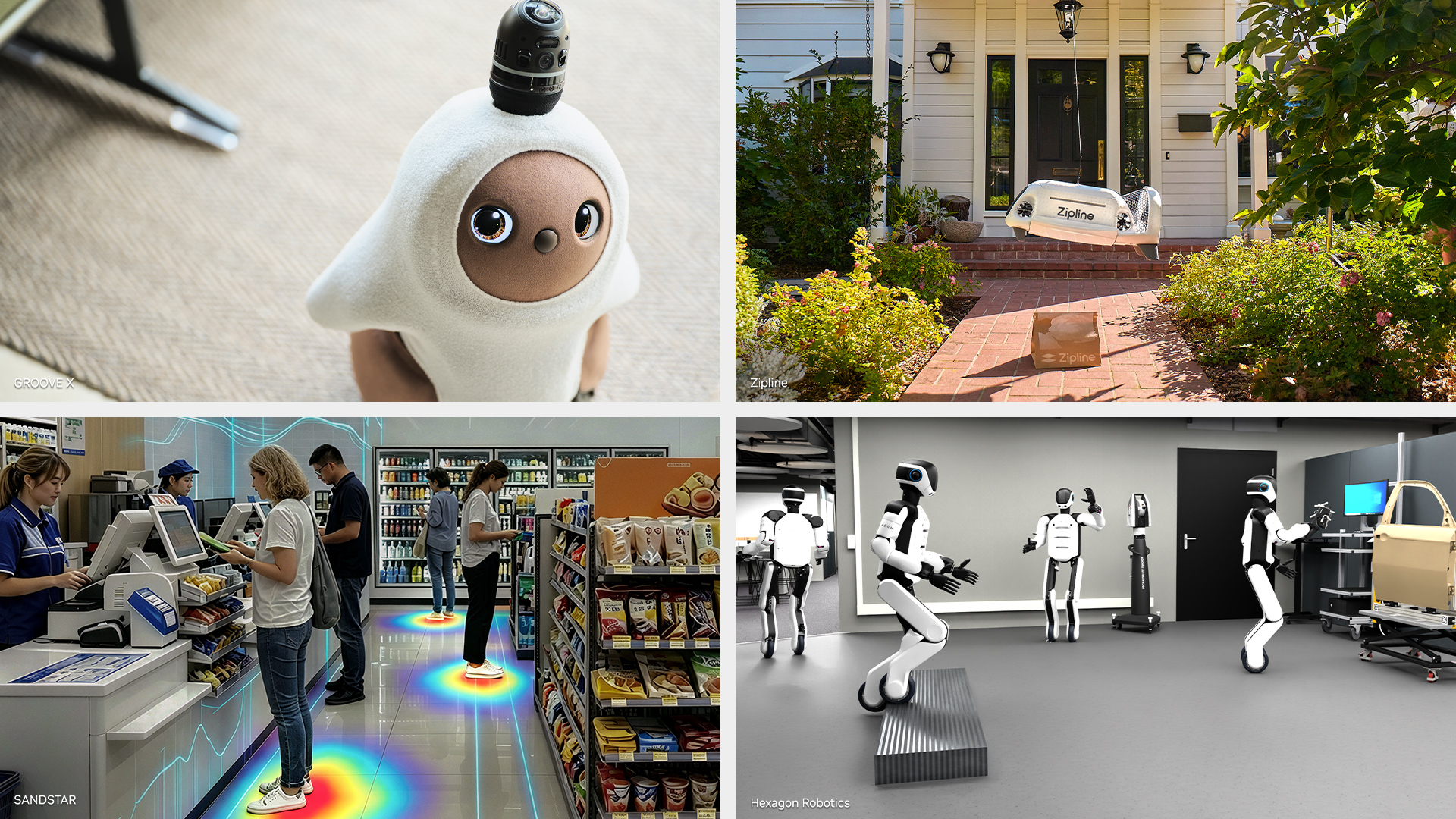
SandStar uses Jetson Orin NX and NemoClaw to power AI vending machines and smart retail operations in more than 30 countries. The company reports achieving nearly 40% memory optimization, which allowed it to migrate from 16GB to 8GB devices while maintaining performance and reducing deployment costs.
NoTraffic develops AI-powered traffic management systems that analyze real-time conditions and optimize signal operations. The company optimized CUDA library overhead through static compilation and targeted kernel pruning, reducing memory usage by 29%.
GROOVE X, maker of the LOVOT companion robot, uses various AI accelerators on Jetson modules to offload CPU and GPU workloads and reduce memory footprint.
Yocto Adoption Grows Among Production Deployments
Hexagon Robotics integrates Jetson Thor to power safer and more autonomous humanoid robots with real-time AI, high-speed sensor processing, and multimodal data fusion. The company uses Yocto-based OS customization for better reproducibility and safety in demanding environments like manufacturing, logistics, and construction.
Zipline uses Jetson Orin NX in its autonomous delivery drones for real-time sensor fusion, environmental awareness, and safe navigation. Zipline builds a custom operating system with Yocto, designed for high-performance onboard AI processing with a lower memory footprint.
1X (maker of the Neo Humanoid) and Universal Robots plan to adopt Yocto-based JetPack 7.2 in their production deployments.
Ecosystem partners including Balena, Konsulko Group, Neurealm, Peridio, RidgeRun, and Wind River provide Linux distribution products, engineering services, and long-term support. AAEON, ASUS, Avermedia, Connect Tech, and YUAN have validated Yocto OS with their production edge computing systems.
What's Next for Physical AI Agents
NemoClaw started in the data center and now runs in retail stores, on humanoid robots in factories, and in traffic systems at busy intersections. NVIDIA says the era of physical AI agents has just begun.
Developers can start building agentic AI on Jetson through the Jetson software page. NVIDIA founder and CEO Jensen Huang delivered a keynote at GTC Taipei.
Related on Neura Market: