
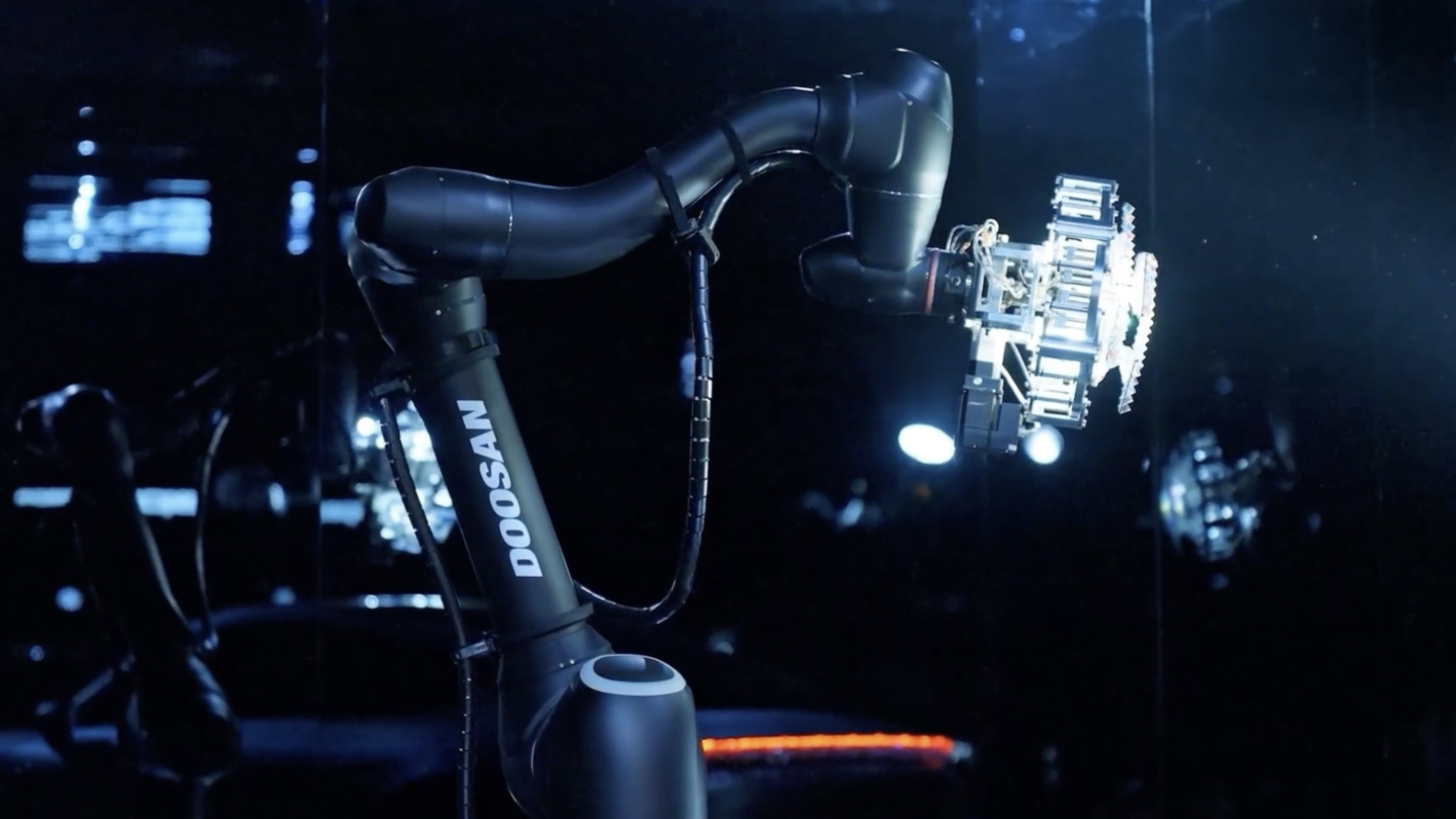
NVIDIA and Doosan Group have announced an expanded collaboration to pursue new opportunities in physical AI, robotics, and AI factory infrastructure. The partnership involves several Doosan subsidiaries: Doosan Robotics, Doosan Bobcat, Doosan Enerbility, and Doosan Corporation Electro-Materials BG.
The agreement brings together NVIDIA's full-stack accelerated computing platforms with Doosan Group's capabilities in industrial automation, power generation, and advanced electronics materials. The goal is to support next-generation AI infrastructure.
Doosan Group's businesses cover multiple layers of the AI factory ecosystem, from intelligent robotics systems to large-scale power solutions and advanced electronics materials used in AI data center equipment. NVIDIA and Doosan will explore how NVIDIA's physical AI stack, the NVIDIA DSX AI factory platform, NVIDIA MGX, and accelerated computing platforms can support these areas.
Advancing Physical AI and Robotics
Doosan Robotics is integrating several NVIDIA technologies into its Agentic Robot OS. These include NVIDIA Isaac Sim and Isaac Lab open robotics frameworks, NVIDIA Cosmos open world foundation models, the open source Newton physics engine, and NVIDIA Jetson Thor. Agentic Robot OS is an AI-powered platform that connects perception, reasoning, simulation, learning, and on-device inference.
By incorporating NVIDIA's physical AI technologies, Doosan Robotics aims to help industrial robots better perceive, reason, and act in complex and dynamic environments. Simulation-to-real workflows, physics calibration, and AI reasoning are expected to make collaborative robots more adaptable, task-specialized, and suitable for scalable deployment.
The companies are also developing reference use cases for high-value industrial tasks such as depalletizing and sanding, as well as new robot form factors including dual-arm and humanoid platforms.
These capabilities, built on Agentic Robot OS, are intended to help Doosan Robotics evolve from a robot arm provider into a full-stack AI-first robotics solution company. This work is part of a broader Doosan Group-wide direction for physical AI that extends beyond robotics into areas such as construction machinery and power equipment.
Stay ahead of the AI curve
The most important updates, news, and content — delivered weekly.
No spam. Unsubscribe anytime.
Doosan Bobcat also plans to explore integrating NVIDIA physical AI technologies into equipment used in construction, landscaping, agriculture, and material handling applications. This work will help accelerate the development of specialized world models that enable Doosan Bobcat's equipment to perceive diverse operating environments, reason about changing conditions, and perform tasks more autonomously. The companies also aim to help establish an industry-standard ecosystem for compact autonomous equipment.
Exploring AI Factory Power Solutions
Doosan Enerbility is exploring opportunities to support NVIDIA AI factories and the NVIDIA DSX AI factory platform through its large-scale power infrastructure portfolio. This includes gas turbines, steam turbines, and small modular reactors, together with Doosan Fuel Cell's hydrogen fuel-cell systems. These technologies are relevant to AI data centers that require reliable, high-efficiency, and continuously available power.
Future collaboration could include power supply design for AI factory deployments, optimization of generation equipment, and evaluation of low-carbon power sources such as small modular reactors. By aligning AI infrastructure requirements with energy system expertise, Doosan Enerbility could help address the growing power demands of accelerated computing.
Supporting the NVIDIA MGX Ecosystem With Advanced PCB Materials
Doosan Corporation Electro-Materials BG is supporting next-generation AI data center infrastructure through copper clad laminate (CCL), a key foundational material for printed circuit boards. High-performance CCLs are used in PCBs for networking equipment, AI accelerators, and AI server motherboards, where low signal loss and high reliability are critical.
NVIDIA MGX provides a modular reference architecture for accelerated systems, helping system manufacturers and ecosystem partners build servers and rack-scale AI factory infrastructure. As AI servers and networking systems increase in performance and bandwidth, advanced PCB materials such as CCL can play an important role in enabling high-speed signal integrity across the data center equipment ecosystem.