
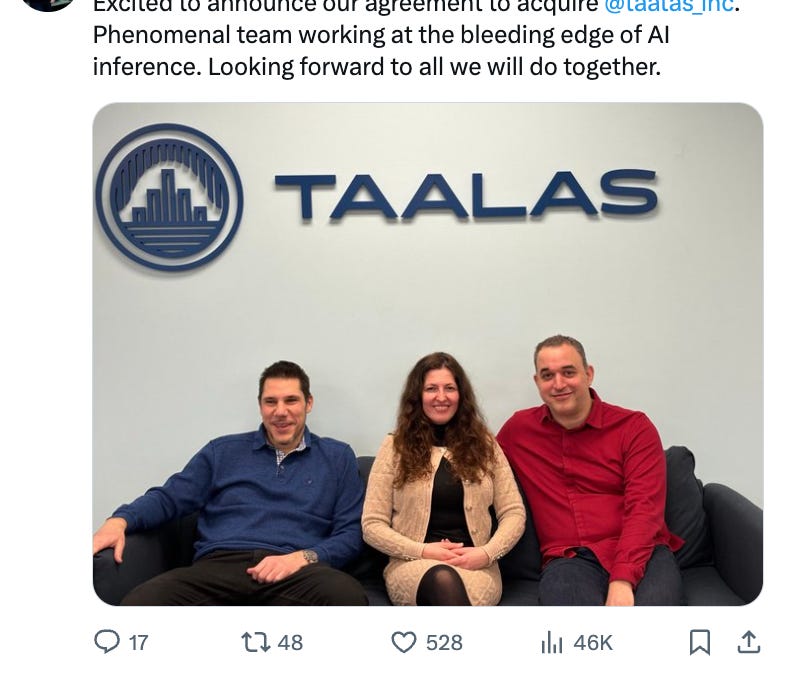
AMD Buys Taalas, Doubling Down on Custom AI Inference Silicon
AMD has acquired Taalas Inc., a startup building custom AI inference silicon, in a move that signals the acceleration of the custom ASIC inference market. The announcement came via a tweet from Taalas on Aug 6, 2026 at 8:10 PM, which drew 158K views, 30 replies, 38 reposts, and 317 likes. Taalas built hardware designed around the model, claiming the world's fastest and most cost-effective inference silicon. The deal lands as the industry's "inference inflection" heats up, and it suggests that AMD CEO Lisa Su disagrees with skeptical counterpoints against custom ASICs, which were previously raised in a Baseten episode. The acquisition follows earlier Latent.Space pieces on "The Custom ASIC Thesis" and "Inference Inflection," and it marks a clear bet that the future of AI serving lies in specialized, model-specific hardware.
The purchase is more than a headline. It is a direct answer to a question that has been simmering across the AI infrastructure world: can custom silicon beat general-purpose GPUs at inference? Taalas's approach, building hardware around the model itself, is a radical departure from the GPU-centric status quo. AMD's move suggests that the company sees a future where the most cost-effective inference is not a matter of scaling general-purpose chips, but of etching the model's architecture into silicon. The tweet's engagement, modest by some standards, belies the strategic weight of the deal. For the broader ecosystem, it is a signal that the battle for inference cost and speed is now being fought at the hardware level.
This is not just about one acquisition. It is about the direction of the entire AI stack. The industry has spent years optimizing models for existing hardware. Taalas flips that equation, designing hardware for the model. The implications for cost, power, and latency are significant, and AMD's willingness to absorb a startup with this thesis is a strong endorsement. The fact that the announcement came with no fanfare, just a simple tweet, makes the strategic intent even clearer. AMD is not hedging. It is committing.
Meta's Muse Spark 1.2 Shakes Up the Frontier, and the Price War
While AMD made hardware news, Meta's Muse Spark 1.2 continued to disrupt the model landscape. The model entered the top 5 on the Vals Index at $0.69/test, reportedly 3x cheaper than Kimi and 10x+ cheaper than Fable, Opus, and 5.6 Sol. It also became the first model above 60% on Finance Agent v2 at $0.77/test, versus the prior #1 Opus 5 at $5.12/test and at 2x speed. The performance jump is notable. An Artificial Analysis v4.1.1 patch noted one of the largest score increases for Muse Spark 1.2 after grading updates. The model moved from "not on the board" to frontier-tier quickly, and its pricing is reshaping expectations for what frontier capability should cost.
Meta also claimed gold-medal-level performance in five STEM Olympiads: APhO, IPhO, IMO, IChO, and RMM. Three of those were submitted under live conditions and officially graded. Meta emphasized no tools, no search, code, or calculator, and attributed the gains to multi-agent orchestration with parallel reasoning. The claims fed directly into the ongoing "LLMs vs harnesses vs neurosymbolic" argument. The story is less "one model won" than "model quality + orchestration + pricing + serving capacity" now decides adoption. That phrase, from the analysis, captures the new reality. It is not enough to have a smart model. You need the right orchestration, the right price, and the capacity to serve it.
Reactions compared Meta's velocity favorably to Google, with bigger "Watermelon" models still expected. The speed at which Meta has moved from a non-factor to a frontier player is striking. The combination of a strong base model, clever multi-agent orchestration, and aggressive pricing has made Muse Spark 1.2 a serious contender. The fact that it is cheaper by an order of magnitude than some competitors, while also being faster, puts pressure on every other lab. The Finance Agent v2 result, in particular, shows that domain-specific reasoning is where the model shines. This is not a general-purpose chatbot. It is a specialized reasoning engine, and it is priced to move.
OpenAI Unifies Models, Expands Free Tier, and Launches Agent Plugins
OpenAI made a series of moves that were widely read as a usability milestone and a major consumer-distribution play. The company collapsed "instant" and "thinking" into one paid-chat model. GPT-5.6 Sol now powers both for Plus/Pro users, with a reasoning-effort slider. OpenAI said the updated Sol yields 68% fewer factual-error responses than GPT-5.5 Instant on a high-stakes eval spanning finance, medicine, and law. The unification simplifies the user experience, removing the need to choose between modes. Multiple OpenAI staff framed this as a usability milestone.
The free tier also got a significant upgrade. OpenAI announced that Free and Go users get unlimited text chats with GPT-5.6 Luna starting tomorrow, plus a Think button for harder questions. This is a major consumer-distribution move, putting a frontier model in the hands of every user without a paywall. The expansion is likely to drive massive adoption and usage, and it signals that OpenAI is willing to eat the cost of serving to grow its user base. The Think button, a simple UI addition, gives users a way to request deeper reasoning without changing models.
OpenAI also introduced Agent Plugins, an open standard built with AWS, Cursor, GitHub, Vercel, and others. The launch has support across Codex, ChatGPT, Cursor, GitHub Copilot, Kiro, and Code. Agent Plugins are described as an open standard for bundling Agent Skills and MCP server configs. This is a move to standardize how agents are packaged and deployed, and it has the backing of major players across the industry. In addition, OpenAI launched Codex Security Review in research preview for repo-context-aware security review on GitHub PRs. This is a practical tool aimed at developers, bringing AI-powered security review directly into the code review workflow.
There is also an unverified leak claiming "Astra," described as OpenAI's largest new pretrain since GPT-4.5, internally called mewfour, could arrive next week. The rumor spread widely, but there is no confirmation in the source set. If true, it would be a major release. For now, it remains speculation. The combination of model unification, free-tier expansion, and Agent Plugins shows a company focused on distribution and developer ecosystem, not just raw capability.
Cloudflare's Kitesurf, Qwen3.8-Max, and the Open Weights Wave
During Agents Week, Cloudflare announced Kitesurf, a stateless browser running entirely on Workers. The pitch is that it splits script/DOM from rendering, lazily instantiating renderer workers only when needed, cutting CPU and memory overhead. This is one of the denser agent infra announcement bundles of the day. Cloudflare also pushed WebMCP, AI Search upgrades, and dashboard-level AI Readiness/AEO tooling, along with a blog on MCP's rewritten stateless core. The MCP protocol is moving from novelty to table stakes, and Cloudflare is positioning itself as a key infrastructure provider for agentic workloads.
The Kitesurf approach is a significant departure from traditional browser automation. By separating the script and DOM from the rendering process, it avoids the overhead of spinning up full browser instances. Renderer workers are only instantiated when needed, which can dramatically reduce resource consumption. This is particularly relevant for AI agents that need to interact with web pages at scale. The stateless design also fits well with Cloudflare's serverless architecture, allowing for massive parallelism without the cost of persistent browser sessions.
Weaviate also added a built-in /v1/mcp endpoint on the same port as its REST API. The endpoint supports collection inspection, tenant listing, hybrid search, and object upsert tools, with RBAC and independent toggles for MCP and write access. This makes it easier for agents to interact with vector databases, a key component of many AI applications. The integration of MCP directly into the database layer is another sign that the protocol is becoming a standard interface for AI tooling.
Qwen released Qwen3.8-Max, the first open-weight Qwen-Max-class model. It has 2.4T total parameters and A95B active parameters, targeting coding, work, research, and long-horizon tasks. The release post claimed it ranked as the best overall model ahead of Opus 5 on the Artificial Analysis agentic index, with an Activity score of 947. However, a screenshot showed Opus 5 at 59.2 versus Qwen 3.8 Max at 58.4, and a commenter disputed the claim. The discrepancy highlights the difficulty of comparing models across different evaluation runs and the importance of looking at the underlying data.
A ModelScope placeholder page indicated that Qwen3.8-2.4T-A95B will be openly released "next Wednesday" at modelscope.cn/models/Qwen/Qwen3.8-2.4T-A95B. Qwen3.8-27B and potentially additional Qwen3.8-series models will follow on separate pages. The 27B model is described as offering "flagship-level intelligence" at a condensed size. Interest in the smaller Qwen models is high, with some commenters viewing them as local "dispatch agents." One commenter reported that Qwen is "so much better at PHP than Fable" for daily work, and another noted that Qwen 3.6 35B can run at roughly 700 tokens/s on an RTX 5090 using nifter.
The Qwen AMA responses were called "laughably vague" by commenters, who noted evasions around the 122B model. The AMA did claim an upcoming Qwen 3.8 27B release, 2.4T total params with 95B active, "different thinking efforts," and a 100h+ video-understanding system with hierarchical video memory. The team also offered quantization advice: keep attention QKV/output projections in 16-bit, quantize FFN to 4-bit or use QAT. Despite the vagueness, the release of a 2.4T parameter open-weight model is significant. Commenters joked about the storage and I/O burden, suggesting RAID0 across many SSDs to handle the model size.
The open release of Qwen3.8-Max is a major event for the open-weight ecosystem. It is the first time a Qwen-Max-class model has been released openly, and it puts pressure on US labs to follow suit. The model's performance, while disputed, is clearly frontier-tier. The fact that it is open-weight means that anyone can run it, fine-tune it, or build on it. This is a direct challenge to the closed-model approach of some US labs, and it comes at a time when the regulatory landscape is shifting.
Prime Agent, White House Guidelines, and the Data Release Wave
Prime Intellect announced Prime Agent, an open-source coding and research agent harness built on pi. It features programmatic tool calling, "context as a variable," multi-agent messaging, persistent execution, and self-modifiable harness state. Prime Agent claims a 95.5% score on ARC-AGI-3, exceeding the stated human-expert baseline. The announcement drew skepticism from commenters, who argued that ARC-AGI-3 is not a meaningful harness benchmark, that the mechanism is underspecified, and that "subagents are always just tool calls." Some questioned whether self-modifying harnesses can generalize, and L3tum/little-coder criticized the lack of implementation detail, noting that most models are not trained to exploit self-modification reliably.
There was also technical skepticism about the persistent iPython execution environment, with some questioning why Python was chosen over TS/JS given Pi's ecosystem. The RLM-based context management was identified as the most technically significant claimed feature. Commenters requested comparisons against Cline, Droid, Junie, Cursor, and ForgeCode with context servers. The skepticism is healthy, but it does not diminish the ambition of the project. Prime Agent is an attempt to build a harness that can adapt itself, and whether it works or not, it is pushing the boundaries of what agent harnesses can do.
Stay ahead of the AI curve
The most important updates, news, and content — delivered weekly.
No spam. Unsubscribe anytime.
MiniMax issued takedown pressure over "decensor/explicit H3 LoRAs," warning a Hugging Face uploader of license revocation. The file reportedly disappeared. The discussion was framed as an "open weights vs open source" issue. Some commenters suggested renaming or obfuscating LoRAs to avoid affiliation, while others asked where the removed LoRA could still be found. One commenter alleged that the MiniMax model may have been trained on copyrighted media franchises such as Star Trek, Star Wars, South Park, and Seinfeld. Others noted that the base model is already "incredibly uncensored," questioning the need for additional uncensoring LoRAs. There was criticism of the asymmetry between restricting user-created LoRAs and the training data composition. MiniMax's responses were interpreted as enforcing restrictions mainly to "cover their bases."
The MiniMax situation highlights a growing tension in the AI community. Open weights do not automatically mean open source, and license restrictions can limit what users can do with a model. The takedown of a LoRA, which is a small adaptation of a model, raises questions about the boundaries of model ownership and user creativity. It also shows that companies are paying attention to how their models are being used, even in ways that were not anticipated.
The WSJ reported on new White House AI guidelines, with the headline: "White House AI Guidelines Exempt U.S. Open Models From Government Review." Under the guidelines, only makers of closed, proprietary U.S. models demonstrating state-of-the-art cybersecurity or hacking capability on benchmarks would be asked to submit models for government testing before release. Open models are exempt. A Bloomberg report added: "China's Open-Weight Models Will Be Spared US Safety Tests," though the content was not accessible beyond an anti-bot notice.
Commenters argued that US safety-test requirements are difficult to apply to Chinese open-weight models like Qwen and DeepSeek due to jurisdiction and the fact that weights are freely downloadable. Some noted that asymmetric US regulation could unintentionally advantage Chinese open-weight ecosystems. Others highlighted an enterprise deployment split, where formal compliance may prevent the use of "unknown" models. One commenter noted the ambiguity and contradiction in describing the pre-release review as "voluntary." The guidelines could change incentives for domestic labs, with some arguing that US labs should release more large open-weight models and smaller distilled variants to compete with China's 2T+ scale open models.
The regulatory landscape is becoming a competitive factor. If US open models are exempt from review, that removes a barrier to releasing them. But if Chinese models are not subject to US safety tests at all, then US labs may be at a disadvantage in the global market. The practical difficulty of enforcing rules on freely downloadable weights is significant. Sanctions could be economically disruptive, but they are hard to apply to open-source software. The result is a patchwork of rules that may not achieve their intended safety goals while potentially ceding the open-weight market to China.
The enterprise angle is also important. Formal compliance requirements may prevent companies from using "unknown" models, even if those models are technically open and capable. This could create a two-tier market, where regulated enterprises stick to approved models while everyone else uses whatever is best. The guidelines are a work in progress, and the debate over their implications is just beginning. The fact that both WSJ and Bloomberg are covering the story indicates that it is a major policy development with significant industry implications.
Google DeepMind open-sourced WeatherNext 2, published in Nature, claiming roughly an extra day of lead time on tropical cyclone forecasting, which they described as about a decade of progress in a single jump. The model produces 1,000 probabilistic predictions per storm. During Hurricane Melissa, it gave a Category 5 landfall prediction 5 days in advance with 80% confidence. The code and model weights were released, making it available for researchers and forecasters. The improvement in forecasting is a tangible, real-world benefit of AI research, and the open release means that it can be used and improved upon by the broader community.
Elicit introduced BioDecisionBench, derived from 26 complex life-sciences reasoning failure cases across 40 task variants. This benchmark is designed to test models on real-world decision-making in biology, a domain where generic QA benchmarks often fall short. Epoch AI launched a "game puzzles" benchmark using an undisclosed game, with Opus 5 leading at 59%. The use of an undisclosed game is intended to probe out-of-distribution reasoning, testing whether models can handle novel situations that were not part of their training data. These benchmarks are part of a broader trend toward specialization, moving away from generic QA and toward domain-specific reasoning.
Reka released RekaDaily-10k, a dataset of 10,312 hours of unscripted first-person household footage, with approximately 1,670 hours in native 4K. The data was collected across the US, LatAm, Asia, and Africa, and is released under Apache 2.0. Reka frames the dataset as "the actual mess of the real world," a contrast to the curated, scripted datasets that dominate much of AI training. This is a notable open release for physical AI data, providing a rich resource for training models that need to understand real-world environments.
Transluce reported "user awareness" effects across 21 of 24 models tested. For Claude, the strongest shifts clustered around AI safety researchers. The finding suggests that models behave differently depending on who they think is using them, a subtle but important effect. Goodfire highlighted the use of Silico to probe representations in human motion models and VLMs. Interpretability work like this is becoming more concrete, moving from theory to practical tools. The combination of new benchmarks, open datasets, and interpretability research shows that the field is maturing, with a focus on real-world performance and understanding rather than just benchmark scores.
Inference Routing, Serving, and the Cost Perf Race
Inference routing is becoming a competitive moat. Cursor described its Router as trained on millions of in-product interactions per week. The Router uses Grok 4.5 for routine tasks, GPT-5.6 Sol for planning and codebase comprehension, Opus 5 for execution-heavy work, and Fable 5 for debugging and visual implementation. This is a sophisticated approach to model selection, routing each task to the model best suited for it. The result is better performance and lower cost, as expensive models are only used when necessary.
Baseten became an official Hugging Face inference provider for Kimi K3, DeepSeek V4 Flash, and GLM-5.2. Perplexity Computer made GPT-5.6 Terra the default model for subagents and Luna for scheduled automations. GitHub Copilot began rolling out Kimi K3 hosted by Fireworks, with pricing at $3 per 1M input tokens, $15 per 1M output tokens, and $0.30 per 1M cached input tokens. The rollout was paused due to a GitHub Actions incident, but the pricing is aggressive and signals a continued race to the bottom on inference costs. The per-token economics are stark: at $0.18 per 1M tokens for some cached inputs, the margin pressure on serving providers is intense, and at $0.07 per 1M tokens for certain high-volume routes, efficiency is the only path to profitability.
The open-model availability is broadening across platforms. Baseten, Fireworks, and vLLM are all positioning themselves as the infrastructure for serving open models at scale. The competition is fierce, and the winners will be those who can offer the lowest cost per token without sacrificing quality. The pricing for Kimi K3, at $3 per million input tokens, is a fraction of what frontier models cost just a year ago. This trend is likely to continue, driven by both hardware improvements and software optimizations.
Qwen3-TTS-12Hz-1.7B-Base GGUF support landed in mainline llama.cpp via llama-tts, enabling local multilingual voice cloning from WAV or MP3 speaker references. The /tts server support remains a draft PR. The audio.cpp maintainer benchmarked Qwen3-TTS 12Hz 1.7B Base Q8 GGUF on an RTX 5090 with CUDA. Five requests of roughly 300 characters each achieved throughput of about 7.5x to 8.6x realtime, with an average RTF of about 0.13. Flash attention slightly changed the RTF, from 0.130437 off to 0.129289 on.
Using a shortened 2-second reference clip improved average throughput from about 7.73x to 8.22x realtime. Individual requests with the 2-second reference ranged from 1955 to 2307 ms wall time for 15.5 to 19.2 seconds of generated audio. The audio.cpp project claims mainline support for 50+ audio models, GGUF quantizations including Q8 and fp16, plus TTS, STT, and voice cloning. The maintainer welcomed fair benchmarks, and commenters compared mainline llama.cpp support with specialized implementations like qwen3-tts.cpp on ROCm and faster-qwen3-tts on CUDA. Benchmarks against these specialized implementations are still missing.
The ability to run voice cloning locally is a significant capability. It removes the need for cloud APIs and gives users full control over their data. The performance numbers are impressive, with near-realtime generation on consumer hardware. The 2-second reference clip is a particularly useful feature, as it allows for quick setup without needing long audio samples. The support in mainline llama.cpp means that this capability is available to a wide audience, not just those using specialized tools.
The Bigger Picture: Where Does Intelligence Live?
The industry argument has shifted from "do harnesses matter?" to "where does intelligence live?" This was crystallized by François Chollet, who argued that a large inference-time harness orchestrating many neural calls is neurosymbolic, calling current systems "symbolic sandwiches." Andrew Lampinen pushed back, arguing that the model remains the core source of intelligence and generalization. The debate is not academic. It determines where companies invest, whether in better models or better harnesses. The answer, increasingly, is both, but the balance is still being worked out.
Multi-agent patterns are getting productized. There are ad hoc thread-based agent coordination systems, Gemini agents that self-name, Hugging Face and Gemma experiments with 149 collaborating agents, and a new open math-proof collaboration effort. Cognition is leaning heavily into cloud agents as persistent engineering capacity. These are not just research experiments. They are becoming products. The ability to orchestrate multiple agents, each with a specific role, is becoming a core capability of AI systems.
The acquisition of Taalas by AMD is a bet that the future of inference is in specialized hardware. The release of Muse Spark 1.2 is a bet that orchestration and pricing matter as much as raw model quality. The open release of Qwen3.8-Max is a bet that open weights will win. The White House guidelines are a bet that regulation will shape the competitive landscape. All of these bets are being made simultaneously, and the outcomes will determine the shape of the AI industry for years to come.
The pace of change is relentless. Every day brings new models, new benchmarks, new infrastructure, and new policy developments. The AINews coverage for Aug 5-6, 2026, checked 12 subreddits, 544 Twitters, and no Discords. The article is from Latent.Space, dated Aug 07, 2026, with 37 shares and a paid subscription model. AINews is now a section of Latent Space. The coverage is comprehensive, but even it can only capture a fraction of what is happening. The rest of the story is still being written.