
A hiring manager at a mid-size insurer posted a role titled "AI Agent Engineer" last quarter. The req didn't exist in her HR system's taxonomy three years earlier. That small administrative detail signals a larger shift. Enterprises are moving past single-shot AI features and into multi-step, production-grade agentic systems. And they need a new kind of engineer to build them.
The emerging role is called Agent Engineer. It is distinct from prompt engineering and from general AI engineering. It focuses on designing, building, and maintaining autonomous AI systems that reason, plan, use tools, and act toward goals with minimal human intervention. Demand for this role is growing rapidly, according to hiring data and industry projections. The role emerged from a bottleneck, not a rebrand.
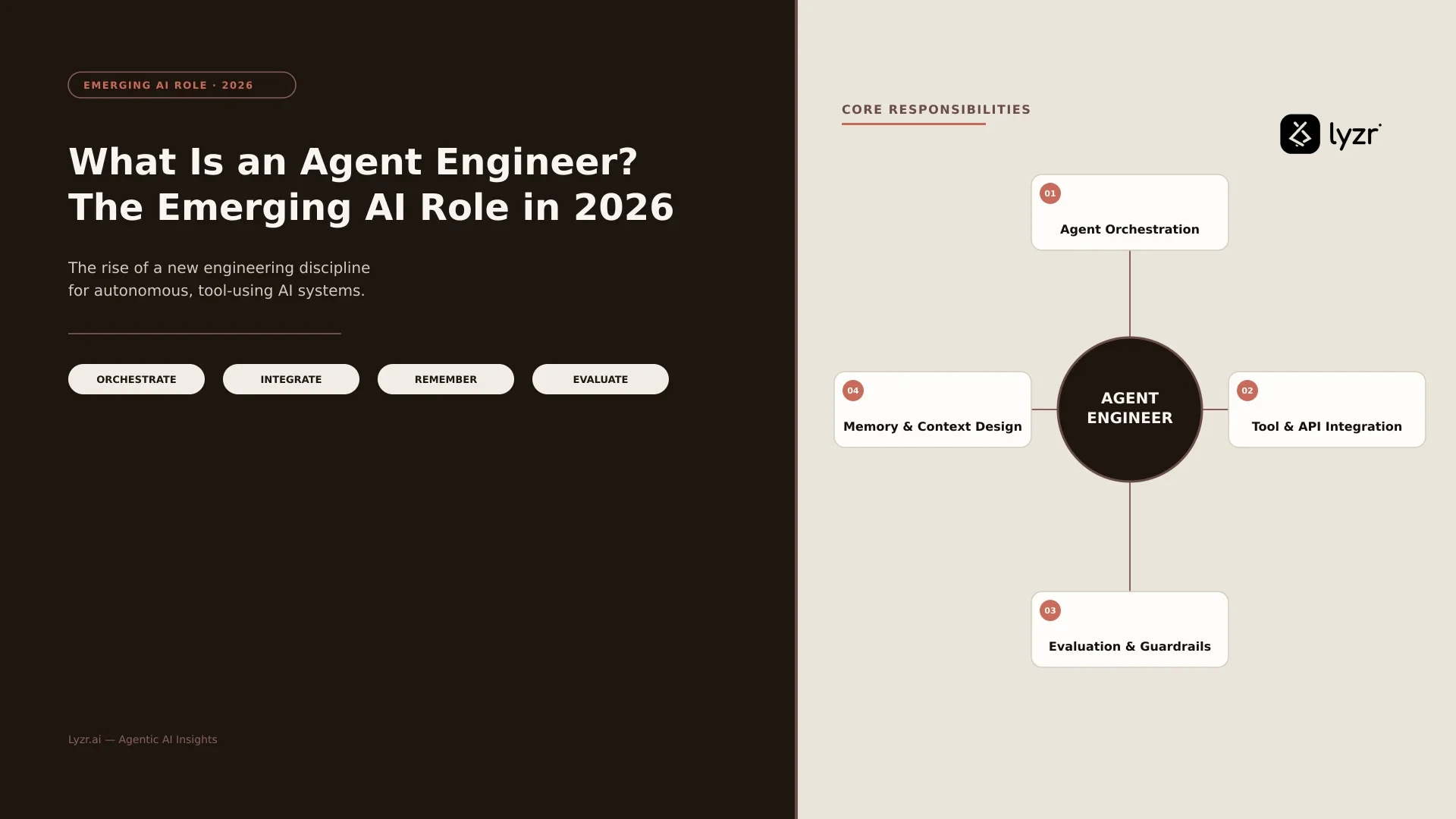
The first wave of enterprise generative AI was about single-shot outputs: summarize, draft, answer. That was largely a prompt engineering problem. Moving past single exchanges into full workflows requires building systems around the model. That means tool calling, sub-agent orchestration, memory design, and evaluation harnesses. Agent engineering is the iterative process of refining non-deterministic LLM systems into reliable production experiences.
The delta between "it works on my machine" and "it works in production" can be huge. Agents give you neither known inputs nor defined outputs. A prompt engineer optimizes what you say to the model. An AI engineer builds the product around the model. An Agent Engineer builds the system that lets the model act and stays accountable for when it acts wrong. The goal is that "the system does this reliably, every day, in production."
Defining the Role Against Its Neighbors
Prompt engineering is a real skill. It designs and optimizes instructions, system prompts, and few-shot examples to control AI model behavior. But it is a skill an Agent Engineer uses, not the whole job. The title of Prompt Engineer is increasingly seen as a skill rather than a standalone department.
AI engineering is broader. It builds applications using pre-trained AI models as components. Think of a traditional software engineer with an AI specialization. They work with LLM APIs, vector databases, and RAG pipelines. They focus on shipping features. They do not necessarily build multi-step agentic behavior.
Agent engineering sits on top of both. It requires software engineering fundamentals, including system design, API integration, and production discipline. It demands fluency in the modern agent stack: LLMs, vector databases, and agent architecture patterns. It requires evaluation, not just building. It calls for judgment about non-determinism. And it needs domain fluency.
Domain fluency matters more than many job descriptions admit. A financial services Agent Engineer and a healthcare one aren't interchangeable. The systems they build touch different regulations, different data models, and different failure modes. That is why the role sits close to platform engineering, with identity, permissions, and observability concerns, and also close to multi-agent orchestration.
Not everyone agrees that Agent Engineer should be a job title. LangChain, a company in the AI agent space, argues the opposite. Its position: "Agent engineering isn't a new job title. Instead, it's a set of responsibilities that existing teams take on when they're building systems that reason, adapt, and behave unpredictably."
LangChain's model distributes those responsibilities across existing roles. Software engineers and ML engineers write prompts, build tools, and trace tool calls. Platform engineers build agent infrastructure, including durable execution and human-in-the-loop. Product managers write prompts and define agent scope. Data scientists measure reliability.
That view has real evidence. But hiring data tells a different story. Second Talent, an engineering hiring platform, published a 2026 New AI Roles Report. It identifies AI Agent Engineer as the fastest-growing role of 2026. The report lists ten engineering job titles that did not exist in stable form three years ago. Agent Engineer leads that list.
General Motors is one established enterprise posting the title explicitly. The company's posting reads: "We are seeking an AI Agent Engineer to design, build, and operationalize AI-powered agents that enhance employee productivity and decision-making in a complex enterprise environment."
Both views have real evidence. Whether a standalone title is warranted depends on how many production agent workflows an organization runs. A company running one or two contained AI features may be fine with an AI Engineer who has agentic exposure. A company running multiple agents that hand off work, maintain state, and are trusted with real decisions needs a dedicated Agent Engineer or a small team.
Why Enterprises Are Opening These Reqs Now
The low-hanging fruit is picked. Chatbots and summarizers are done. The remaining work requires systems that touch real processes. That is why the role emerged from a bottleneck. The first wave of enterprise gen AI was single-shot outputs. The next wave is full workflows.
Gartner projects that 40% of enterprise applications will be integrated with task-specific AI agents by end of 2026, up from less than 5% today. That is a massive jump in a single year. It explains why hiring managers are scrambling to fill roles that did not exist in their HR taxonomies three years ago.
Companies are already delivering measurable outcomes with agents. Clay uses agents for prospect research, personalized outreach, and CRM updates. LinkedIn uses agents to scan talent pools for recruiting, ranking candidates and surfacing matches. These are not demos. They are production systems with real users and real consequences.
The gap between a working demo and a production system is where most agent initiatives die. Agentic systems need someone to turn rapidly evolving frameworks and model capabilities into reliable, secure, cost-effective, and reusable platform primitives. That someone is the Agent Engineer.
Enterprises that separate these concerns cleanly tend to move from pilot to production faster. The role sits close to platform engineering and multi-agent orchestration. When those concerns are tangled together, projects stall. When they are separated, teams ship.
The role is young. Its edges are still being argued over by vendors, hiring platforms, and engineers. LangChain says the responsibilities belong to existing teams. Second Talent says the title is the fastest-growing role of 2026. General Motors is hiring for it explicitly. All three can be right at the same time.
The underlying work is not optional for any company serious about moving past pilots. The gap between demo and production is where most agent initiatives die. Someone has to close that gap. Whether that someone carries the title Agent Engineer or absorbs the responsibilities into an existing role is a matter of organizational design.
The Skills That Separate Credible Candidates
Evaluation is the differentiator separating senior candidates. Most applicants can build a demo agent. Few have run one in production with testing and rollback processes. That scarcity of production experience is the real story behind job postings.
A credible Agent Engineer has software engineering fundamentals. They understand system design, API integration, and production discipline. They are fluent in the modern agent stack. They know LLMs, vector databases, and agent architecture patterns. They treat evaluation as a core part of the job, not an afterthought.
They also have judgment about non-determinism. LLMs are probabilistic. A system that works once may fail the next time. The Agent Engineer builds systems that account for that uncertainty. They design for failure. They build rollback processes. They test continuously.
Domain fluency is the final piece. A financial services Agent Engineer understands compliance and audit trails. A healthcare Agent Engineer understands HIPAA and clinical workflows. These are not interchangeable skill sets. The systems they build are different because the domains are different.
The article advises: "Don't hire for the title. Hire for the specific failure mode you're trying to prevent." That is the practical takeaway for hiring managers. A title is just a label. The failure mode is what matters.
Stay ahead of the AI curve
The most important updates, news, and content — delivered weekly.
No spam. Unsubscribe anytime.
The threshold for hiring a dedicated Agent Engineer is clear. If you are running one or two contained AI features, an AI Engineer with agentic exposure may suffice. If you are running multiple agents that hand off work, maintain state, and are trusted with real decisions, you need a dedicated Agent Engineer or a small team.
The role sits close to platform engineering. Identity, permissions, and observability are core concerns. Multi-agent orchestration is another. Enterprises that separate these concerns cleanly tend to move from pilot to production faster. That separation is an organizational choice.
Salary Snapshot for 2026
Salary data for 2026 shows a wide range. Entry-level Agent and AI Engineer base salaries typically fall between $100K and $135K. The average annual pay for an AI Agent Engineer in the US is $111,552. That figure comes from Second Talent's report.
Glassdoor puts the median AI engineer salary at $142,110. The typical range is $113,718 to $180,018. Senior roles and multi-agent specialists command higher pay. Their base range is $200K to $350K+. The full AI engineer salary range in 2026 spans $100K to $350K+.
The widest premiums go to candidates with production deployment experience. That is where the scarcity is. The AI-skill premium at entry-level is about 6% compared with equivalent non-AI technical roles. At senior levels, that premium jumps to more than 70%. The gap widens sharply with seniority.
In FAQ terms, entry-level agent engineering salaries sit around $111,000. The broader AI engineering median is around $142,000. These figures reflect the 2026 market. They will likely shift as the role matures.
The salary story is really a scarcity story. There are many people who can build a demo. There are few who can run a system in production with eval pipelines, traces, and rollbacks. Those few command the top of the range.
The AI-skill premium widens sharply with seniority. At entry-level, it is about 6%. At senior levels, it is more than 70%. That widening premium reflects the scarcity of production experience. Few candidates have run agents in production with testing and rollback processes.
What This Means for Hiring Managers
The title is still being written. But the work is real. Enterprises that separate concerns cleanly tend to move from pilot to production faster. Those that do not tend to stall. The Agent Engineer, by whatever name, is the person who makes the system work reliably, every day, in production.
The role emerged from a bottleneck. The first wave of enterprise gen AI was single-shot outputs. The second wave is multi-step workflows. That second wave requires systems that reason, plan, use tools, and act. It requires evaluation harnesses and rollback processes. It requires domain fluency and judgment about non-determinism.
The hiring manager at the mid-size insurer did not invent a new job title. She identified a failure mode she needed to prevent. Her HR system did not have a category for it three years ago. Now it does. That is how new roles are born.
The data supports the trend. Second Talent's 2026 New AI Roles Report identifies AI Agent Engineer as the fastest-growing role of 2026. Gartner projects 40% of enterprise applications will integrate task-specific AI agents by end of 2026. The salary data shows real premiums for production experience.
The article includes a FAQ section with definitions and salary answers. Entry-level agent engineering salaries sit around $111,000. The broader AI engineering median is around $142,000. Senior roles reach $200K to $350K+. The full range in 2026 is $100K to $350K+.
Clay uses agents for prospect research, personalized outreach, and CRM updates. LinkedIn uses agents to scan talent pools for recruiting, ranking candidates and surfacing matches. These are production systems. They deliver measurable outcomes. They are not demos.
The article advises hiring for the specific failure mode you are trying to prevent. That is the practical guidance. A title is just a label. The failure mode is what matters. If you are trying to prevent agents from acting wrong in production, you need an Agent Engineer.
The underlying work is not optional. Any company serious about moving past pilots needs someone to build reliable, secure, cost-effective, and reusable platform primitives. That work is the Agent Engineer's domain. The title may change. The work will not.
The gap between demo and production is where most agent initiatives die. The Agent Engineer is the person who closes that gap. They build the evaluation harnesses. They design the rollback processes. They make the system work reliably, every day, in production.
Prompt engineering is a skill. AI engineering is a discipline. Agent engineering is a system. The Agent Engineer builds the system that lets the model act and stays accountable for when it acts wrong. That accountability is the core of the role.
The salary data tells the story. Entry-level roles pay $100K to $135K. The average is $111,552. The median AI engineer salary is $142,110, with a typical range of $113,718 to $180,018. Senior roles pay $200K to $350K+. The full range in 2026 is $100K to $350K+.
The AI-skill premium is about 6% at entry-level. It is more than 70% at senior levels. That widening gap reflects the scarcity of production experience. The real story behind job postings is the scarcity of candidates with eval pipelines, traces, and rollbacks.
Enterprises that separate concerns cleanly tend to move from pilot to production faster. The Agent Engineer role sits close to platform engineering and multi-agent orchestration. When those concerns are separated, teams ship. When they are tangled, projects stall.
The title is young. Its edges are still being argued over by vendors, hiring platforms, and engineers. LangChain says the responsibilities belong to existing teams. Second Talent says the title is the fastest-growing role of 2026. General Motors is hiring for it explicitly.
The underlying work is not optional. Any company serious about moving past pilots needs to build reliable agentic systems. That work requires evaluation, judgment about non-determinism, and domain fluency. It requires software engineering fundamentals and fluency in the modern agent stack.
The role emerged from a bottleneck. The first wave of enterprise gen AI was single-shot outputs. The second wave is multi-step workflows. That second wave requires systems that reason, plan, use tools, and act. It requires someone to build those systems and stay accountable for them.
The hiring manager at the mid-size insurer posted a role that did not exist in her HR taxonomy three years ago. That is the story of 2026. The Agent Engineer is the fastest-growing role of the year. The work is real. The title is still being written.