
Back to Blog antigravity
 gemma
gemma community
 ai
ai ai
ai githubactions
 ai
ai
Testing Antigravity: Building a Data-Intensive POC at 300km/h
Patricio Navarro March 22, 2026
0 views
Introduction Last week, I spent a few hours on a Frecciarossa train from Rome to Calabria....
Introduction
Last week, I spent a few hours on a Frecciarossa train from Rome to Calabria. Usually, this is time spent catching up on emails, but I decided to use the journey to stress-test Antigravity for code development.
As a Google GDE and Data Engineer, I’m always looking for ways to streamline the "zero-to-one" phase of a project. My objective was specific: Build a functional, data-intensive Proof of Concept (POC) that I could eventually use in a GDE workshop or technical presentation.
The Smoke Test
Before trusting an AI framework with my GCP environment, I started by running through some of the more complex Antigravity examples. I wanted to see if the agent could handle intricate logic and performance-sensitive code without "hallucinating" or breaking under pressure. Once it proved it could handle high-level orchestration and optimization in these isolated tests, I knew it was ready for a real-world Data Engineering pipeline.
The Objective
The project I set out to build is an intensive data application called "Dog Finder". The goal was to create a system that could handle real-time sightings of lost dogs, process them through a reliable pipeline, and land them in a data warehouse for analysis.
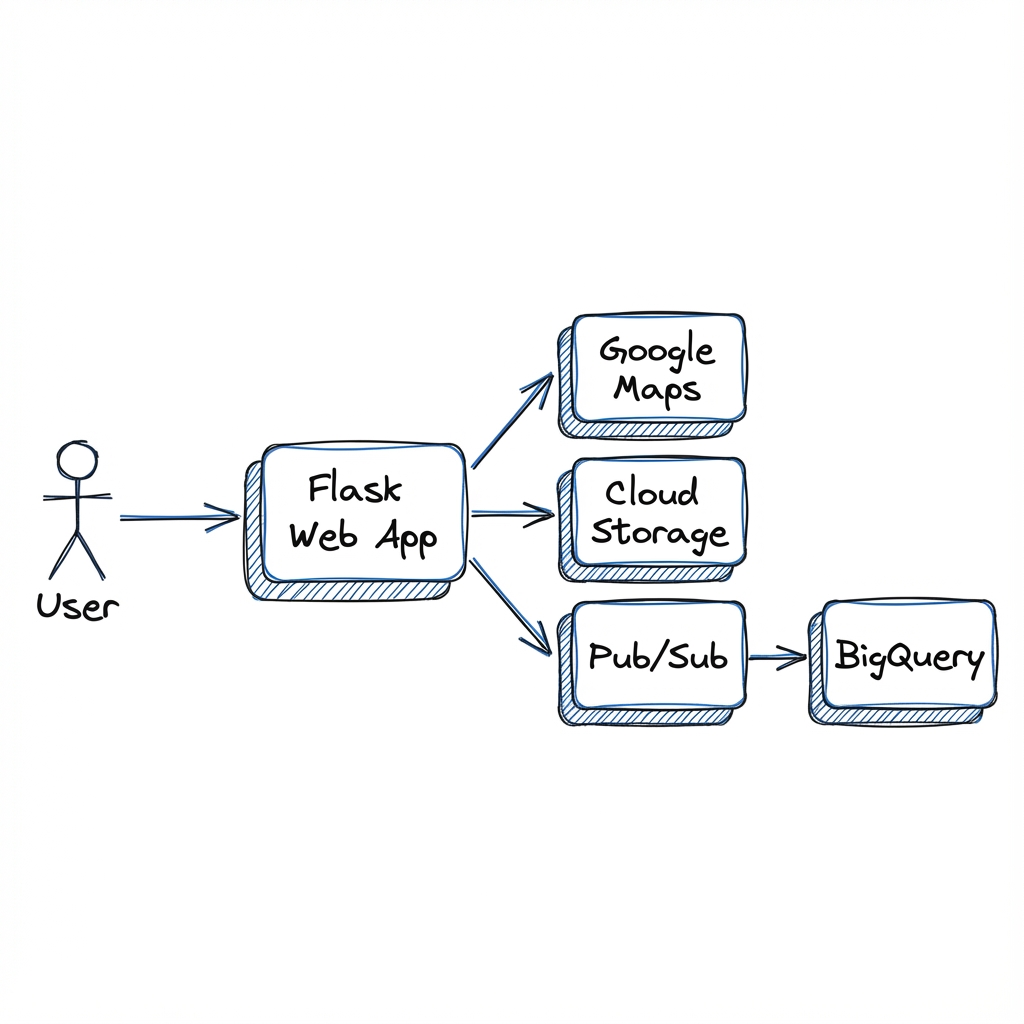
The final architecture consists of:
- Frontend/Backend: A Flask application deployed on Google Cloud Run.
- Ingestion: A Pub/Sub topic with a strict schema to ensure data quality at the entry point.
- Storage/Analytics: A BigQuery dataset with a table partitioned by
sighting_datefor cost-effective querying. - Automation: Fully idempotent shell scripts for resource provisioning and cleanup.
The Workflow: From Coder to Conductor
Working with Antigravity felt less like traditional coding and more like leading a team of mid-level developers. I was the Architect, and the AI was the execution arm.
The Proactive "Wins"
One of the most interesting aspects of the experience was the AI’s "propropositive" nature. Sometimes it suggested paths I hadn't explicitly asked for, but that added immediate value. For instance, while we were building the documentation, it suggested generating a Mermaid architecture graph directly in the README. It was a "nice-to-have" that I ended up keeping because it made the repo much more professional for a workshop setting.
The "Experience" Corrections
However, "AI-driven" doesn't mean "autopilot." I frequently had to use my experience to correct the course. In the initial infrastructure scripts, the AI took some "happy path" shortcuts that wouldn't fly in a real environment. I had to explicitly step in to enforce Data Engineering standards:
- Idempotency: I guided the agent to ensure
setup_resources.shwouldn't crash if a bucket or topic already existed. - Schema Integrity: I enforced
snake_caseanddouble precisionfor coordinates to prevent downstream data issues in BigQuery. - Refactoring: I instructed the AI to reorganize the project—moving scripts to
/scriptsand schemas to/schemas. Once the instruction was clear, the AI executed the refactor across the entire project flawlessly.
From POC to "Almost Prod-Ready"
The most impressive part of this experience was the velocity. What I initially planned as a simple POC evolved so quickly that I spent some time at home after my trip hardening it into an almost production-ready state.
Funny Fact: I was doing all of this while traveling through the tunnels of the Italian countryside. I was constantly losing my 5G connection as the train sped along. If I managed to build and deploy a full GCP data pipeline while dealing with intermittent connectivity, imagine what you can achieve with a stable fiber connection.
The Verdict
If you are an experienced developer, Antigravity is a superpower. It allows you to focus 100% of your energy on solution design and architectural tuning. You can move fast because you already know what "good" looks like and can spot the shortcuts the AI might try to take.
For junior developers, my advice is to go easy. It allows you to arrive at a working result very quickly, but "working" isn't always "ideal." Use it to learn, but always question the architectural choices it makes for you.
You can check out the full project and the result of this high-speed experiment here:
{% embed https://github.com/patricio-navarro/dog_finder_app %}
Comments
More Blog
View allgemmaFive Gemma-4 models, one accelerator: what porting E2B 31B to AWS Inferentia2 taught me
I ported the whole Gemma-4 family — E2B, E4B, 12B, 31B, and the 26B-A4B MoE — to run on...
X
xbillcommunityHey DEV, I'm Tobore. Let's actually connect.
Hey DEV, I'm Tobore. Let's actually connect. I've been on here for a while now, mostly writing and...
L
Laurina AyarahaiI burned through thousands of AI tokens. Then a friend did it for free
(yep, kinda clickbait, just for the funsies 😊) At the beginning of the year, I relaunched my...
P
Paulo HenriqueaiClaude might be saturating your machine
My laptop was sitting idle with the fan at full tilt. Nothing was running that I knew of. The culprit...
S
Sidhant PandagithubactionsAutomated GitHub Code Reviews Using Google Gemini
I Built a Thing! TL;DR — Google Gemini-based Pull Request reviews and Issue Triaging for...
D
Darren "Dazbo" LesteraiWhat is an "agentic harness," actually?
I've been hearing the word "harness" thrown around a lot lately. I assumed it just meant "the IDE" or...
T
Tilde A. ThuriumReady-made automations for this
Workflows from the Neura Market marketplace related to this DeepSeek resource
- Extract Data from YAPE Receipts via Telegram OCR and Store in Google Sheetsn8n · $24.99 · Related topic
- Daily Insight Email from Structured Web Data with Firecrawln8n · $14.99 · Related topic
- Extract Text from Images & PDFs via Telegram with Mistral OCR to Markdownn8n · $24.99 · Related topic
- Bright Data-Powered Competitive Price Lookup and Report Generatorn8n · $14.99 · Related topic