
Back to Blog productivity
 gemma
gemma community
 ai
ai ai
ai githubactions
 ai
ai
Building Stdout: A Local-First Developer Toolkit for Privacy-Focused Workflows
Chung Ho March 6, 2026
0 views
In fintech, a single leaked payload isn't just a bug—it's a compliance incident. That anxiety of...
In fintech, a single leaked payload isn't just a bug—it's a compliance incident. That anxiety of pasting production JSON into an online formatter is what killed my flow. So I built stdout: a local-first workspace where privacy isn't a feature, it's the architecture.
The Problem: When Convenience Conflicts with Compliance
As a Tech Lead working on multi-country lending products, I handle sensitive data daily: merchant KYC payloads, API keys, transaction logs, and loan calculation schemas.
The workflow was familiar:
- Copy a production payload for debugging
- Open an online JSON formatter / JWT decoder / base64 tool
- Paste → process → copy result → move on
But step 3 always came with a quiet question: "Did this page just send my data somewhere?"
The Invisible Tracking Risk
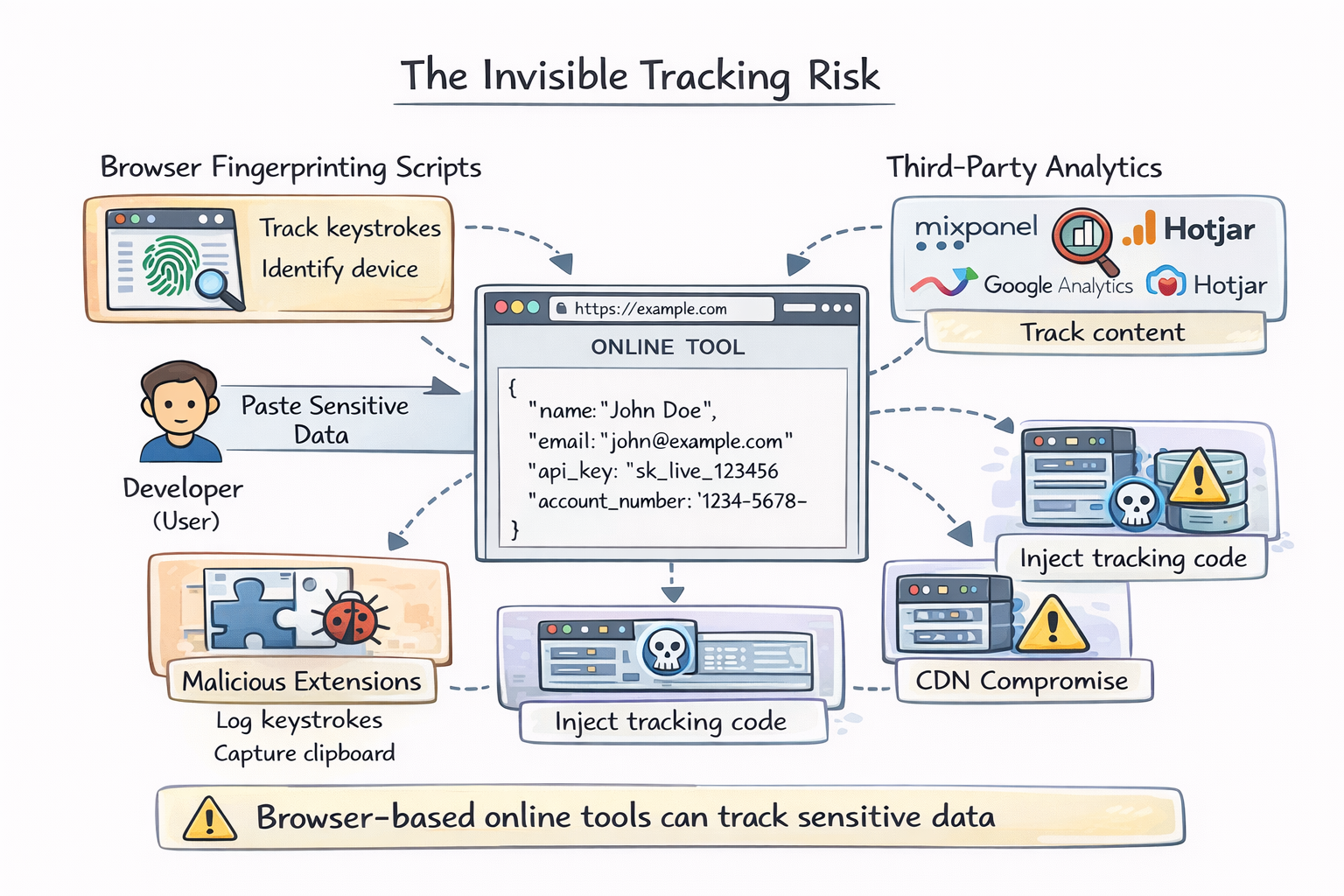
Even if a tool claims not to store your data, the modern web is rarely that simple. When you paste sensitive merchant data into a browser-based editor, you're potentially exposing it to:
- Browser fingerprinting scripts that log input patterns
- Third-party analytics (Mixpanel, GA, Hotjar) capturing DOM content
- Malicious browser extensions with content-script access
- CDN compromises injecting telemetry via compromised dependencies
For a lending platform operating across VN, TH, PH, HK, ID with country-specific compliance rules, this isn't paranoia—it's threat modeling. A single leaked KYC document or loan schema could trigger regulatory scrutiny, merchant trust erosion, or worse.
I didn't need another online tool. I needed a trusted local workspace that respected the constraints of real-world engineering: air-gapped environments, compliance boundaries, and the simple desire to keep sensitive data on my machine.
The Solution: Local-First by Design, Not by Accident
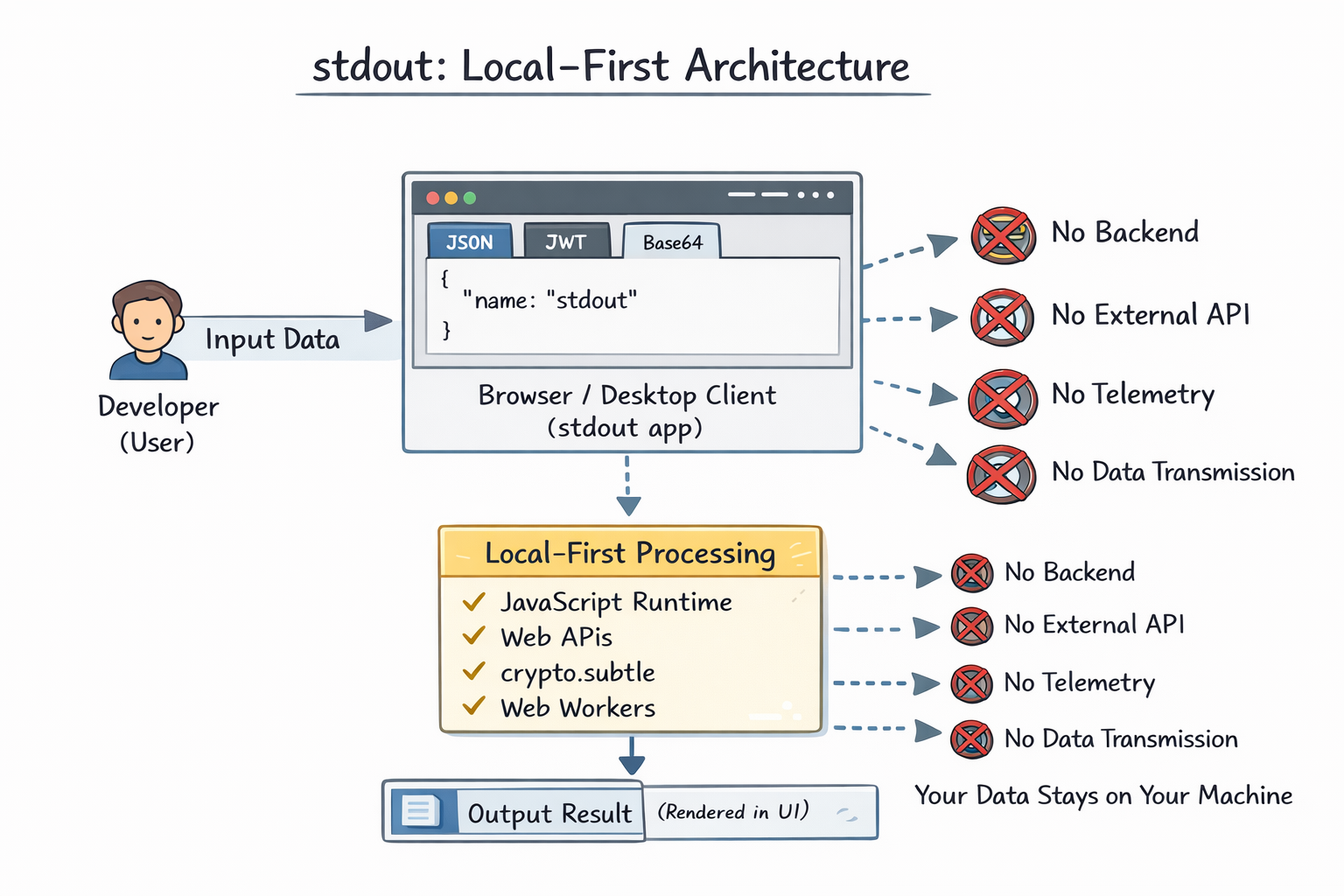
stdout started as a personal scratchpad and evolved into a modular toolkit with 50+ developer utilities—running entirely in your browser, with zero backend, zero telemetry, zero network requests after initial load.
Core Architecture Principles
| Principle | Why It Matters | Implementation |
|---|---|---|
| Zero-backend | No server = no attack surface, no compliance review, no operational overhead | Static hosting (Cloudflare Pages/Vercel), all logic in-client |
| Local-first data flow | Your data never leaves your machine unless you explicitly export it | No fetch calls to external APIs for tool processing; optional user-controlled exports |
| Modular registry | Scale to 100+ tools without bloating the initial bundle | Lazy-loaded tool modules via dynamic imports; shared context via Zustand |
| Progressive enhancement | Works offline, installs as PWA, optional Electron wrapper for power users | Service workers for caching; Electron build for system-level integrations |
The "Hero Tools" — Where Local-First Shines
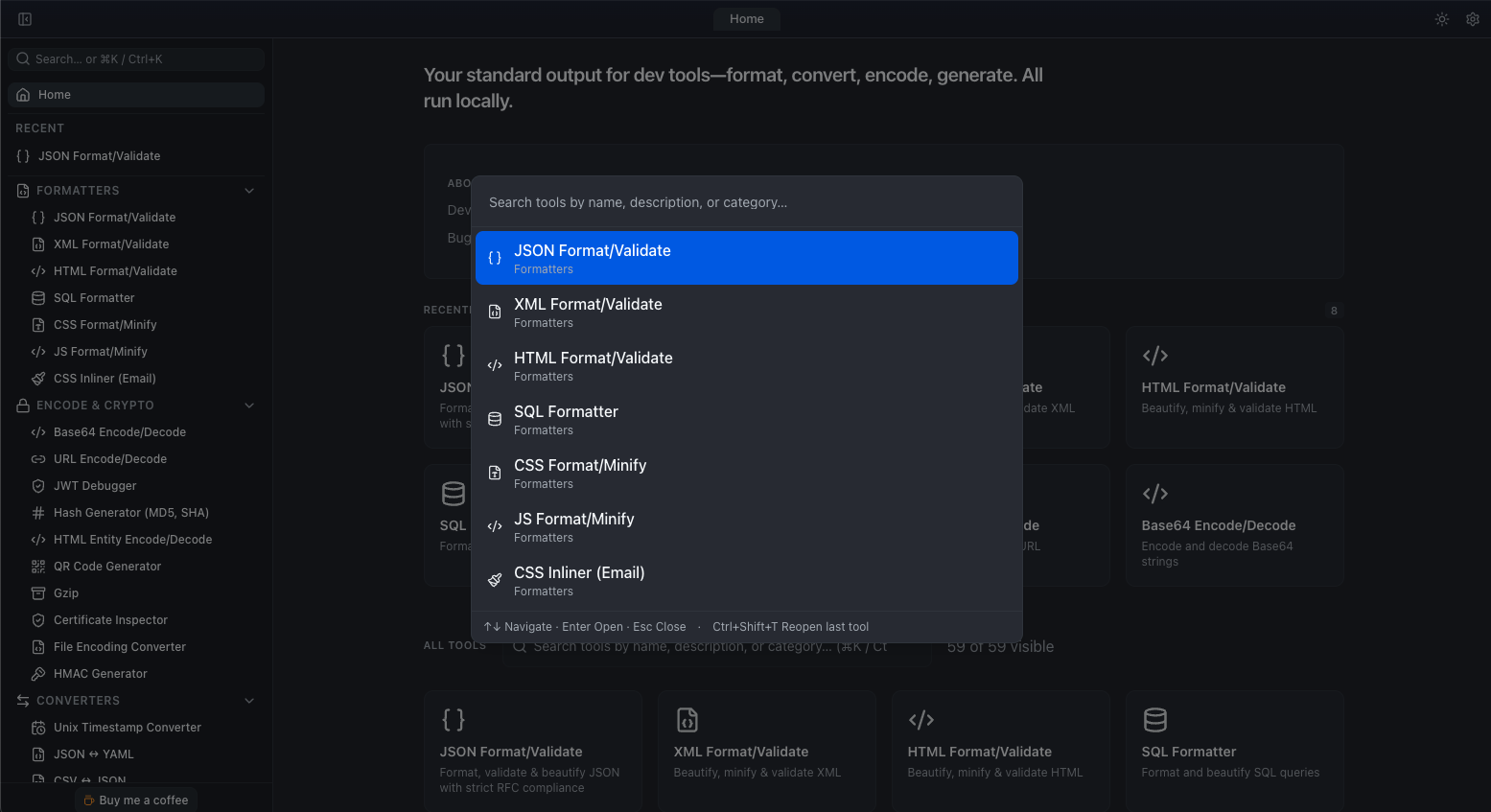
Instead of listing all 50+ utilities, here are 3 that demonstrate the philosophy:
-
JWT Debugger (Local)
Decode and verify tokens without sending them to a third-party server. Supports HS256/RS256 with local key input. No network, no logs, no surprises. -
Payload Sanitizer
Paste production JSON → auto-mask PII fields (email, phone, account numbers) based on configurable rules → copy sanitized output. Built for fintech debugging workflows. -
Webhook Replay Lab
Simulate webhook signatures locally using your secret key. Test signature verification logic without hitting staging endpoints or leaking test data.
These aren't just "tools that work offline". They're trust primitives: operations that were previously risky to delegate to the cloud, now safely brought back to your machine.
Technical Trade-offs: What You Gain, What You Give Up
Building local-first isn't free. Here are the real trade-offs I navigated:
Gains
- Security boundary by architecture: No backend means no SQL injection, no auth bypass, no data breach surface.
- Zero marginal cost: Hosting static assets is cheap; scaling is just CDN distribution.
- User trust as differentiator: In a world of "free tools that sell your data", being verifiably local is a feature.
Challenges
- Performance with large payloads: Processing 10MB+ JSON in-browser requires careful memory management. Solution: Web Workers for heavy parsing, with progress feedback.
- State management across tools: With 50+ modules, sharing clipboard history or preferences needed a lightweight global store. Solution: Zustand with persisted middleware (localStorage, user-controlled).
- Discoverability vs. bundle size: Lazy-loading solves bundle bloat, but how do users find tools? Solution: Command palette (Ctrl+K) + fuzzy search, indexed at build time.
🔍 Verifying the "Zero Network" Claim
Skepticism is healthy. Here's how I validate the privacy guarantee:
- Audit network tab during tool usage
- Run Lighthouse with network throttling to "Offline"
- Check source for fetch/XMLHttpRequest outside of explicit export flows
- Optional: build from source and verify no telemetry SDKs
The promise isn't "trust me". It's "verify me".
What's Next: From Utility to Workflow Memory
The current version of stdout is deliberately stateless: refresh the page, and your work is gone. This keeps the core simple and privacy-preserving.
But I'm exploring an optional, user-controlled sync layer—not for your data, but for your workflow memory:
- Saved snippet libraries (encrypted, client-side key)
- Tool preferences and presets
- Session restoration across devices
The core remains free, local, and open. The value-add would be continuity: picking up your debugging context on another machine without compromising the local-first guarantee.
Would you pay for "context portability" or keep everything strictly local? This isn't a rhetorical question—I'm gathering signals before building. Let's discuss.
Try It, Break It, Make It Yours
- 🌐 Web app: stdout (PWA, works offline)
- 💻 Desktop: Electron builds via Homebrew / direct download
- 🔨 Contribute: Modular registry makes adding tools straightforward; PRs welcome
If you build with constraints like compliance, air-gapped envs, or just value data sovereignty—I'd love to hear which tools matter most to your workflow.
stdout is a product experiment, a distribution lab, and a case study in "free utility → optional SaaS" evolution. Built in public, because transparency is the only sustainable trust model.
Comments
More Blog
View allgemmaFive Gemma-4 models, one accelerator: what porting E2B 31B to AWS Inferentia2 taught me
I ported the whole Gemma-4 family — E2B, E4B, 12B, 31B, and the 26B-A4B MoE — to run on...
X
xbillcommunityHey DEV, I'm Tobore. Let's actually connect.
Hey DEV, I'm Tobore. Let's actually connect. I've been on here for a while now, mostly writing and...
L
Laurina AyarahaiI burned through thousands of AI tokens. Then a friend did it for free
(yep, kinda clickbait, just for the funsies 😊) At the beginning of the year, I relaunched my...
P
Paulo HenriqueaiClaude might be saturating your machine
My laptop was sitting idle with the fan at full tilt. Nothing was running that I knew of. The culprit...
S
Sidhant PandagithubactionsAutomated GitHub Code Reviews Using Google Gemini
I Built a Thing! TL;DR — Google Gemini-based Pull Request reviews and Issue Triaging for...
D
Darren "Dazbo" LesteraiWhat is an "agentic harness," actually?
I've been hearing the word "harness" thrown around a lot lately. I assumed it just meant "the IDE" or...
T
Tilde A. ThuriumReady-made automations for this
Workflows from the Neura Market marketplace related to this DeepSeek resource
- Intelligent AI Digest for Security, Privacy, and Compliance Feedsn8n · $24.99 · Related topic
- AI Privacy-Minded Router: PII Detection for Privacy, Security, & Compliancen8n · $14.99 · Related topic
- EPA Clean Water Act Data Access & Compliance Monitoring API Integrationn8n · $24.99 · Related topic
- Building a RAG Chatbot for Movie Recommendations with Qdrant and OpenAIn8n · $14.99 · Related topic