
Back to Blog ui
ui gemma
gemma community
 ai
ai ai
ai githubactions
 ai
ai
Turning Missing Avatars into a Design Opportunity
Bansal February 17, 2026
0 views
We’ve all seen it — the awkward blank circle, the grey silhouette, or the predictable two-letter...
We’ve all seen it — the awkward blank circle, the grey silhouette, or the predictable two-letter initials when someone hasn’t uploaded a profile photo.
Missing avatars feel like a tiny detail, but they influence how polished a product appears. When an interface handles these moments thoughtfully, it feels intentional. When it doesn’t, it feels unfinished.
While building UI components recently, I found myself wanting something better than initials.
That’s how the mesh gradient placeholder idea began.
The Problem with Initials
Initial-based avatars are everywhere because they’re simple.
But after working with dense lists and profile-heavy interfaces, the drawbacks become obvious. They look repetitive. They add visual noise. Multiple users with the same initials become indistinguishable. And visually, they feel purely functional rather than pleasant.
When a screen fills with identical “JS” or “AK” bubbles, the placeholder stops helping.
I wanted something that felt cleaner, more distinctive, and easier on the eyes.
A Different Approach
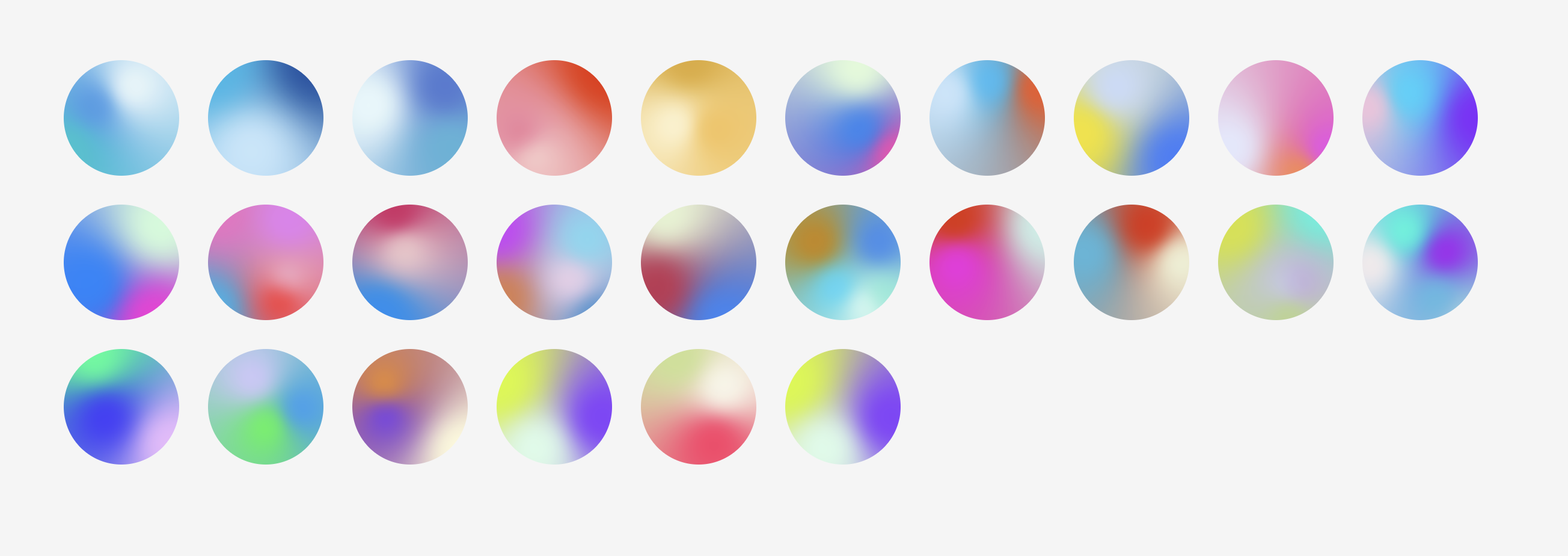
Instead of showing initials when an avatar is missing, I tried replacing them with soft mesh gradients.
The idea was simple: map a gradient to the first letter of a name and keep it consistent. “A” always receives the same gradient, “B” another, and so on through the alphabet.
This preserves recognizability while making the interface feel more alive. The result doesn’t feel like a fallback — it feels like a design decision.

Why Mesh Gradients Work
Mesh gradients have a softness that flat colors lack. They feel organic and modern without demanding attention. The gentle blending avoids harsh edges and sits comfortably within both light and dark themes.
More importantly, they introduce variation without adding clutter. Instead of repeating identical shapes, the interface gains subtle depth and warmth.
It’s a small change, but it removes the mechanical feel that placeholders often introduce.
Creating a Set That Feels Balanced
To make this practical, I generated hundreds of mesh gradients and curated a set of twenty-six — one for each letter. The goal wasn’t randomness; it was harmony. Each gradient needed to feel calm, distinct, and consistent with the others.
I used a mesh gradient generator to explore variations and refine the palette
Once mapped to letters, missing avatars retained a visual identity without requiring any extra input from users.
Beyond Avatars
After using gradients for avatars, I began noticing other places where the same idea worked just as well.
Blog cards without thumbnails no longer looked broken. Link previews and OG images felt complete instead of empty. Even loading states felt calmer when a subtle gradient filled the space.
These small adjustments improved the visual rhythm of the interface. Nothing felt missing; everything felt intentional.
Designing for Interfaces with People
If you’re building anything centered around people — comments, teams, founder communities like PitchWall, or collaboration tools — identity cues become important very quickly. When many profiles appear together, identical placeholders blur into each other. Subtle gradient variations provide differentiation without adding labels, badges, or extra visual clutter.
Designing for Absence
Good interface design isn’t only about what is present. It’s also about how the system behaves when something is missing.
Users may never consciously notice avatar placeholders. But they do feel the difference between an interface that looks incomplete and one that feels thoughtfully finished.
Sometimes, improving a product isn’t about adding more — it’s about handling the empty spaces better.
Comments
More Blog
View allgemmaFive Gemma-4 models, one accelerator: what porting E2B 31B to AWS Inferentia2 taught me
I ported the whole Gemma-4 family — E2B, E4B, 12B, 31B, and the 26B-A4B MoE — to run on...
X
xbillcommunityHey DEV, I'm Tobore. Let's actually connect.
Hey DEV, I'm Tobore. Let's actually connect. I've been on here for a while now, mostly writing and...
L
Laurina AyarahaiI burned through thousands of AI tokens. Then a friend did it for free
(yep, kinda clickbait, just for the funsies 😊) At the beginning of the year, I relaunched my...
P
Paulo HenriqueaiClaude might be saturating your machine
My laptop was sitting idle with the fan at full tilt. Nothing was running that I knew of. The culprit...
S
Sidhant PandagithubactionsAutomated GitHub Code Reviews Using Google Gemini
I Built a Thing! TL;DR — Google Gemini-based Pull Request reviews and Issue Triaging for...
D
Darren "Dazbo" LesteraiWhat is an "agentic harness," actually?
I've been hearing the word "harness" thrown around a lot lately. I assumed it just meant "the IDE" or...
T
Tilde A. ThuriumReady-made automations for this
Workflows from the Neura Market marketplace related to this DeepSeek resource
- Automate Blog Content Creation with Notion MCP, DeepSeek AI, and WordPressn8n · $9.99 · Related topic
- Generate AI Videos from Scripts with DeepSeek, Synthesia, and Together.ain8n · $24.99 · Related topic
- Compare Multi-Period Financial Data from Google Sheets with DeepSeek AI Analysisn8n · $14.99 · Related topic
- PostgreSQL Conversational Agent with Claude & DeepSeek (Multi-KPI, Secure)n8n · $14.99 · Related topic