
Back to Blog claudecode
 cursor
 ai
ai amazonbedrock
 ai
ai ai
ai mcp
mcp
Your AI agent is lying to you — and your CLAUDE.md is why
keterslayter March 16, 2026
0 views
TL;DR — Your AI coding agent's quality is capped by the quality of its context. Most devs have...
cover_image: https://raw.githubusercontent.com/rely-ai-org/caliber/master/assets/social-preview.png
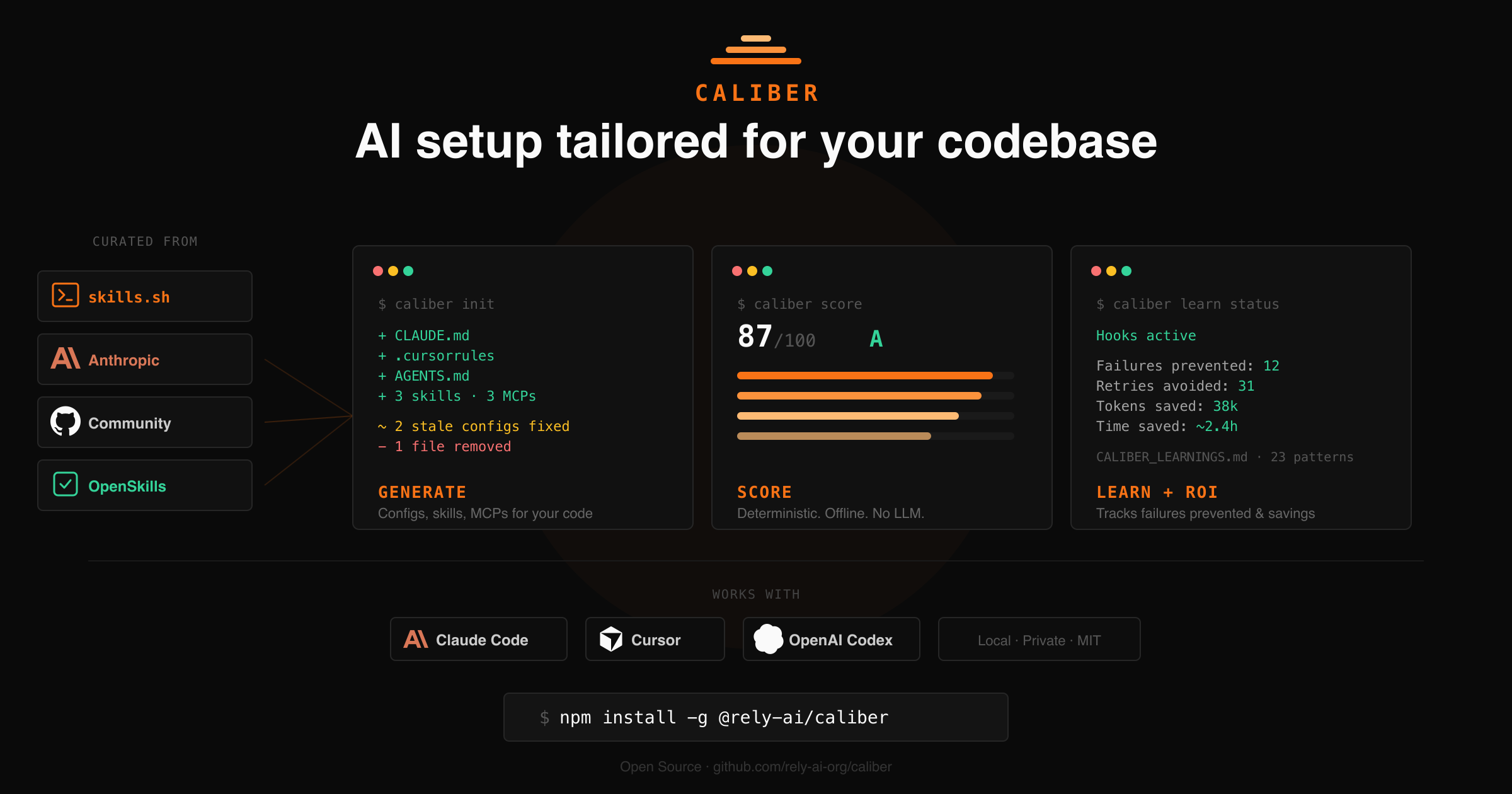
TL;DR — Your AI coding agent's quality is capped by the quality of its context. Most devs have stale, generic, or missing CLAUDE.md / .cursorrules files. Caliber fixes this in one command — scans your repo, generates tailored configs, recommends MCPs, and gives you a 0-100 setup score.<br>---<br>## The problem nobody talks about<br>Everyone's debating which AI coding tool is best — Claude Code vs Cursor vs Codex. Meanwhile, the real reason most developers aren't getting great results is upstream of all of them:<br>Their project context is wrong.<br>Your
CLAUDE.mdwas written in 20 minutes when you first set up the project. Your.cursorruleswas copy-pasted from a Reddit thread. Neither has been touched since.<br>And your AI agent is making decisions based on that stale, inaccurate information every single session.<br>## What bad context actually looks like<br>Here are the most common failure modes I've seen:<br>🚨 Stale architecture — YourCLAUDE.mdsays you use REST APIs but you migrated to GraphQL 3 months ago. The agent keeps generating REST patterns.<br>🚨 Contradictory rules — Old rules say "use CommonJS", newer ones say "use ESM". The agent picks one arbitrarily.<br>🚨 No MCP coverage — You're running PostgreSQL and there's a great Postgres MCP that would let your agent query your schema directly. You've never heard of it.<br>🚨 Config drift — You refactor every week. Your AI config was updated once, on day one.<br>🚨 Team inconsistency — One dev has MCPs set up, another doesn't. Rules differ across machines. There's no source of truth.<br>## Meet Caliber<br>Caliber is a CLI tool that solves this with one command. It scans your project and:<br>- ✅ Generates a tailoredCLAUDE.mdwith your actual stack, architecture, and commands<br>- ✅ Creates.cursorrules/.cursor/rules/*.mdcmatching your dependencies<br>- ✅ Recommends MCPs you should install based on what you're running<br>- ✅ Deletes stale rules that contradict your current code<br>- ✅ Scores your setup 0–100 across 6 dimensions<br>And it can run continuously — so configs stay fresh as your code evolves.<br>## See it in action<br>Here's whatcaliber initlooks like on a real Next.js + TypeScript project:<br>bash<br>$ caliber init<br>Scanning project structure...<br>Detected: TypeScript, React, Next.js, Tailwind CSS<br>Detected: 847 files, 12 dependencies with AI relevance<br>Config files:<br>+ create CLAUDE.md project context<br>+ create .cursorrules cursor rules<br>~ modify .cursor/rules/testing.mdc outdated patterns<br>- delete .claude/rules/old-api.md stale, contradicts code<br>Skills:<br>+ create .claude/skills/deploy.md deploy flow<br>+ create .cursor/skills/review.md code review<br>MCP Recommendations:<br> • @modelcontextprotocol/server-postgres (detected: pg in package.json)<br> • @modelcontextprotocol/server-github (detected: .git, gh-cli)<br> • @upstash/context7-mcp (detected: React 18+)<br><br>Notice it's not just adding files — it also deletes stale ones and modifies outdated patterns.<br>## The setup score: caliber score<br>This is my favorite feature. Runcaliber scoreon any project and get a deterministic 0–100 grade — no LLM needed, works offline.<br>bash<br>$ caliber score<br>Score: 87/100 Grade: A<br>Existence 23/25 • Config files present, cross-platform parity<br>Quality 22/25 • Commands documented, no bloat, no vague rules<br>Coverage 18/20 • Dependencies & services reflected in configs<br>Accuracy 13/15 • Documented commands & paths actually exist<br>Freshness 8/10 • Config recency, no leaked secrets<br>Bonus 3/5 • Hooks, AGENTS.md, OpenSkills format<br><br>This gives you an objective baseline before onboarding a new dev, switching AI tools, or auditing your setup.<br>## The full CLI — 4 commands, that's it<br>| Command | What it does |<br>|---|---|<br>|caliber init| Scan repo, generate/update all config files |<br>|caliber score| Rate your setup 0–100 (offline, no LLM) |<br>|caliber recommend| Discover MCPs and skills for your stack |<br>|caliber config| Set provider, API key, model |<br>Works with: Claude Code, Cursor, OpenAI Codex<br>No API key needed with Claude Code or Cursor — uses your existing subscription.<br>## Why this matters for teams<br>This isn't just a solo-dev tool. The consistency problem is worse at the team level:<br>> "One dev has MCPs configured, another doesn't. Cursor rules differ across machines. Nobody knows which CLAUDE.md is the canonical one."<br>With Caliber, you commit your configs to git like any other file. Every developer who runscaliber initgets the same baseline — and the same AI agent experience. New team members are set up in 30 seconds.<br>## Get started in 30 seconds<br>bash<br>npm install -g @rely-ai/caliber<br>caliber init<br><br>That's it. No API key needed if you're on Claude Code or Cursor.<br>🔗 GitHub: https://github.com/rely-ai-org/caliber<br>📦 npm: https://www.npmjs.com/package/@rely-ai/caliber<br>💬 Discord: https://discord.gg/XUNaJEsw<br>MIT licensed. Open source. Your code never leaves your machine.<br>---<br>Built at Rely AI. If this saved you time, a ⭐ on GitHub goes a long way — and PRs are very welcome.
Comments
More Blog
View allcursorCursor Automations in 2026: wire event-triggered coding agents to Slack, CI, and timers
Cursor Automations in 2026: wire event-triggered coding agents to Slack, CI, and...
M
Manu ShuklaaiIndex Everything, or Read Everything? The Dilemma of Feeding Specs to AI in Multi-Repo Development
The specs exist. The AI just can't see them. I've always been the type who builds hobby...
S
Shunya ShidaamazonbedrockConnect Claude Code, Cursor and Codex to Amazon Bedrock's new console (2026)
Connect Claude Code, Cursor and Codex to Amazon Bedrock's new console (2026) Summary. On 5...
M
Manu ShuklaaiSpotting AI UI is too easy
There is a weird uncanny valley with LLM-generated UI right now. The code functions perfectly, but if...
H
Harish .saiSeven ranking frameworks, one search page, zero translation tables
I went down a rabbit hole this morning reading the late-2025 Juejin AI roundups side by side, and the...
N
ninghonggangmcpZendesk MCP: Let Claude Handle Your Support Tickets
Install guide and config at curatedmcp.com Zendesk MCP: Let Claude Handle Your Support...
C
curatedmcpReady-made automations for this
Workflows from the Neura Market marketplace related to this Cursor resource
- Full Blog Content Automation with GPT-4, Claude & Ghost CMS Publishern8n · $24.99 · Related topic
- Automate Shopify SEO Content Creation with GPT-4 & Claude Multi-Agent Systemn8n · $24.99 · Related topic
- PostgreSQL Conversational Agent with Claude & DeepSeek (Multi-KPI, Secure)n8n · $14.99 · Related topic
- AI Blog Post Journalist: Perplexity for Research, Anthropic Claude for Blogn8n · $9.99 · Related topic