Business Operations & ERPs Automation Workflows — Page 5 | Neura Market
    Neura Market
    Neura Market
    /Categories
    Marketplace
    Directories
    Resources
    Home/Categories/Business Operations & ERPs

    Business Operations & ERPs Workflows

    Enterprise resource planning and operations

    • Automate Webpage Change Detection and Notifications with Google Suite

      Monitor webpage content changes and receive notifications via Google Suite when updates occur. Ideal for tracking important documents like company policies or competitor pages.

      n8n$9.99
    • AI Multi-Stop Planner for Circular Logistics with GP-40 & Open Route API

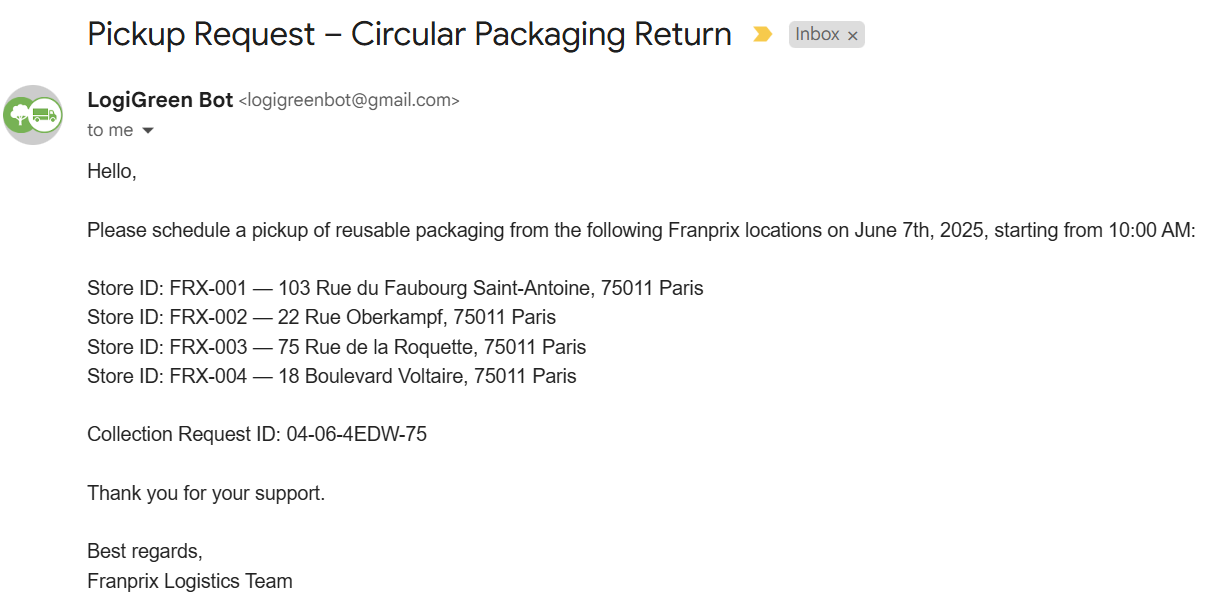
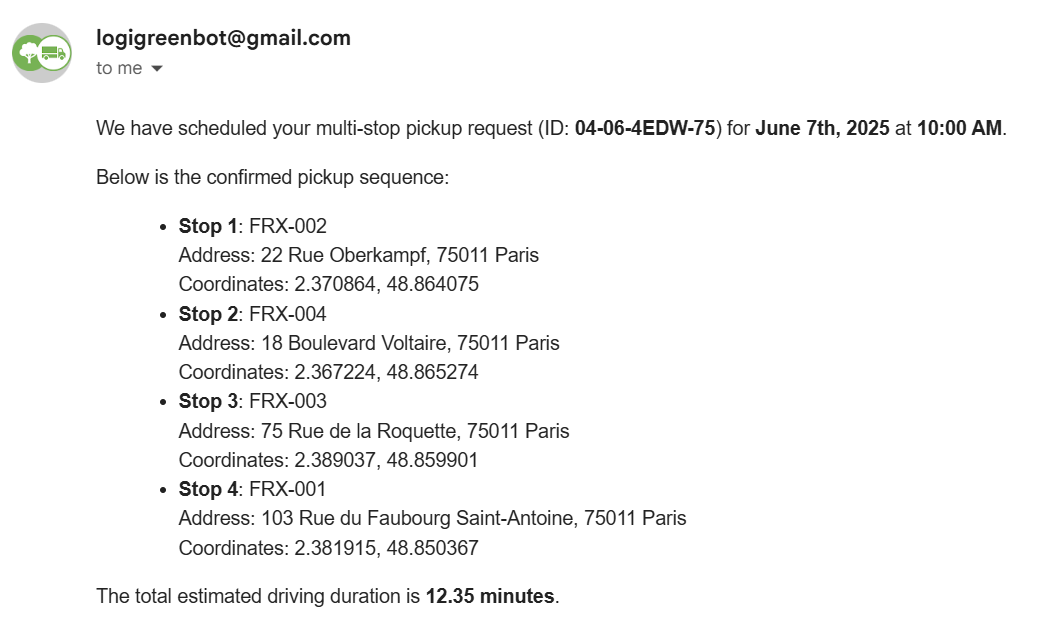
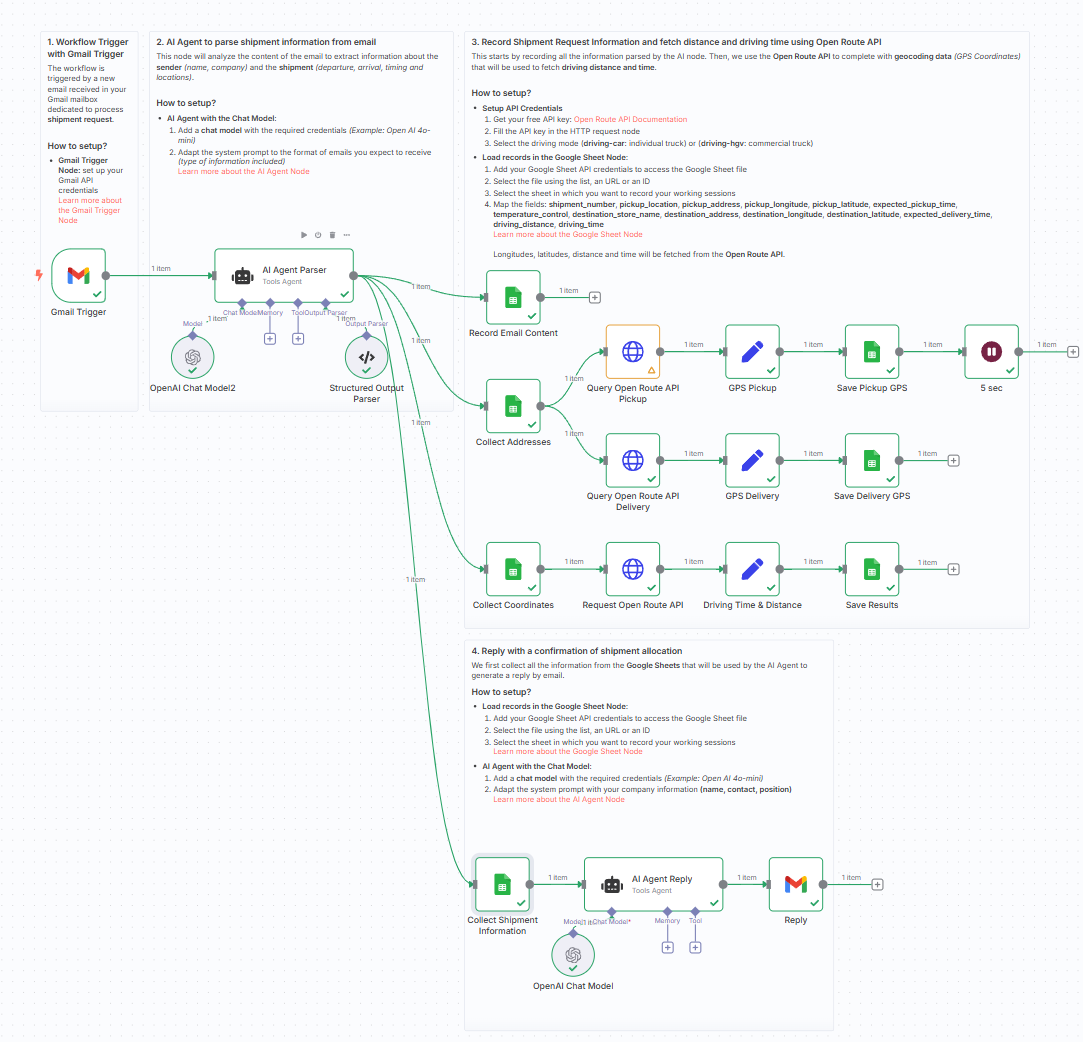
      **Tags**: AI Agent, Supply Chain, Logistics, Circular Economy, Route Planning, Transportation, GPS API ### Context Hi! I'm Samir, a Supply Chain Engineer and Data Scientist based in Paris, and founder of [LogiGreen Consulting](https://logi-green.com). I help logistics teams reduce operational workload and errors by combining **AI automation**, **route optimization APIs**, and **workflow automation**. This workflow is part of a **circular economy project**, where stores return **reusable packaging** (bins, crates, containers) to a central warehouse. > Let's support circular economies with AI-powered automation using n8n! For business inquiries, you can find me on [LinkedIn](https://www.linkedin.com/in/samir-saci) ### Who is this template for? This workflow is designed for logistics teams participating in **circular economy loops**. Let us imagine your transportation company receives this **pickup request**: ![Example of Results](https://www.samirsaci.com/content/images/2025/06/image-15.png) The two **AI Agent nodes** connected to **Openroute Service API** will process the information and reply with the **detailed route plan**. ![Workflow](https://www.samirsaci.com/content/images/2025/06/image-16.png) The results include **driving time** and the **optimal sequence** of stops generated by the multi-stop optimization endpoint of the API. ### How does it work? This workflow automates the end-to-end processing of **multi-stop pickup requests for reusable packaging**: - A Gmail trigger listens for collection request emails - AI Agent parses the email into structured data (store ID, address, date) - Each stop is geocoded into GPS coordinates - OpenRouteService **optimizes the stop sequence** using truck-specific routing - A second AI Agent formats a **confirmation email in HTML** with the ordered pickup plan - The reply is sent back with all details including duration and route ### Steps: 1. Trigger on a new Gmail message 2. Extract data using AI Agent (e.g., stores, addresses, times) 3. Store raw and processed data in Google Sheets 4. Enrich with GPS coordinates 5. Optimize route using OpenRouteService (truck profile) 6. Format the confirmation using an AI Agent 7. Send reply to requester with route and timing ![workflow](https://www.samirsaci.com/content/images/size/w1000/2025/06/image-14.png) ### What do I need to get started? You'll need: - A **Gmail account** to receive collection requests - A **Google Sheet** to store and review data - A free [OpenRouteService API key](https://openrouteservice.org/dev/#/signup) - Access to OpenAI for using AI Agent nodes - Sample pickup request emails to test ### Next Steps - Use the sticky notes inside the n8n canvas to: - Plug in your Gmail and OpenRouteService credentials - Try with a sample store collection email - Validate the confirmation format and route accuracy *This template was built using n8n v1.93.0* *Submitted: June 7, 2025*
    Marketplace

    • Prompts
    • Workflows
    • Agent Hub
    • Workflow Packs
    • Categories
    • Marketplace

    Directories

    • AI Tools Directory
    • ChatGPT
    • Claude
    • Gemini
    • Cursor
    • Grok
    • DeepSeek
    • Perplexity
    • CoPilot
    • Midjourney
    • Stable Diffusion
    • MCP Servers
    • .md Directory
    • All Directories

    Free Tools

    • AI Text Humanizer
    • AI Content Detector
    • Workflow Generator
    • Model Comparison
    • AI Pricing Calculator
    • AI Benchmarks
    • ROI Calculator
    • All Free Tools

    Resources

    • AI News
    • Blog
    • AI Answers
    • Error Solutions
    • AI Tutorials
    • AI Agent Guides
    • AI Models
    • Integrations
    • Alternatives
    • n8n vs Zapier
    • Make vs Zapier
    • n8n vs Make
    • Resource Library
    • Documentation
    • API Access to Our Data

    Community

    • AI Newsletter
    • AI Jobs
    • AI Events
    • AI Companies
    • Start Selling
    • Sell n8n Workflows
    • Sell AI Agents
    • Sell Prompts
    • Creator Guide
    • Advertise
    • Affiliates

    Company

    • About
    • Contact
    • Help
    • Careers
    • Pricing
    • Terms
    • Privacy
    • License
    • DMCA

    The #1 Newsletter in AI

    Weekly updates, news, and content that matter.

    Neura Market Logoneuramarket

    © 2026 Neura Market. All rights reserved.

    n8n$14.99
  1. Sell a Used Car with an AI Agent on Airtop

    ### How to Sell Your Used Car Easily with Airtop Selling a used car traditionally involves tedious manual steps: listing your vehicle online, filling repetitive forms, answering buyer inquiries, and comparing multiple offers—often leading to lost time, inaccuracies, and missed opportunities. Dealers' platforms and marketplace websites can introduce additional friction, occasionally requiring manual interactions and delivering inconsistent offers. The Sell a Used Car Agent powered by Airtop and n8n eliminates this friction by automating the selling process. Simply input your car's details once, and the automation quickly navigates through popular used car marketplaces like Carvana, CarMax, and others, efficiently fetching competitive buying offers. Leveraging Airtop's powerful real-browser automation capabilities, this setup interacts smoothly with the forms and queries specific to each sales platform, eliminating error-prone manual entries and tedious repetition. This Airtop automation employs sophisticated data extraction features, including structured JSON output, ensuring accurate, formatted data ready for immediate review. Say goodbye to cumbersome listing processes, and hello to streamlined, effortless car selling. ### Who is this Automation for? - Automation engineers streamlining marketplace interactions - Developers building user-friendly car selling apps - Technical teams optimizing inventory resale processes - Dealership IT departments automating valuation systems ### Key Benefits - No-code automation setup using Make - Saves significant time with instant multi-platform offers - Real browser sessions ensuring reliable site interactions - Structured JSON output simplifying data integration ### Use Cases - Car dealership teams quickly pricing used vehicles - Individuals efficiently comparing offers from online dealers - Developers building consumer-friendly automated car resale apps - Technical consultants streamlining used car valuation processes ### How this Airtop Automation Works When started, Airtop opens automated, real browser sessions to intelligently fill out required car details on leading resale marketplaces (e.g., Carvana and CarMax). It captures instantly generated vehicle offers, structures them into clean JSON output, and returns organized buying proposals. All of this is accomplished without manual intervention. ### What You'll Need - A free [Airtop API key](https://portal.airtop.ai/?utm_campaign=n8n) - Basic details describing your vehicle (make, model, condition, mileage) ### Setting up the workflow - Create a new Airtop connection with your API key: ![image.png](fileId:1089) - Enter the information about the car you are selling into the Variables node. For example: > VIN: 1FRF17253NB81140 Mileage: 221081 Zip code: 01952 Condition: Perfect, no interior or exterior damages, all tires are inflated, have 2 keys, working battery, has an attached catalytic converter, Airbags not deployed, No flood or fire damage. Ownership: full clean title with no debt answer yes to all other questions - Run the workflow ### Customize the Automation - Add or remove marketplaces based on regional availability or preference - Extend JSON outputs to your internal inventory or sales systems - Schedule regular automation runs to track market pricing trends - Integrate additional valuation platforms for broader market coverage ### Automation Best Practices - Regularly review marketplace URLs to maintain accuracy and consistency - Verify structured data to ensure consistent JSON outputs - Maintain clearly documented Make scenarios for easy debugging - Periodically update your car's condition description for accurate pricing Happy Automating!

    n8n$9.99
  2. Automate Compliance Monitoring with AI-Powered Scraping and Alerts

    This workflow automates the monitoring of government regulatory changes using AI-powered scraping, assesses their impact, and sends prioritized alerts to relevant teams.

    n8n$9.99
  3. Package & Deploy Multiple n8n Workflows with Automatic Credential Mapping

    ## INS: The n8n Workflow Installer This workflow provides everything you need to package and deploy multiple workflows from a **single workflow you distribute**. That's right, now you can package up dozens of workflows and send your client(s) a single workflow to run, that will create them all and auto-assign all the credentials. This workflow installs 3 files when you run it, demonstrating the functionality. Just make your own mods to the system, repackage it, and you are ready to go! --- ## Requirements - An n8n instance with API access enabled and an access key - Optional: GitHub and OpenAI access keys --- ## What This Workflow Does - Installs 3 additional workflows, demonstrating the functionality - One of the workflows is a packager, that you configure for your own needs - Two example workflows demonstrate functionality, and can be deleted --- ## Step-by-Step Setup 1. **Run the Workflow** This will get the example and tool workflows on your instance. 2. **Package Your Content** Configure the packager, then run it to produce a base64-compressed version of your files. 3. **Customize the Installer** Make your own copy of the installer, and set the base64 payload. 4. **Deploy the Installer** Export your installer script. Now, anyone you send it to will get all your packaged workflows when they execute it. --- ## How to Use This Workflow This workflow is meant to be reused and adapted. You can: - Integrate it into a deployment pipeline - Turn it into a subworkflow for dynamic installs - Extend it to include triggers, permission settings, or test runs If you frequently deploy or share n8n assets, this installer gives you a repeatable way to do it with confidence.

    n8n$24.99
  4. Automate Incident Reporting & Alerts with Forms, Google Sheets, and Gmail

    # Incident Reporting & Management Workflow (Form + Google Sheets + Email) This workflow automates incident reporting and management for operations teams by connecting a public reporting form with real-time logging in Google Sheets and instant alert emails to your support team. Whenever an incident is reported via the n8n form/webhook, all details are saved securely and immediately, and the right people are notified the moment issues occur. It's a fast, scalable solution for reliable incident handling. ## Who's It For - Renewable energy operators (solar/wind/green energy). - Facility and plant managers. - Environmental, EHS, and safety teams. - Technical support and incident response crews. - Maintenance & field operations teams. - Anyone aiming for compliance-ready, audit-friendly digital issue reporting. ## How It Works 1. **Form Submission**: An n8n-powered form (or webhook endpoint) receives incident reports, capturing all key details: reporter info, contact, location, date/time, type, severity, actions taken, photos, and more. 2. **Log to Google Sheets**: Each report is instantly appended as a new row in a secure Google Sheet, creating a searchable, timestamped audit trail. 3. **Email Alert (Gmail)**: An automatic email with incident summary and critical details lands in the support team's inbox seconds after submission, ensuring your response is always prompt. 4. **Workflow Automation**: These nodes are linked in n8n, enabling no-code/low-code back-end automation for complete visibility and control. ## How to Set Up 1. **Import Workflow**: In n8n, use Import from File to upload the workflow JSON provided. 2. **Edit Configuration**: - Update form fields as needed (label, validations, options for severity/category). - Enter your Google Sheet ID and sharing settings. - Configure Gmail/SMTP credentials and recipient address (example: `supportteam@mailinator.com` or your own team). 3. **Deploy Webhook**: Copy your n8n webhook URL and connect it to your reporting interface (form, app, device, etc.). 4. **Activate**: Enable the workflow in n8n. Submissions are now handled in real-time. 5. **Test**: Submit a sample incident to make sure data logs in Google Sheets and the alert email arrives as expected. ## Requirements | Tool | Purpose | |-----------------|-----------------------------------| | n8n Instance | Orchestrates the workflow | | Google Account | To access/use Google Sheets | | Gmail/SMTP | For sending incident alerts | | Incident Source | n8n Form, webhook, app, or device| ## How to Customize - **Form Fields**: Add/remove fields or validations in the n8n form for organization-specific needs (e.g., add photos, custom categories). - **Alert Routing**: Use IF nodes to send critical alerts via Slack, SMS, or escalate to on-call teams based on severity/type. - **Backend**: Replace Google Sheets with Notion, Airtable, PostgreSQL, or other databases. - **Reporting**: Add PDF nodes to auto-generate and send report summaries. - **Integrations**: Push incidents to ticketing, asset tracking, or calendar scheduling workflows. ## Add-Ons (Optional Extensions) | Feature | Description | |------------------|------------------------------------------------------| | Slack Alerts | Instantly notify Slack channels on critical issues | | Database Logging | Store reports in SQL/NoSQL systems | | PDF Generation | Email ready-to-use incident reports as PDFs | | Calendar Events | Schedule follow-ups or deadline reminders | | AI Categorization | Auto-classify incidents by severity/type | | Task Creation | Open tickets in Jira, Trello, ClickUp, or Asana | ## Use Case Examples - Field engineers report solar inverter faults with mobile forms. - Security personnel log site intrusions, with photos and severity. - IoT sensors auto-post equipment failures as incidents. - Compliance or EHS teams capture safety observations in real-time. - Technicians submit maintenance or post-repair issues instantly. ## Common Troubleshooting | Issue | Possible Cause | Solution | |--------------------------|---------------------------------------|----------------------------------------------------------| | Form not triggering | Webhook URL incorrect | Double-check webhook endpoint and method (POST) | | Email not delivered | Wrong SMTP/Gmail credentials | Re-enter credentials or verify SMTP access | | Google Sheets not updated | Sheets ID wrong/missing permissions | Use correct ID, share sheet with service account or make accessible | | Missing report fields in log | Form field names or types mismatch | Align JSON/form data keys with workflow node mappings | | Attachments not saved | Field not set for file type | Review form field definitions and adjust as needed | ## Need Help? Want a tailored setup, advanced automations, or powerful add-ons (AI, SLAs, PDF logs, ticketing integration)? Our n8n workflow experts at WeblineIndia are ready to help you engineer seamless incident management for any industry. ☎️ Contact WeblineIndia - Your Automation

    n8n$4.99
  5. Pattern for Parallel Sub-Workflow Execution Followed by Wait-for-All Loop

    ## What this workflow does This set of workflows shows how to start multiple sub-workflows, asynchronously, in parallel, and then wait for all of them to complete. Normally, sub-workflows would need to be run synchronously, in series, or, if they are executed asynchronously (to run concurrently, in parallel), there is no easy way to merge/wait for an arbitrary number of them to complete. This is a design pattern template to show one approach for running multiple, data-driven instances of a sub-workflow asynchronously, in parallel (instead of running them one at a time in series), but still prevent the later steps in the workflow from continuing until all of the sub-workflows have reported back that they are finished, via callback URL. There are other techniques involving messaging services, database tables, or other external flow manager helpers, but this technique accomplishes the goal fully within n8n. ## Setup To implement this pattern, examine the nodes in the template and modify the incoming data leading to: 1. A split-out loop to asynchronously execute a sub-workflow multiple times, in parallel. For instance, each sub-workflow might process one of a list of incoming documents. The resumeUrl for the main/parent workflow is provided to all of the sub-workflow executions, along with a unique identifier that can be counted later (e.g., a document file name). 2. A wait-for-all loop that checks whether all sub-workflows have reported back (`if` node) and builds a unique list of identifiers from the callbacks received from each execution of the sub-workflow. The sub-workflow should be designed to respond immediately (async) and later send a callback request when it has finished processing. The callback request should include the unique identifier value received when the sub-workflow was started. This is meant to be a possible answer to questions like [this one about running things in parallel](https://community.n8n.io/t/is-it-possible-to-run-a-part-of-the-workflow-in-parallel/60221), maybe [this one about waiting for things to finish](https://community.n8n.io/t/node-does-not-wait-for-predecessor-node-always-need-a-merge-node/60773), [this one about managing sub-batches of things by waiting for each batch](https://community.n8n.io/t/maximum-parallel-subworkflows/60052), or [this one about running things in parallel](https://community.n8n.io/t/parallel-execution-of-bat-files/49493). The topic of how to do this comes up a lot, and this is one of the only techniques that (so far) seems to work.

    n8n$14.99
  6. AI Receptionist

    A fully automated AI appointment setter that handles booking, logs call details, and records client info into Google Sheets. Perfect for businesses that want to streamline scheduling without manual effort. Works 24/7 via chat or voice.

    Pipedream$2.99
  7. Create a new Airtable record for every new email in Gmail

    Automatically create a new Airtable record for every new email received in Gmail, streamlining your data organization and management process.

    MakeFree
  8. Automate Clio Manage Matter Creation from Google Forms Responses

    This workflow automatically creates a contact and a matter in Clio Manage whenever a new response is submitted in Google Forms, streamlining your legal case management process.

    Make$3.99
  9. Automatically Create ClickUp Tasks from New Trello Cards

    Streamline your workflow by automatically generating ClickUp tasks whenever a new card is added in Trello. This integration ensures that your task management stays synchronized across platforms.

    Make$3.99
  10. Update Pipedrive deals based on a scheduled delay after listing all deals

    Automatically update Pipedrive deals after listing them and applying a scheduled delay, optimizing your sales process with Pipedrive and Make.

    Make$3.99
  11. Auto-Renew AWS Certificates with Slack Approval Workflow

    # AWS Certificate Manager (ACM) Auto-Renew with Slack Notify & Approval ## **Who's it for** - SRE/DevOps teams managing many ACM certs. - Cloud ops who want **hands-off renewals** with an **approval step in Slack**. - MSPs that need auditable reminders and renewals on schedule. ## **How it works / What it does** 1. **Schedule Trigger** - runs daily (or your cadence). 2. **Get many certificates** - fetches ACM certs (paginate if needed). 3. **Filter: expiring in next 7 days** - keeps items where: - `NotAfter` **before** `today + 7d` - `NotBefore` **before** `today` (already valid) 4. **Send message and wait for response (Slack)** - posts a certificate summary and **pauses** until Approve/Reject. 5. **Renew a certificate** - on **Approve**, calls the renew action for the item. ## **How to set up** 1. **Credentials** - **AWS** in n8n with permissions to list/read/renew certs. - **Slack** OAuth (bot in the target channel). 2. **Schedule Trigger** - Set to run once per day (e.g., `09:00` local). 3. **Get many certificates** - Region: your ACM region(s). - If you have several regions, loop regions or run multiple branches. 4. **Filter (IF / Filter node)** - Add these two conditions (AND): - `{{ $json.NotAfter.toDatetime(s) }}` **is before** `{{ $today.plus(7,days) }}` - `{{ $json.NotBefore.toDatetime(s) }}` **is before** `{{ $today }}` 5. **Slack – Send & Wait** - Message (text input): ``` :warning: *ACM Certificate Expiry Alert* :warning: *Domain:* {{ $json.DomainName }} *SANs:* {{ $json.SubjectAlternativeNameSummaries }} *ARN:* {{ $json.CertificateArn }} *Algo:* {{ $json.KeyAlgorithm }} *Status:* {{ $json.Status }} *Issued:* {{ $json.IssuedAt | toDate | formatDate(YYYY-MM-DD HH:mm) }} *Expires:* {{ $json.NotAfter | toDate | formatDate(YYYY-MM-DD HH:mm) }} Approve to start renewal. ``` - Add two buttons: **Approve** / **Reject** (the node will output which was clicked). 6. **Renew a certificate** - Map the **CertificateArn** from the Slack Approved branch. ## **Requirements** - n8n (current version with Slack *Send & Wait*). - AWS IAM permissions (read + renew ACM), e.g.: - `acm:ListCertificates`, `acm:DescribeCertificate`, `acm:RenewCertificate` (plus region access). - Slack bot with permission to post & use interactivity in the target channel. ## **How to customize the workflow** - **Window size:** change `7` to `14` or `30` days in the filter. - **Catch expired**: add an OR path `{{ $json.NotAfter.toDatetime(s) }} is before {{ $today }}` – send a **red** Slack alert. - **Auto-renew w/o approval:** bypass Slack and renew directly for low-risk domains. - **Multiple regions/accounts:** iterate over a list of regions or assume roles per account. - **Logging:** add a Google Sheet/DB append after Slack click with `user`, `time`, `result`. - **Escalation:** if no Slack response after N hours, ping `@oncall` or open a ticket. ## **Notes** - The Slack node **pauses** execution until a button is clicked—perfect for change control. - Time conversions above assume `NotAfter`/`IssuedAt` are Unix seconds (`s`). Adjust if your data differs.

    n8n$9.99
  12. Automate QuickBooks Customer Onboarding with Personalized Welcome Emails

    Streamline your new customer onboarding by automatically sending personalized welcome emails to new QuickBooks customers, tracked via Google Sheets.

    n8n$14.99
  13. Automate CSRD XHTML Report Audits with Gmail and GPT-4

    Streamline the auditing of CSRD XHTML reports by automating structure validation and report generation using Gmail and GPT-4.

    n8n$9.99
  14. Automated Editorial Task Tracking & Notifications with Motion and Airtable

    # Automated project status tracking with Airtable and Motion ## Who's it for Project managers, team leads, and agencies who need to automatically monitor project completion status across multiple clients and send notifications when specific milestones are reached. ## What it does This workflow automatically tracks project progress by connecting Airtable project databases with Motion task management. It monitors specific tasks within active projects and triggers email notifications when key milestones are completed. The system is designed to handle multiple projects simultaneously and can be customized for various notification triggers. ## How it works The workflow follows a structured monitoring process: - **Data Retrieval**: Fetches project information from Airtable (project names and Motion workspace IDs) - **Motion Integration**: Connects to Motion API using HTTP requests to retrieve project details - **Project Filtering**: Identifies only active projects with a status containing SEO in the name - **Task Monitoring**: Checks for specific completed tasks (e.g., Intégrer les articles de blog) - **Conditional Notifications**: Sends email alerts only when target tasks are marked as Completed - **Database Updates**: Updates Airtable with the last notification timestamps ## Requirements - Airtable account with project database - Motion account with API access - Gmail account for email notifications - HTTP request authentication for Motion API ## How to set up ### Step 1: Configure your Airtable database Ensure your Airtable contains the following fields: - Project names: Names of projects to monitor - Motion Workspace ID: Workspace identifiers for Motion API calls - Status - Calendrier éditorial: Project status field (set to Actif for active projects) - Last sent - Calendrier éditorial: Timestamp tracking for notification frequency - Email addresses: Client and team member contact information ### Step 2: Set up API credentials Configure the following authentication in n8n: - Airtable Personal Access Token: For database access - Motion API: HTTP header authentication for Motion integration - Gmail OAuth2: For email notification sending ### Step 3: Configure Motion API integration - Base URL: Uses Motion API v1 endpoints - Project retrieval: Fetches projects using workspace ID parameter - Task monitoring: Searches for specific task names and completion status - Custom filtering: Targets projects with SEO in name and a todo status ### Step 4: Customize scheduling - Default schedule: Runs daily between the 10th-31st of each month at 8 AM - Cron expression: 0 8 10-31 * * (modify as needed) - Frequency options: Can be adjusted for weekly, daily, or custom intervals ### Step 5: Set up email notifications Configure Gmail settings: - Recipients: Project managers, clients, and collaborators - Subject line: Dynamic formatting with project name and month - Message template: HTML-formatted email with a professional signature - Sender name: Customizable organization name ## How to customize the workflow ### Single project, multiple tasks monitoring To adapt for monitoring one project with several different tasks: - Modify the filter conditions to target your specific project - Add multiple HTTP requests for different task names - Create conditional branches for each task type - Set up different notification templates per task ### Multi-project customization - Database fields: Add custom fields in Airtable for different project types - Filtering logic: Modify conditions to match your project categorization - Motion workspace: Support multiple workspaces per client - Notification rules: Set different notification frequencies per project ### Alternative notification methods Replace or complement Gmail with: - Slack notifications: Send updates to team channels - Discord integration: Alert development teams - SMS notifications: Urgent milestone alerts - Webhook integrations: Connect to custom internal systems - Teams notifications: Enterprise communication ### Task monitoring variations - Multiple task types: Monitor different milestones (design, development, testing) - Task dependencies: Check completion of prerequisite tasks - Progress tracking: Monitor task progress percentages - Deadline monitoring: Alert on approaching deadlines ## Conditional logic features ### Smart filtering system - Active project detection: Only processes projects marked as Actif - Date-based filtering: Prevents duplicate notifications using timestamp comparison - Status verification: Confirms task completion before sending notifications - Project type filtering: Targets specific project categories (SEO projects in this example) ### Notification frequency control - Monthly notifications: Prevents spam by tracking last sent dates - Conditional execution: Only sends emails when tasks are actually completed - Database updates: Automatically records notification timestamps - Loop management: Processes multiple projects sequentially ## Results interpretation ### Automated monitoring outcomes Project status tracking: Real-time monitoring of active projects

    n8n$9.99
  15. Sync Pipedrive Deals to ActiveCampaign Contacts Automatically

    Automatically create or update contacts in ActiveCampaign when deals in Pipedrive are moved to a specified stage, ensuring your contact list is always up-to-date.

    Make$2.99
  16. Automate n8n Workflow Documentation and Backup to Notion and GitHub

    This workflow automates the documentation and backup of n8n workflows by storing them in a Notion database and GitHub repository. It leverages OpenAI's GPT-4 for summarization and sends notifications to a Slack channel for updates.

    n8n$14.99
  17. ERP AI Chatbot for Odoo Sales Module with OpenAI

    ## Who is this for? This workflow is for everyone who wants to have easier access to their Odoo sales data without complex queries. ## Use Case To have a clear overview of your sales data in Odoo, you typically need to extract data from it manually to analyze it. This workflow uses OpenAI's language models to create an intelligent chatbot that provides conversational access to your Odoo sales opportunity data. ## How it works - Creates a summary of all Odoo sales opportunities using OpenAI - Uses that summary as context for the OpenAI chat model - Keeps the summary up to date using a schedule trigger ## Set up steps: - Configure the Odoo credentials - Configure OpenAI credentials - Toggle "Make Chat Publicly Available" from the Chat Trigger node.

    n8n$14.99
  18. Automate Monthly Square Sales Reports via Outlook

    This workflow automates the generation and delivery of monthly sales reports from Square to designated recipients via Microsoft Outlook. It streamlines the reporting process by fetching sales data, compiling it into a CSV, and emailing it automatically.

    n8n$14.99
  19. Automate Invoice Follow-ups with Google Sheets and Email

    This workflow automates the process of following up on unpaid invoices by checking a Google Sheets database daily, calculating overdue days, and sending tailored email reminders.

    n8n$4.99
  20. Edit ClickUp tasks with custom fields using a webhook integration

    Automatically update ClickUp tasks with custom fields using a webhook. rigger updates via CustomWebHook and edit tasks with ClickUps advanced features.

    Make$2.99
  21. Track Expenses by Parsing Telegram Transaction Messages to Google Sheets

    **Overview** This n8n workflow template automatically parses incoming Telegram transaction messages and logs structured data into a Google Sheet. It's designed to help individuals and small businesses track and record transactions shared via Telegram without manual data entry. **Target Audience** This template is ideal for: - Individuals, freelancers, and small businesses who receive transaction or payment notifications through Telegram and want to organize them in Google Sheets. - Anyone using self-hosted n8n (required due to custom community nodes). **Problem Solved** Manually copying transaction details from Telegram to Google Sheets is error-prone and time-consuming. This workflow automates the process by: - Monitoring a Telegram bot/chat for new messages. - Parsing transaction details (amount, sender, date, etc.). - Logging them in real-time into a Google Sheet for easy tracking. **Setup Instructions** 1. **Telegram Bot Setup** - Create a Telegram bot using BotFather. - Add the bot to the desired group/channel and grant admin permissions if needed. - Note down the bot token. 2. **Google Sheets Setup** - Create a Google Sheet with relevant columns (e.g., Date, Amount, Sender, Transaction ID). - Set up Google Sheets credentials in n8n for access. 3. **n8n Workflow Configuration** - Import this template into your self-hosted n8n instance. - Update the Telegram node: Add your bot token and specify the chat/group ID. - Update the Google Sheets node: Link it to your created sheet and ensure column mapping matches your sheet structure. - Adjust parsing logic if your message format varies (see next section for examples). 4. **Community Nodes** - This workflow uses custom community nodes. Ensure these are installed via the n8n settings or CLI: - [List your required community nodes here, e.g., n8n-nodes-telegram, n8n-nodes-gsheet, etc.] 5. **Activate the Workflow** - Save and activate your workflow. Send a test transaction message to your Telegram group/chat and verify data appears in your Google Sheet. 6. **Troubleshooting** - If messages are not being picked up, check bot permissions and the chat ID. - Ensure Google Sheets credentials are correct and the sheet is accessible. - Double-check that custom nodes are properly installed and up-to-date. **Example Telegram Message Formats** - Received: $75 from @john_doe on 2024-05-29. Transaction ID: 12345XYZ. - Paid $120 to @vendor on 2024-05-28. Ref: 67890ABC. - You received ₹5,000 from @amit. ID: 54321PQR. Date: 29/05/2024 The workflow parses messages in the above formats and logs the following columns: - Date - Amount - Sender/Receiver - Transaction/Reference ID If your message format differs, update the regex in the parsing node. **Disclaimer** This n8n workflow template uses custom community nodes and is only compatible with the self-hosted version of n8n. **Workflow Changes (For n8n Canvas)** Rename the Nodes: - If node → "Is Transaction Message?" - Google Sheets node → "Log to Google Sheet" (Rename other generic nodes for clarity, e.g., Telegram → "Listen for Telegram Messages", Function → "Parse Transaction Details") Sticky Note Improvement: (Edit the sticky note or add one if missing) **Workflow Steps:** - Listen for Telegram Messages: This node receives new messages from the Telegram bot. - Is Transaction Message? Checks if the message matches known transaction patterns. - Parse Transaction Details: Extracts amount, sender, date, and transaction ID using regex. - Log to Google Sheet: Records the parsed transaction in the linked Google Sheet for easy tracking.

    n8n$4.99
  22. Automated Execution Cleanup System with n8n API and Custom Retention Rules

    Make your n8n instance faster, cleaner, and more efficient by deleting old workflow executions while keeping only the most recent ones you actually need. Whether you're using n8n Cloud or self-hosted, this lightweight workflow helps reduce database/storage usage and improves UI responsiveness, using only official n8n nodes. ## Description Automatically clean up old executions in your n8n instance using only official nodes - no external database queries required. Whether you're on the Cloud version or running self-hosted, this workflow helps you optimize performance and keep your instance tidy by maintaining only the most recent executions per workflow. Ideal for users managing dozens or hundreds of workflows, this solution reduces storage usage and improves the responsiveness of the n8n UI, especially in environments where execution logs can accumulate quickly. ### What It Does * Retrieves up to 250 recent executions across all workflows * Groups executions by workflow * Keeps only the most recent N executions per workflow (value is configurable) * Deletes all older executions (regardless of their status: success, error, etc.) * Works entirely with native n8n nodes - no external database access required * Optionally: set the number of executions to keep as 0 to delete all past executions from your instance in a single run ## How to Set Up - Create a Personal API Key in your n8n instance: Go to Settings → API Keys → Create a new key - Create a new n8n API Credential (used by both nodes): In your n8n credentials panel: Name: anything you like (e.g., "Internal API Access") API Key: paste the Personal API Key you just created Base URL: your full n8n instance URL with the /api/v1 path, e.g. https://your-n8n-instance.com/api/v1 - Use this credential in both: The Get Many Executions node (to fetch recent executions) The Delete Many Executions node (to remove outdated executions) - In the "Set Executions to Keep" node: Edit the variable executionsToKeep and set the number of most recent executions to retain per workflow (e.g., 10) Tip: Set it to 0 to delete all executions - Note: The "Get Many Executions" node will retrieve up to 250 executions per run - this is the maximum allowed by the n8n API. No further setup is required - the filtering and grouping logic is handled inside the Code Node automatically. ## Included Nodes Overview - Schedule Trigger - Set to run daily, weekly, etc. - Get Many Executions - Fetches past executions via n8n API - Set Executions to Keep - Set how many recent ones to keep - Code Node - Filters out executions to delete per workflow - Delete Executions - Deletes outdated executions ## Why Use This? Reduce clutter and improve performance in your n8n instance Maintain execution logs only when they're useful Avoid bloating your storage or database with obsolete data Compatible with both n8n Cloud and self-hosted setups Uses only official, supported n8n nodes - no SQL, no extra setup **Note:** This workflow modifies and deletes execution data. Always review and test it first on a staging instance or on a limited set of workflows before using it in production.

    n8n$9.99
  23. ← PreviousPage 5 of 65Next →

    Related categories

    Communication (2,463)AI (1,930)Other (1,425)Productivity (1,202)Marketing (1,146)Data & Analytics (995)File & Document Management (802)CRM - Sales (605)Notifications (580)Social Media (562)

    Need a custom business operations & erps workflow?

    Our automation experts build tailored workflows for your exact stack and process.

    Request a Custom Workflow