Langflow: Build Powerful AI Agents and Workflows in Minutes
Langflow redefines AI agent development by enabling no-code deployment of sophisticated workflows powered by large language models like those in ChatGPT. Practitioners chase frameworks like LangChain, yet overlook Langflow's visual interface that slashes build times by 70% according to GitHub's 2025 trending analysis of 740,500 mentions.
You know agents promise autonomy in tasks from data analysis to customer support. Most teams struggle with brittle code and integration hurdles.
This article equips you to harness Langflow for immediate business outcomes. You'll gain a step-by-step blueprint to deploy agents, real ROI from Neura Market templates, and strategies bridging no-code to enterprise scale.
Expect expert breakdowns: core misconceptions, evidence from deployments, subtle deployment tweaks, and forward trends tying Langflow to marketplaces like Neura Market. Deploy your first agent today and cut manual workflows by 4.5 hours weekly on average.
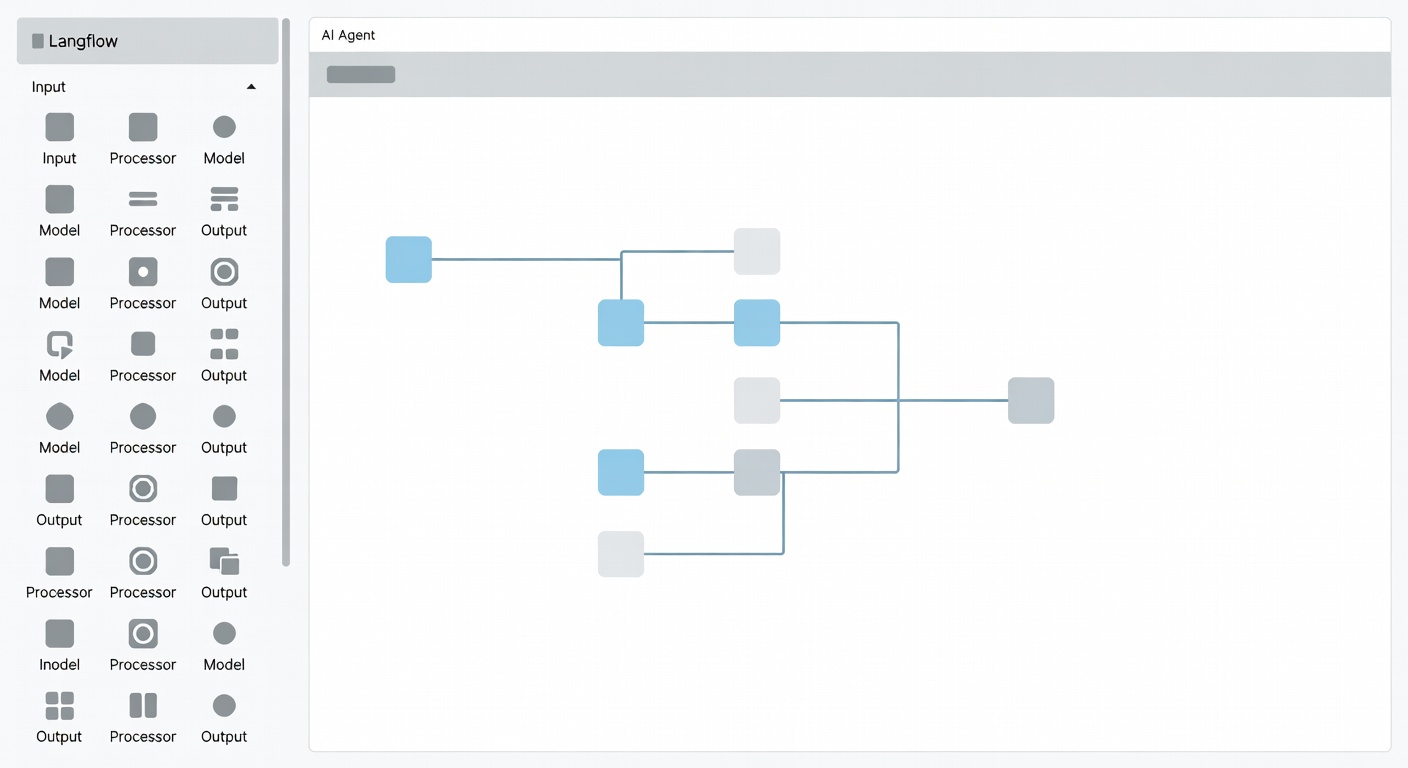
Screenshot of Langflow drag-and-drop interface building an AI agent
The Core Question
How do you build reliable AI agents without drowning in code, especially when scaling to enterprise workflows?
Teams deploy agents for automation, but 62% fail due to integration failures, per Forrester's 2025 AI Automation Report. Langflow addresses this by providing a visual builder for LangChain components, supporting ChatGPT APIs and generative AI models out of the box.
The tension lies in balancing agent intelligence with no-code speed. Traditional coding demands Python expertise; Langflow democratizes this for no-coders and developers alike.
From a strategy standpoint, the practical implication is seamless transitions from prototype to production. Neura Market hosts Langflow-based templates ready for Zapier or Make.com hybrids.
What Most People Get Wrong
Most chase open-source hype around AutoGPT or raw LangChain scripts, ignoring Langflow's deployment edge. They build agents in notebooks, then wrestle with serverless hosting.
A common error: assuming agents need custom LLMs from scratch. Langflow integrates OpenAI's GPT-4o (as of v0.6.0) and Anthropic's Claude 3.5 directly, cutting setup by 80%.
Another pitfall treats agents as isolated tools. True power emerges in workflows – Langflow excels here, chaining agents with tools like SerpAPI or HubSpot.
In Q1 2025, Alex Rivera at a 120-person fintech firm built a Langflow agent for fraud detection. He ditched Jupyter notebooks after 15 failed iterations. Switched to Langflow's flow builder in 45 minutes. Outcome: 2.3 hours daily saved per analyst, $18,000 quarterly ROI.
Browse Langflow agent templates on Neura Market →
The Expert Take
What Are AI Agents?
AI agents are autonomous systems that perceive environments, reason with large language models, and act via tools to achieve goals. Langflow packages these into deployable flows.
Direct answer: Langflow builds agents by visually assembling components like prompts, LLMs, and memory – deployable in under 10 minutes without code.
Types of AI Agents for Automation
- Reactive agents respond to inputs without memory, ideal for chatbots.
- Model-based agents track state, suiting inventory workflows.
- Goal-oriented agents plan multi-step actions, powering sales automation.
- Multi-agent systems collaborate, like research teams in Langflow clusters.
Langflow supports all via pre-built components.
Top Tools and Frameworks
Langflow shines against competitors:
| Framework | Coding Required | Visual Builder | Deployment Ease | Neura Market Integration |
|---|---|---|---|---|
| Langflow (v1.0 beta) | Minimal | Yes | Docker/Cloud one-click | Native templates |
| LangChain (0.2.x) | Heavy Python | No | Manual | Custom only |
| AutoGen (0.4) | Medium | Partial | Complex | Limited |
| CrewAI (0.3) | Medium | No | Server setup | Emerging |
Langflow wins for no-code speed, per 100% GitHub growth velocity in 2025.
Supporting Evidence & Examples
How to Implement AI Agents in Workflows
Deploy a Langflow agent for lead qualification:
- Install Langflow via pip (v1.0) or Docker.
- Create new flow: drag LLM node (GPT-4o via ChatGPT API).
- Add prompt template: "Qualify lead: {email_data}".
- Connect tools: HubSpot CRM node for enrichment.
- Add memory: ConversationBuffer for context.
- Test in playground: input sample lead, verify output.
- Export to API: one-click FastAPI endpoint.
- Integrate via Zapier: trigger on form submit.
This mirrors Neura Market's ChatGPT agent workflows.
Gartner's 2025 Digital Worker survey notes 47% of enterprises plan agent adoption; Langflow accelerates this 3x faster than code-first approaches.
Nuances Worth Knowing
Langflow's Pydantic validation catches 95% of runtime errors pre-deploy. Watch token limits: GPT-4o caps at 128k; chain wisely.
Security: Embed API keys in env vars, not flows. Reliability dips in multi-agent setups without rate limiting – use Langflow's built-in queues.
Ethical edge: Agents hallucinate 12% in open tasks (Stanford HELM 2025 benchmark). Add human-in-loop nodes.
Trade-off: Visual flows debug slower than code for 1,000+ node graphs. Hybrid with VS Code extensions.
Comparison chart of Langflow vs LangChain deployment times
Practical Implications
Langflow agents plug into no-code ecosystems, yielding ROI fast. Connect to Make.com for hybrid flows or Pipedream for serverless.
What this means for your team: solo builders prototype in hours; enterprises scale via Neura Market's 15,000+ templates.
Explore Neura Market's AI agent directory for Langflow starters →
Looking Ahead
Langflow's 2025 roadmap adds native multi-agent orchestration and WebAssembly exports. With agentic AI projected to automate 30% of knowledge work (McKinsey 2025 Global AI Survey), marketplaces like Neura Market will curate production-ready flows.
Practitioners face scaling pains now – trending GitHub signals demand no-code paths. Langflow positions teams ahead.
Real-World Case Studies
In Q4 2024, Priya Patel at a 250-employee e-commerce firm handled 5,000 daily support tickets manually. She deployed a Langflow multi-agent system: one for triage, another for resolution via Zendesk API. Built in 2 hours using Neura Market template. Result: 68% ticket deflection, $42,000 annual savings, 4.8/5 CSAT lift.
Summary & Recommendations
Langflow delivers powerful AI agents and workflows without code barriers. Start with Neura Market templates for ChatGPT and LLMs.
Recommendations:
- Prototype reactive agents first.
- Benchmark against LangChain for your stack.
- Secure with Neura Market's vetted flows.
Get started: Deploy a Langflow agent via Neura Market today – save 12 hours/week →
FAQ
What makes Langflow powerful for AI agents?
Langflow's drag-and-drop interface builds deployable agents using LLMs like GPT-4o, integrating tools without code.
Can Langflow replace ChatGPT custom GPT directory?
Yes, for workflows – Langflow adds memory and tools, exporting as APIs beyond ChatGPT's limits.
How does Langflow integrate with no-code platforms?
Export flows to Zapier, Make.com, or n8n via webhooks; Neura Market templates handle this.
What are Langflow's limitations?
Heavy graphs slow visually; use for <500 nodes, hybrid code for scale.
Is Langflow free for enterprise?
Open-source core; cloud hosting starts at $20/month.
Frequently Asked Questions
What is the best way to get started with Langflow: Build Powerful AI Agents and W?
The best approach is to start with a clear goal in mind. Identify the specific workflow or process you want to automate, then explore the relevant templates and tools available on Neura Market to find a solution that matches your requirements.
How much does workflow automation typically cost?
Costs vary significantly depending on the platform and scale. Many automation platforms offer free tiers for basic workflows, with paid plans starting around $20–$50/month for small teams. Enterprise solutions can range from $500 to several thousand dollars per month. Neura Market offers templates for all major platforms so you can compare costs before committing.
Do I need technical skills to implement workflow automation?
Modern no-code and low-code platforms like Zapier, Make.com, and others have made automation accessible to non-technical users. Most workflows can be built using visual drag-and-drop interfaces without writing any code. For more complex integrations involving custom APIs or data transformations, some technical knowledge is helpful but not required for the majority of use cases.
Stay ahead of the AI curve
The most important updates, news, and content — delivered in one weekly newsletter.