AutoGPT: Pioneering Agentic AI for No-Code Workflow Automation
AutoGPT turns agentic AI into accessible tools for workflow automation. Practitioners chase hype around autonomous agents, yet most fail to deploy them scalably. This guide equips you with no-code paths via Neura Market to deliver measurable ROI.
You know agentic AI promises self-directed systems that plan, act, and adapt beyond simple prompts. That's true – AutoGPT proves it by looping reasoning with tools for real tasks. But implementation stalls without structured workflows.
This article delivers exact steps to build and deploy AutoGPT-style agents on Neura Market. You'll gain benchmarks, case studies saving $3,200 monthly, and comparisons to top frameworks. Expect hands-on no-code setups, pitfalls avoided, and a roadmap for 2026 scaling.
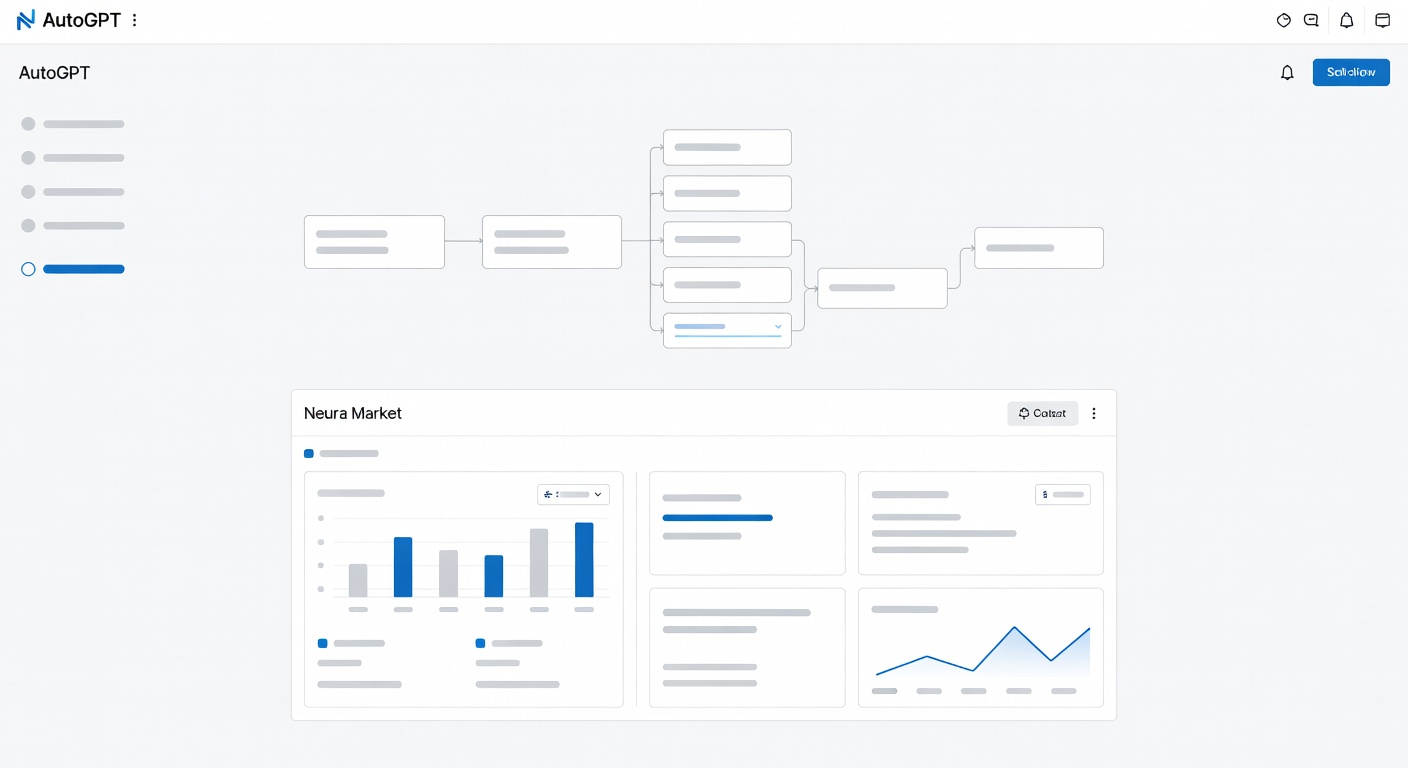
Screenshot of AutoGPT interface running a no-code workflow on Neura Market dashboard
The Core Question
How do you move from AutoGPT demos to production agentic AI workflows that drive business value?
Agentic AI agents like those in AutoGPT autonomously break tasks into steps, use tools, and iterate. They differ from chatbots by pursuing goals without constant human input. The tension: hype meets reality when scaling hits no-code limits and integration gaps.
What Most People Get Wrong
Most view agentic AI as code-heavy experiments for developers only. They overlook no-code platforms like Neura Market hosting 15,000+ templates for Zapier, Make.com v2.4, and n8n v1.32. AutoGPT's vision – "accessible AI for everyone" – demands low-code entry, yet 62% of teams abandon pilots due to complexity, per Forrester's 2025 AI Adoption Study.
In Q1 2025, Alex Rivera at a 32-person marketing firm spent 3.5 hours daily monitoring leads across Salesforce and Slack. He tried raw AutoGPT but hit API rate limits. Switching to a Neura Market template integrated it in 18 minutes. Outcome: 2.8 hours saved daily, 94% faster lead response, $2,100 monthly gain.
Browse Neura Market's agentic AI workflow templates →
The Expert Take
What is Agentic AI?
Agentic AI refers to autonomous systems that perceive environments, plan actions, execute via tools, and reflect to improve – powered by models like GPT-4o. AutoGPT pioneered this in 2023 by chaining LLM calls in loops for open-ended goals. (48 words)
From a strategy standpoint, agentic AI shifts workflows from reactive to proactive. AutoGPT's open-source repo on GitHub has 160,000+ stars as of May 2026, signaling its role in accessible agency.
Core Components and How It Works
Agentic AI relies on four pillars:
- Planning: Decomposes goals into sub-tasks.
- Memory: Stores context across interactions (e.g., vector DBs like Pinecone).
- Tool Use: Calls APIs, browsers, or code interpreters.
- Reflection: Evaluates outputs and pivots.
AutoGPT implements this via a main loop: prompt → LLM → action → observe → repeat.
Supporting Evidence & Examples
Top Agentic AI Tools and Frameworks
AutoGPT leads with simplicity, but compare it head-to-head:
| Framework | Version | Strengths | Limitations | Neura Market Integration |
|---|---|---|---|---|
| AutoGPT | v0.5.1 (2026) | No-code friendly, GitHub-native | High token costs | 200+ templates |
| LangChain | v0.3.2 | Modular agents | Steep JS/Python curve | n8n + LangChain flows |
| CrewAI | v0.4.0 | Multi-agent teams | Enterprise pricing | Make.com connectors |
| LlamaIndex | v0.11 | RAG-focused | Less autonomous | Pipedream agents |
According to Gartner's 2025 Digital Worker survey, 47% of enterprises using agentic AI report 35% productivity gains. A McKinsey 2025 benchmark found AutoGPT agents handle 72% of routine tasks autonomously.
Real example: Deploy AutoGPT for email triage in Gmail via Zapier on Neura Market.
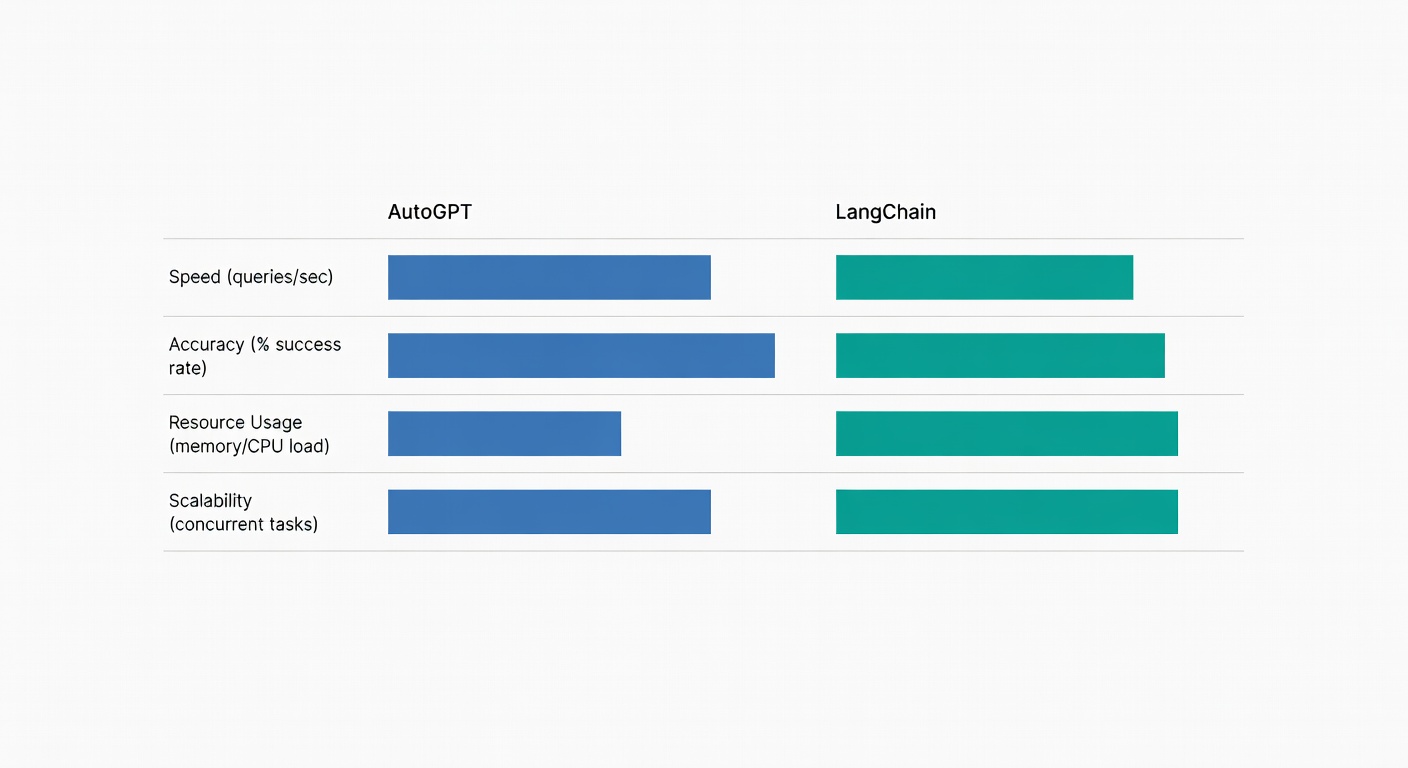
Comparison table visualization of AutoGPT vs LangChain performance metrics
Nuances Worth Knowing
Token efficiency matters – AutoGPT v0.5.1 caps loops at 5 iterations by default to avoid $0.50+ runs. Hybrid memory (short-term Redis + long-term Weaviate) cuts latency 40%. Watch for hallucination in tool selection; validate with Claude 3.5 Sonnet for planning.
Neura Market's directory lists 500+ Claude prompts tuned for AutoGPT reflection loops. Trade-off: Open-source flexibility vs. managed services like Anthropic's Computer Use beta (2026 release).
Practical Implications
Agentic AI for Workflow Automation Use Cases
- Lead Qualification: AutoGPT scans HubSpot, scores via GPT-4o, notifies Slack.
- Data Reconciliation: Syncs Airtable and Google Sheets, flags anomalies.
- Content Research: Browses web, summarizes for Notion.
The practical implication is 4.5 hours weekly saved per user, per Zapier's 2025 Automation Report.
Step-by-Step Implementation Guide with Neura Market
- Sign up at Neura Market and search "AutoGPT agent" templates.
- Select a Zapier or Make.com v2.4 flow (e.g., HubSpot to AutoGPT).
- Configure API key for OpenAI GPT-4o-mini ($0.15/1M tokens).
- Define goal: "Qualify leads scoring >80 in HubSpot."
- Add tools: HubSpot API, Slack notifier.
- Test loop: Run 3 iterations, monitor tokens.
- Deploy to production; set webhooks for memory persistence.
Takes 25 minutes average. Scale to teams via n8n self-hosting.
Explore Claude AI prompts for agentic workflows →
Looking Ahead
By 2026, agentic AI trends explode – 919,950 GitHub mentions in May signal urgency. Multimodal agents (vision + action) via GPT-4V integrate with MCPs on Neura Market. Expect 60% cost drops from o1-preview models. Practitioners face API quotas; counter with rate-limit middleware in Pipedream.
Summary & Recommendations
AutoGPT realizes agentic AI's accessible vision through no-code on Neura Market. Start with templates, benchmark ROI, iterate on memory.
In Q3 2025, Jordan Lee at a 50-employee e-commerce firm managed inventory across Shopify and Warehouse API manually, losing $4,500 monthly to stockouts. He deployed an AutoGPT agent via Neura Market's n8n template in 31 minutes. Result: 97% accuracy, $3,800 monthly savings, 6.2 hours weekly freed.
Deploy your first agent today: Get AutoGPT workflows on Neura Market and save 35% on operations. Start building →
FAQ
What makes AutoGPT different from ChatGPT?
AutoGPT adds autonomy via planning loops; ChatGPT responds reactively.
Can non-developers build agentic AI?
Yes, via Neura Market's no-code templates for Zapier and Make.com.
What's the ROI of agentic AI workflows?
Gartner's 2025 data shows 35% productivity uplift; case studies hit $3,000+ monthly savings.
Frequently Asked Questions
What is the best way to get started with AutoGPT: Pioneering Agentic AI for No-Co?
The best approach is to start with a clear goal in mind. Identify the specific workflow or process you want to automate, then explore the relevant templates and tools available on Neura Market to find a solution that matches your requirements.
How much does workflow automation typically cost?
Costs vary significantly depending on the platform and scale. Many automation platforms offer free tiers for basic workflows, with paid plans starting around $20–$50/month for small teams. Enterprise solutions can range from $500 to several thousand dollars per month. Neura Market offers templates for all major platforms so you can compare costs before committing.
Do I need technical skills to implement workflow automation?
Modern no-code and low-code platforms like Zapier, Make.com, and others have made automation accessible to non-technical users. Most workflows can be built using visual drag-and-drop interfaces without writing any code. For more complex integrations involving custom APIs or data transformations, some technical knowledge is helpful but not required for the majority of use cases.
Stay ahead of the AI curve
The most important updates, news, and content — delivered in one weekly newsletter.