

Amira Learning
FreemiumAI-driven early literacy assessment and tutoring for every K–12 learner.
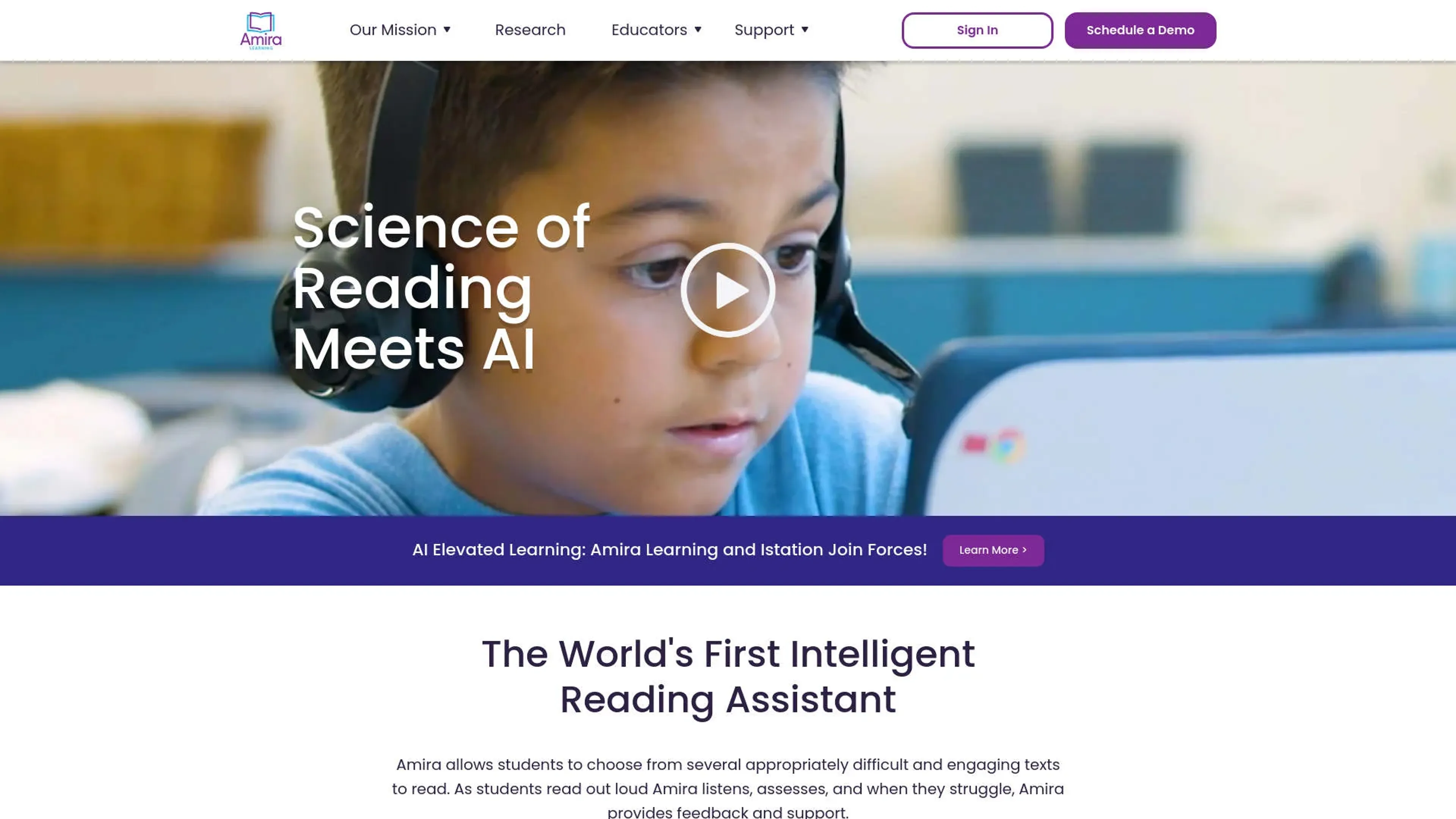
About Amira Learning
Amira Learning is positioned at the cutting edge of educational technology, specifically designed to revolutionize the way children learn to read. Leveraging the power of artificial intelligence, Amira serves as an intelligent reading assistant that supports students by listening, assessing, and providing real-time, personalized tutoring as they read aloud. Developed from over 30 years of research at Carnegie Mellon University, Amira combines the Science of Reading with advanced AI to offer a uniquely effective educational tool. Targeted primarily at educational institutions, teachers, and students, Amira aims to boost reading fluency and comprehension through scientifically-backed techniques.
Key Features
- AI-Powered Reading Assistance: Amira uses sophisticated speech recognition to listen to students as they read, offering immediate feedback and assistance.
- Personalized Learning: Tailored tutoring sessions adapt to each student's individual learning pace, promoting better engagement and understanding.
- Research-Driven: Built on decades of academic research and studies, ensuring the methodologies are effective and scientifically validated.
- Comprehensive Reporting: Provides detailed reports on student progress, helping educators tailor future teaching efforts.
- Global Accessibility: Available in multiple languages and used by over 2 million students across 15 countries, making it a versatile tool for diverse educational settings.
Pros
- Enhanced Reading Outcomes: Studies show students using Amira can achieve reading growth rates twice the national average.
- Time-Efficient: Requires just 10 minutes a day to significantly impact reading proficiency.
- Ease of Use: Intuitive interface allows easy integration into daily classroom activities.
- Supports Diverse Learning Needs: Effective for students with dyslexia and English language learners, providing equitable learning opportunities.
Cons
- Technology Dependence: Relies heavily on technology which might not be readily available in all educational environments.
- Internet Requirement: Needs a consistent internet connection to function optimally.
- Initial Setup: Teachers may need some time to familiarize themselves with the system and best practices.
Use Cases
- Elementary Schools: Integrating Amira into regular classroom reading sessions.
- Special Education Teachers: Employing Amira for tailored support for students with learning disabilities.
- Language Specialists: Using the tool to assist English Language Learners (ELL) in improving their reading skills.
- International Educators: Adopted by schools in over 15 countries, suitable for various educational curriculums.
- Uncommon Use Cases: Utilized in remote learning scenarios; employed in adult education centers to help with adult literacy.
Pricing
Free Trial: Schools can start with a free demo to explore Amira’s capabilities. Subscription Plans: Detailed pricing is available upon request, tailored to the size and needs of the institution. Disclaimer: For the most accurate and current pricing details, refer to the official Amira Learning website.
What Makes It Unique
Amira stands out in the educational technology landscape through its integration of AI with the scientifically-proven methods of the Science of Reading. This unique combination not only enhances learning outcomes but does so in a way that mimics human tutoring, making it a pioneering tool in personalized education.
Ratings
Accuracy and Reliability: 4.7/5 Ease of Use: 4.5/5 Functionality and Features: 4.8/5 Performance and Speed: 4.6/5 Customization and Flexibility: 4.3/5 Data Privacy and Security: 4.5/5 Support and Resources: 4.4/5 Cost-Efficiency: 4.2/5 Integration Capabilities: 4.0/5 Overall Score: 4.5/5
Key Features
Pros & Cons
- Enhanced Reading Outcomes: Studies show students using Amira can achieve reading growth rates twice the national average.
- Time-Efficient: Requires just 10 minutes a day to significantly impact reading proficiency.
- Ease of Use: Intuitive interface allows easy integration into daily classroom activities.
- Supports Diverse Learning Needs: Effective for students with dyslexia and English language learners, providing equitable learning opportunities.
- Technology Dependence: Relies heavily on technology which might not be readily available in all educational environments.
- Internet Requirement: Needs a consistent internet connection to function optimally.
- Initial Setup: Teachers may need some time to familiarize themselves with the system and best practices.
Best For
Alternatives to Amira Learning
to teach
Transform Your Classroom Using AI-Powered Teaching Resources
PrepSup
Transform Your Learning Journey with PrepSup's AI Tutor
LingQ
Create personalized language lessons, engage with interactive activities, and monitor proficiency with quizzes.
Teach-O-Matic
Generate Tailored AI-Produced How-To Videos Using Teach-O-Matic
Learn Prompting
Unlock the power of AI with Learn Prompting. Learn how to create effective prompts to enhance your AI usage, improve outputs, and solve complex problems.
Reach Best
AI for researching and applying to Universities. Tens of thousands of students use Reach Best to check if a University is a good f