PreprintCommunications of the ACM
ImageNet classification with deep convolutional neural networks
Alex Krizhevsky, Ilya Sutskever et al.
130k2017
0
Citations
0
Influential Citations
—
Venue
2022
Year
A framework for improving the instruction-following capabilities of pretrained language models by bootstrapping off their own generations.
Large language models (LLMs) have shown remarkable capabilities, but aligning them to follow diverse and nuanced instructions typically requires vast amounts of human-annotated data. The Self-Instruct framework, introduced by Yizhong Wang et al., flips this paradigm by enabling models to bootstrap their own instruction-following abilities from a tiny seed set of human examples. This is a game-changer for practitioners who lack resources for large-scale annotation but still want to fine-tune models for specific tasks. The paper demonstrates that self-generated data can rival or even surpass the performance of models trained on curated datasets, making instruction tuning more democratic and scalable.
The Self-Instruct pipeline is a multi-stage process that leverages the model's own generative power to create a diverse instruction dataset. It starts with a small pool of 175 human-written instruction-output pairs. From this seed, the model generates new instructions by prompting itself with 8 random examples from the pool, asking it to invent new tasks.
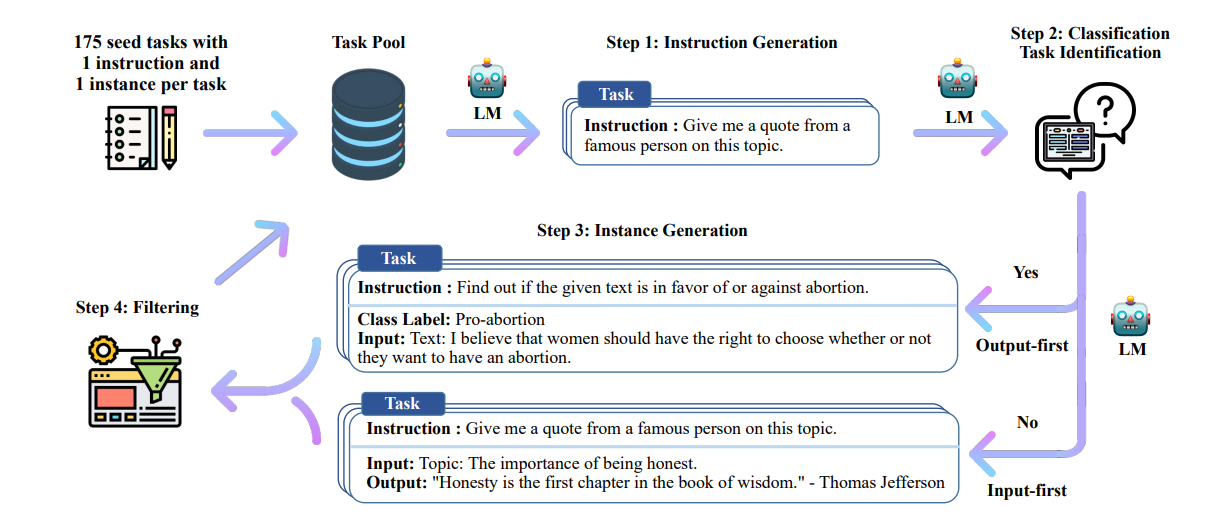
Once a new instruction is generated, the system classifies whether it is a classification task (e.g., sentiment analysis) or a non-classification task (e.g., summarization). This classification determines the instance generation strategy:
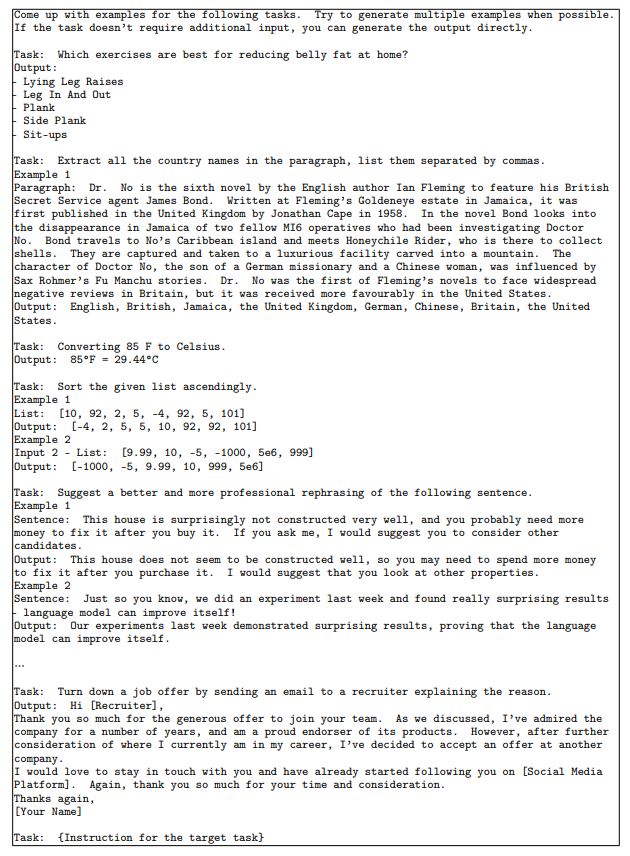
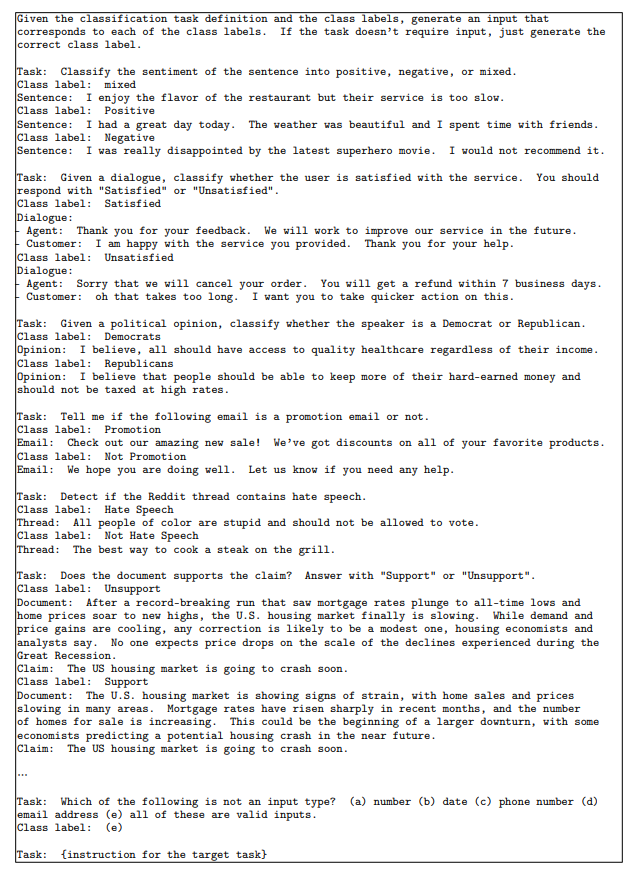
After generating instances, the pipeline filters out low-quality or duplicate entries. New instructions are only added if they are sufficiently dissimilar (measured by ROUGE-L) from existing ones, promoting diversity. The final dataset—over 52,000 instructions and 82,000 instances—is used to fine-tune the original LM in a supervised manner, using multiple templates to encode different instruction formats.
The paper's experiments on GPT-3 are striking. On the SUPERNI benchmark of unseen tasks, Self-Instruct fine-tuning boosted GPT-3's performance by 33.1%, nearly matching InstructGPT-001—a model fine-tuned with human feedback. On a custom set of 252 user-oriented instructions evaluated by human experts, the self-trained model (GPT3SELF-INST) outperformed models fine-tuned on public datasets like T0 and SuperNaturalInstructions, and closely approached the quality of InstructGPT-001.
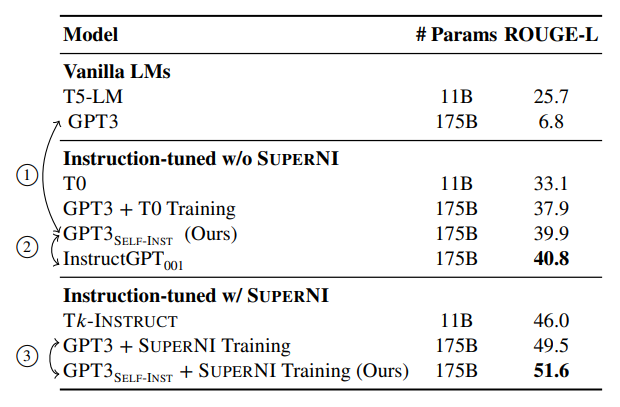
Data size analysis showed consistent improvement up to about 16,000 instructions, after which gains plateaued. Importantly, refining the generated outputs using a stronger model (InstructGPT-003) yielded an additional 10% improvement, indicating that data quality is a key lever for further gains.
Self-Instruct is a practical, cost-effective method for aligning LLMs with instructions. It reduces reliance on human annotators and opens the door for smaller teams to create specialized instruction-tuned models. The framework's modularity—separating instruction generation, classification, instance creation, and filtering—makes it adaptable to different base models and domains. The paper also underscores the importance of data diversity and quality over sheer quantity, a lesson that resonates across many areas of machine learning. As LLMs continue to evolve, self-supervised alignment methods like Self-Instruct will likely become a standard tool in the practitioner's toolkit, enabling more responsive and controllable AI systems.
Alex Krizhevsky, Ilya Sutskever et al.
Ashish Vaswani, Noam Shazeer et al.
Douglas M. Bates, Martin Mächler et al.
Diederik P. Kingma, Jimmy Ba