PreprintCommunications of the ACM
ImageNet classification with deep convolutional neural networks
Alex Krizhevsky, Ilya Sutskever et al.
130k2017
0
Citations
0
Influential Citations
—
Venue
2024
Year
A foundation model towards solving promptable visual segmentation in images and videos based on a simple transformer architecture with streaming memory for real-time video processing.
Segment Anything Model 2 (SAM 2) represents a significant leap in visual segmentation by extending the promptable paradigm from static images to dynamic videos. While the original SAM revolutionized image segmentation with its ability to segment any object given a prompt, SAM 2 tackles the far more challenging domain of video, where objects move, occlude, and change appearance over time. This is crucial for real-world applications like video editing, autonomous driving, and augmented reality, where understanding objects across frames is essential. By introducing a streaming memory mechanism, SAM 2 achieves near real-time performance, making it practical for interactive use.
SAM 2 is built on a simple transformer architecture that generalizes SAM to video. The core innovation is the memory attention mechanism, which conditions the current frame's features on past predictions and prompts stored in a memory bank. This allows the model to propagate segmentation masks across frames while incorporating user corrections.
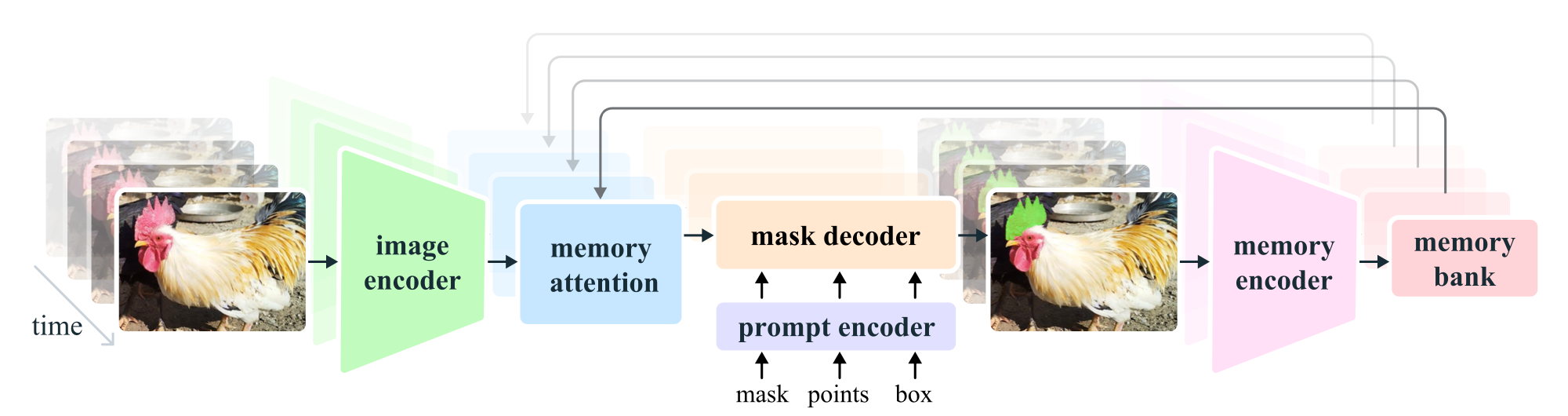
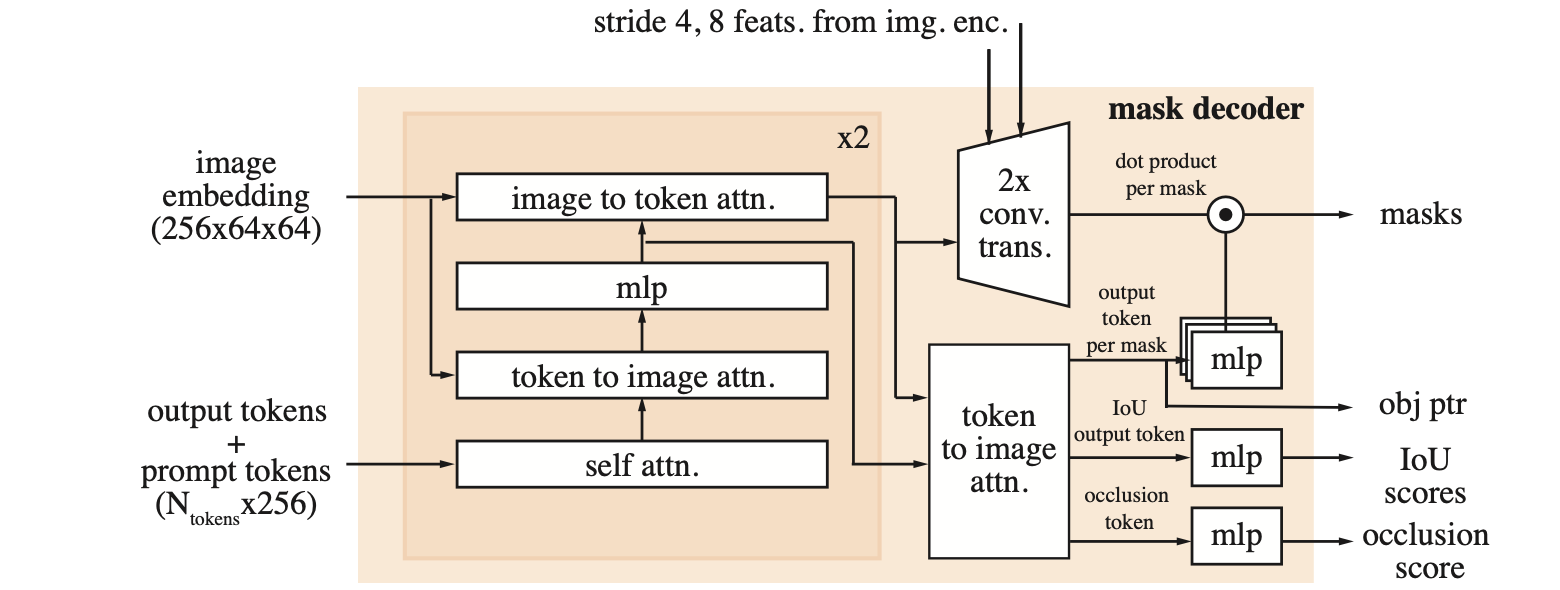
The architecture consists of:
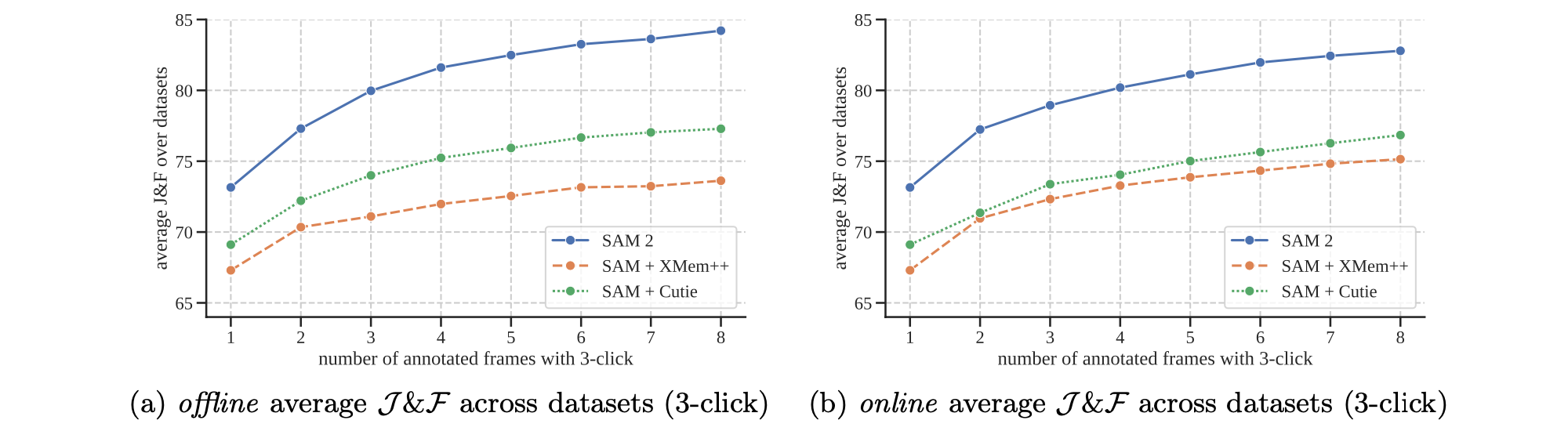
SAM 2 was evaluated on 9 zero-shot video datasets in both offline and online interactive settings. It consistently outperformed baselines (SAM+XMem++ and SAM+Cutie) in J&F accuracy, achieving higher quality with 3× fewer user interactions. In image segmentation, it is 6× faster and more accurate than SAM. The model also excels in semi-supervised VOS with click, box, or mask prompts on the first frame.
SAM 2's impact extends beyond its immediate performance gains. By unifying image and video segmentation under a single promptable framework, it simplifies the development of interactive tools for video editing and analysis. The release of the SA-V dataset (50.9K videos, 642.6K masklets) provides a valuable resource for future research. The model's real-time capability and flexibility in handling various prompt types make it a strong foundation for downstream applications. However, its reliance on clearly defined object boundaries and the need for careful occlusion handling are areas for future improvement. Overall, SAM 2 pushes the boundary of what is possible with promptable visual segmentation, bringing us closer to truly interactive video understanding.
Alex Krizhevsky, Ilya Sutskever et al.
Ashish Vaswani, Noam Shazeer et al.
Douglas M. Bates, Martin Mächler et al.
Diederik P. Kingma, Jimmy Ba