PreprintCommunications of the ACM
ImageNet classification with deep convolutional neural networks
Alex Krizhevsky, Ilya Sutskever et al.
130k2017
152
Citations
17
Influential Citations
arXiv.org
Venue
2025
Year
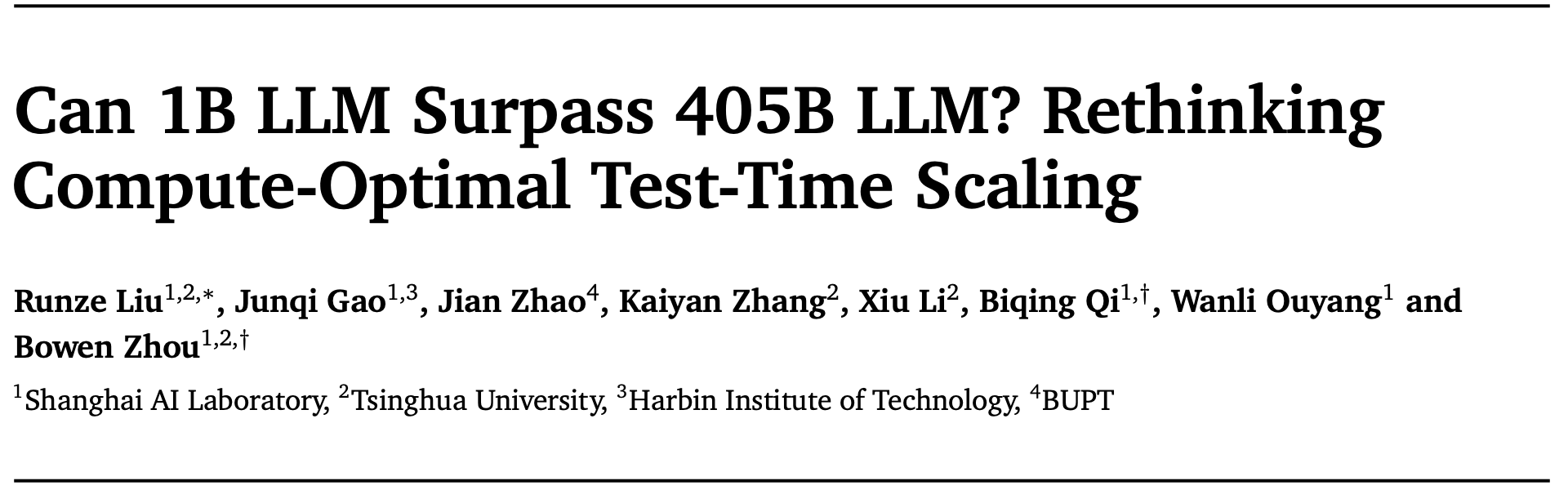
Investigates compute-optimal Test-Time Scaling (TTS) for Large Language Models (LLMs), focusing on the influence of policy models, Process Reward Models (PRMs), and problem difficulty. Through experiments on MATH-500 and AIME24.
This paper challenges the prevailing wisdom that bigger language models are always better. By focusing on how to optimally allocate computation at test time, the authors show that small models—when paired with the right verification and search strategies—can outperform models hundreds of times larger. This has profound implications for democratizing AI, as it suggests that state-of-the-art reasoning performance may be achievable without massive training budgets.
The study systematically explores three key variables: the policy model (the generator), the process reward model (the verifier), and the problem difficulty. The policy models range from 0.5B to 72B parameters from Llama 3 and Qwen2.5 families. The PRMs include Math-Shepherd, RLHFlow, Skywork, and Qwen2.5-Math series, each trained on different base models and data.
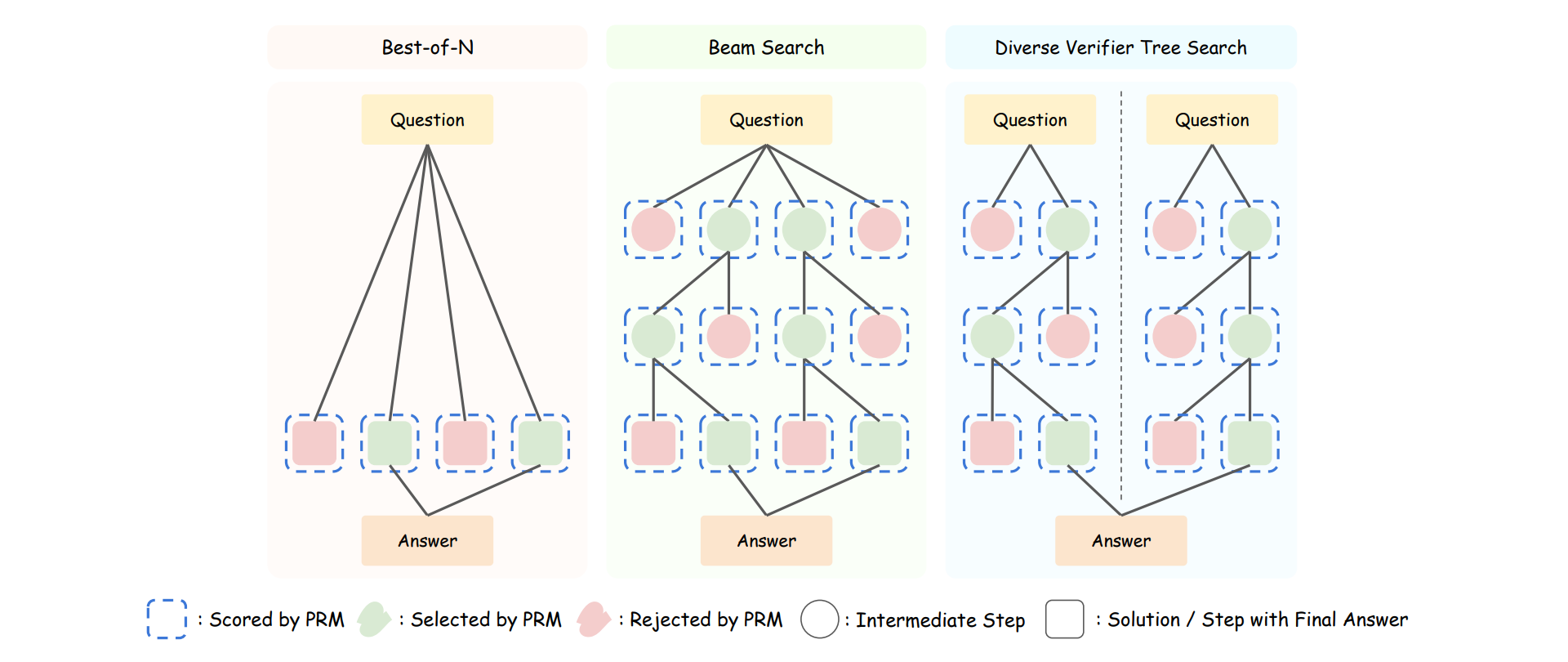
Three TTS methods are compared: Best-of-N (BoN), Beam Search, and Diverse Verifier Tree Search (DVTS). BoN generates N responses and selects the best via scoring or voting. Beam Search expands step-by-step, pruning low-scoring branches. DVTS increases diversity by splitting the search into independent subtrees.
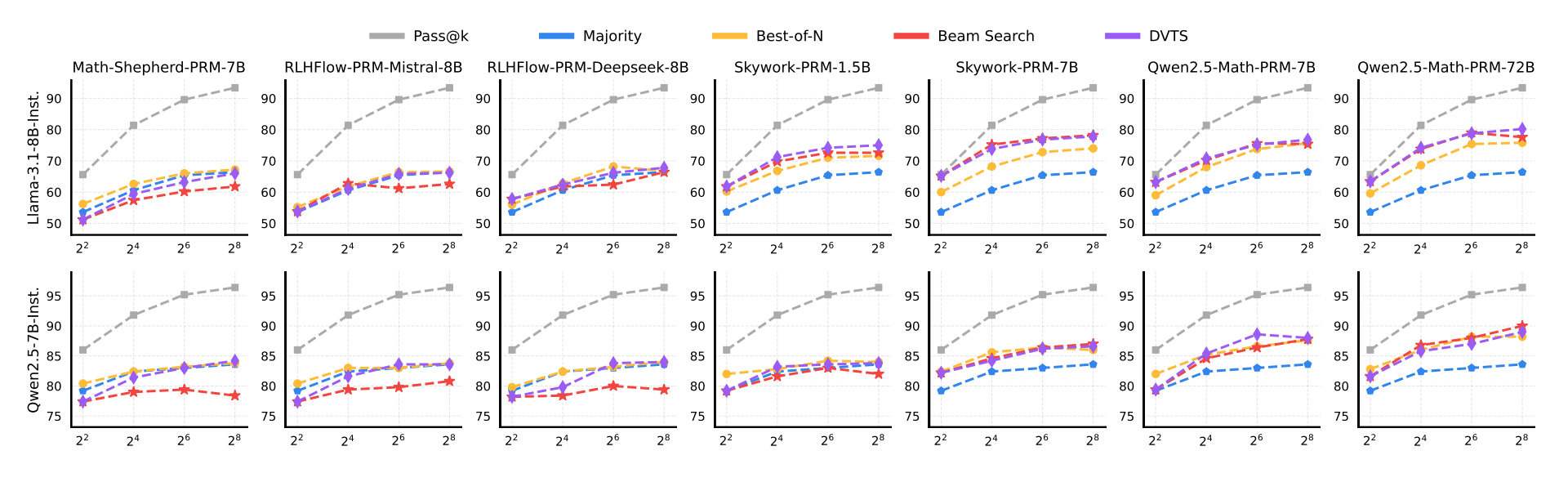
Scoring methods include PRM-Min, PRM-Last, and PRM-Avg. Voting methods include Majority Vote, PRM-Max, and PRM-Vote (which aggregates scores for identical answers).
The paper answers six key questions. First, TTS improvement varies with policy model and PRM: BoN works best with Math-Shepherd and RLHFlow PRMs, while search-based methods excel with Skywork and Qwen2.5-Math PRMs. Second, optimal TTS depends on problem difficulty—small models benefit from beam search on hard problems, while large models prefer BoN across all difficulties.
Third, PRMs show bias: RLHFlow-PRM-Deepseek-8B generates nearly twice as many tokens as RLHFlow-PRM-Mistral-8B due to training data length differences. Fourth, small models with compute-optimal TTS outperform much larger models: Llama-3.2–3B-Instruct beats Llama-3.1–405B-Instruct (135x larger) on both MATH-500 and AIME24.
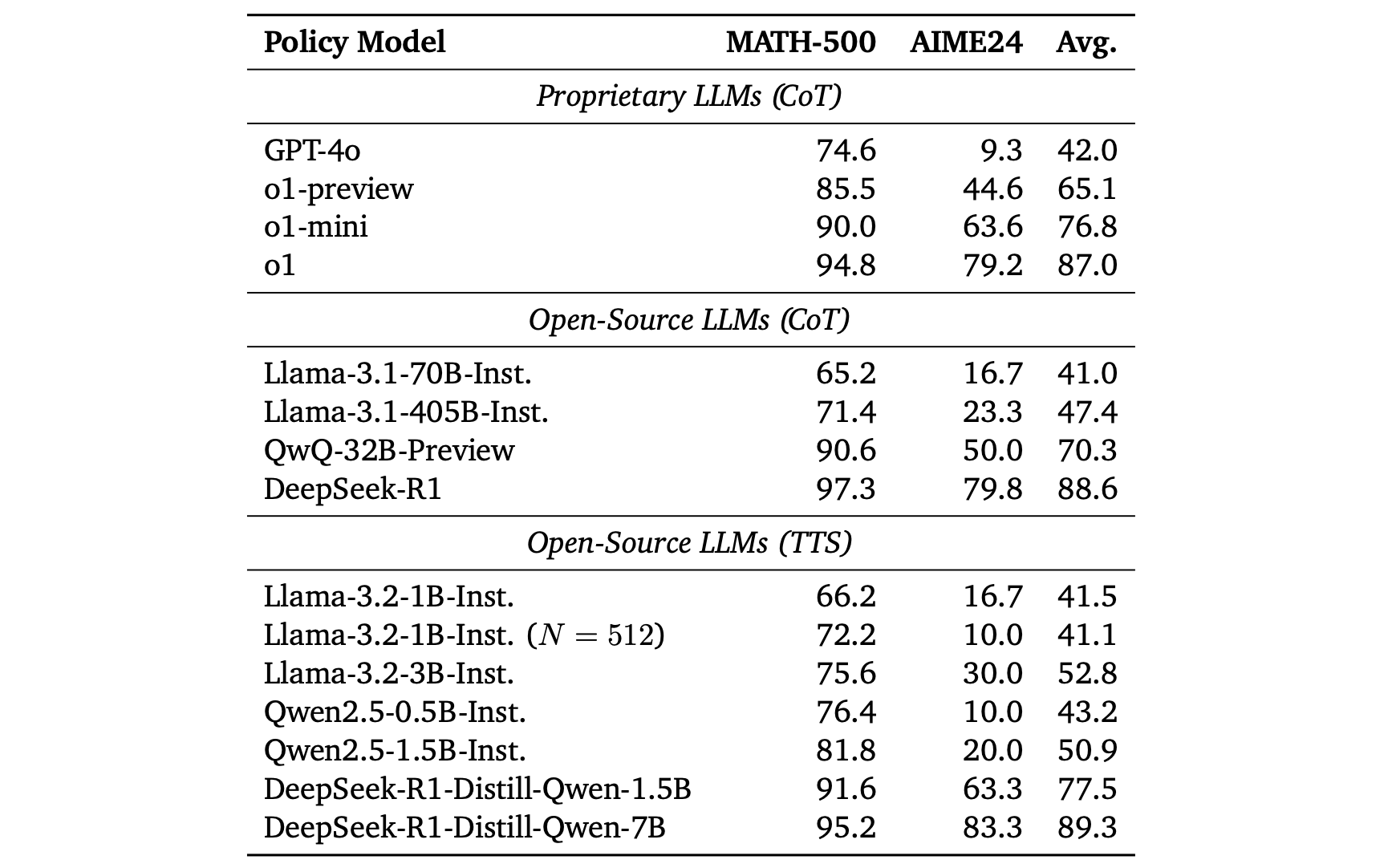
Fifth, compute-optimal TTS is 256x more compute-efficient than majority voting and improves reasoning by 154.6% over CoT. Sixth, TTS outperforms long-CoT methods like rStar-Math and SimpleRL on MATH-500 but lags behind distillation-based methods like DeepSeek-R1-Distill on AIME24.
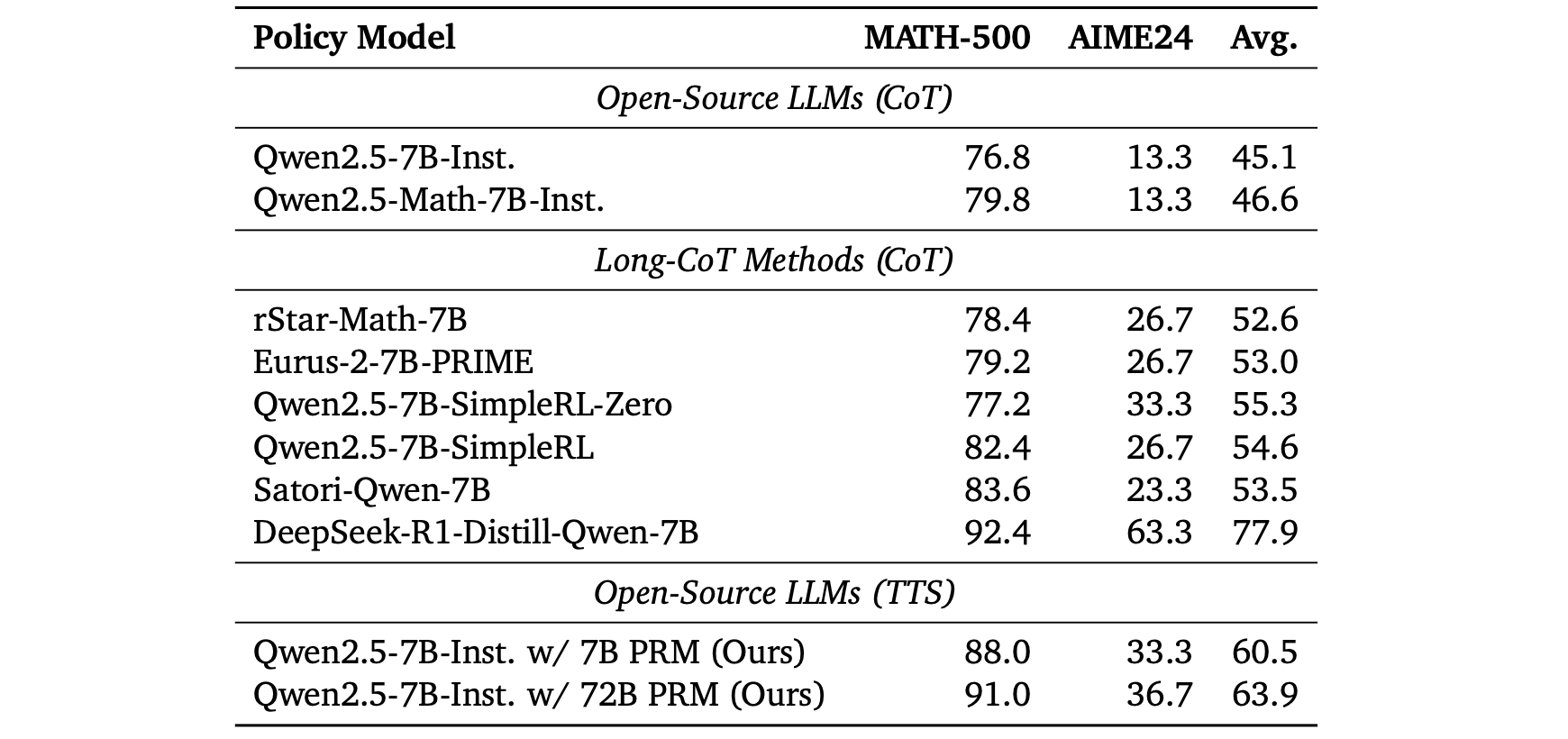
This paper provides a practical roadmap for deploying LLMs efficiently: instead of scaling model size, one can scale test-time compute intelligently. The finding that a 3B model with TTS can surpass a 405B model is a game-changer for resource-constrained applications. However, the approach is less effective on very hard problems and depends on high-quality PRMs. Future work should focus on improving PRM generalization and extending TTS to more complex domains.
Alex Krizhevsky, Ilya Sutskever et al.
Ashish Vaswani, Noam Shazeer et al.
Douglas M. Bates, Martin Mächler et al.
Diederik P. Kingma, Jimmy Ba