PreprintCommunications of the ACM
ImageNet classification with deep convolutional neural networks
Alex Krizhevsky, Ilya Sutskever et al.
130k2017
0
Citations
0
Influential Citations
—
Venue
2023
Year
Allows efficient training of large models on limited GPU memory, through innovations like 4-bit NormalFloat (NF4), double quantization, and paged optimizers.
Fine-tuning large language models (LLMs) typically requires multiple high-end GPUs with ample memory, creating a barrier for many researchers and practitioners. QLoRA addresses this by drastically reducing memory requirements while preserving model quality. It combines quantization and low-rank adaptation in a novel way, allowing models up to 65 billion parameters to be fine-tuned on a single 48GB GPU. This opens up possibilities for customization and domain adaptation of LLMs without expensive hardware.
QLoRA builds on LoRA (Low-Rank Adaptation) by quantizing the pretrained model weights to 4-bit precision. The key innovations are:
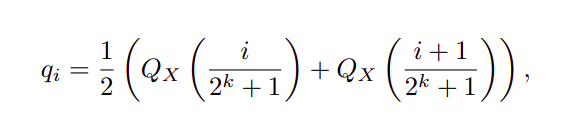
Double Quantization: The quantization constants (c2) from the first quantization step are themselves quantized to 8-bit floats, reducing memory overhead. This is done with a block size of 256 and mean subtraction for symmetric quantization.
Paged Optimizers: Using NVIDIA's unified memory, optimizer states are automatically paged between CPU and GPU. When GPU memory is insufficient, states are evicted to CPU RAM and paged back when needed, preventing out-of-memory errors.

The forward and backward passes use dequantized weights in 16-bit BrainFloat, but gradients are only computed for the LoRA adapters, keeping memory usage low.
Experiments across encoder, encoder-decoder, and decoder-only architectures (up to 13B parameters) show that QLoRA with NF4 matches 16-bit full fine-tuning and LoRA performance on GLUE, Super-NaturalInstructions, and MMLU. NF4 consistently outperforms standard 4-bit floats (FP4). Double quantization provides modest gains but is critical for fitting 33B and 65B models into 24GB and 48GB GPUs respectively.
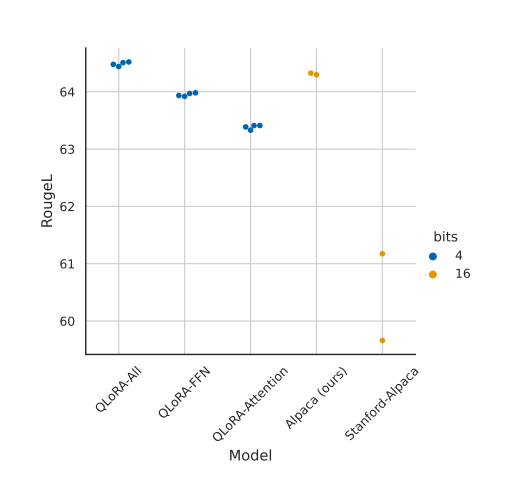
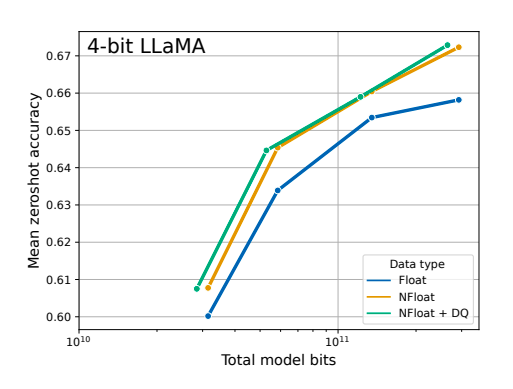
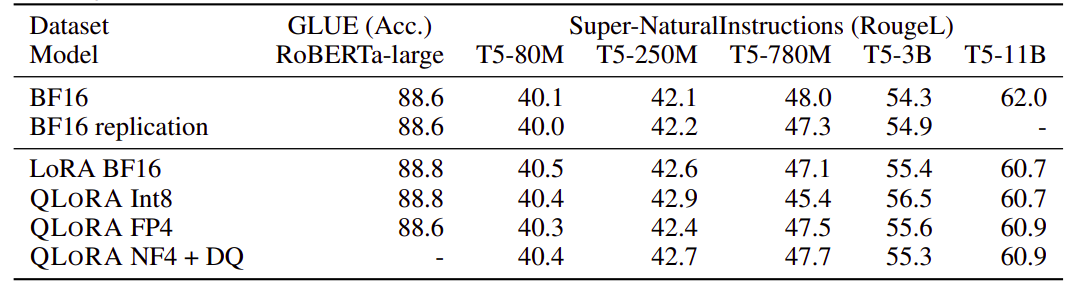

QLoRA makes fine-tuning of state-of-the-art LLMs accessible to a wider audience. By matching full-precision performance, it shows that quantization need not compromise quality. The practical tips from the paper (e.g., applying LoRA to all linear layers) help practitioners achieve optimal results. This work is a step toward more efficient and democratized AI, enabling custom models for specific tasks without massive compute budgets.
Alex Krizhevsky, Ilya Sutskever et al.
Ashish Vaswani, Noam Shazeer et al.
Douglas M. Bates, Martin Mächler et al.
Diederik P. Kingma, Jimmy Ba