PreprintCommunications of the ACM
ImageNet classification with deep convolutional neural networks
Alex Krizhevsky, Ilya Sutskever et al.
130k2017
288
Citations
53
Influential Citations
arXiv.org
Venue
2025
Year
A vision encoder trained via vision-language learning that achieves state-of-the-art results on various tasks, including zero-shot image and video classification/retrieval, document/image/video Q&A, and spatial tasks like detection and depth estimation. It leverages contrastive vision-language training, language alignment, and spatial alignment to produce strong, general embeddings from intermediate layers, outperforming existing models.
Perception Encoder challenges the long-held assumption that vision encoders need specialized pretraining objectives for different downstream tasks. By showing that a single contrastive vision-language training recipe can produce strong general embeddings for classification, retrieval, Q&A, detection, and depth estimation, the paper offers a unified path forward for vision representation learning. This is especially valuable for AI practitioners building multimodal systems, as it reduces the need for task-specific encoders and simplifies model deployment.
The core insight is that powerful embeddings are hidden in intermediate layers of a contrastively trained network. The authors extract them through two alignment methods: language alignment for multimodal language modeling and spatial alignment for dense prediction.
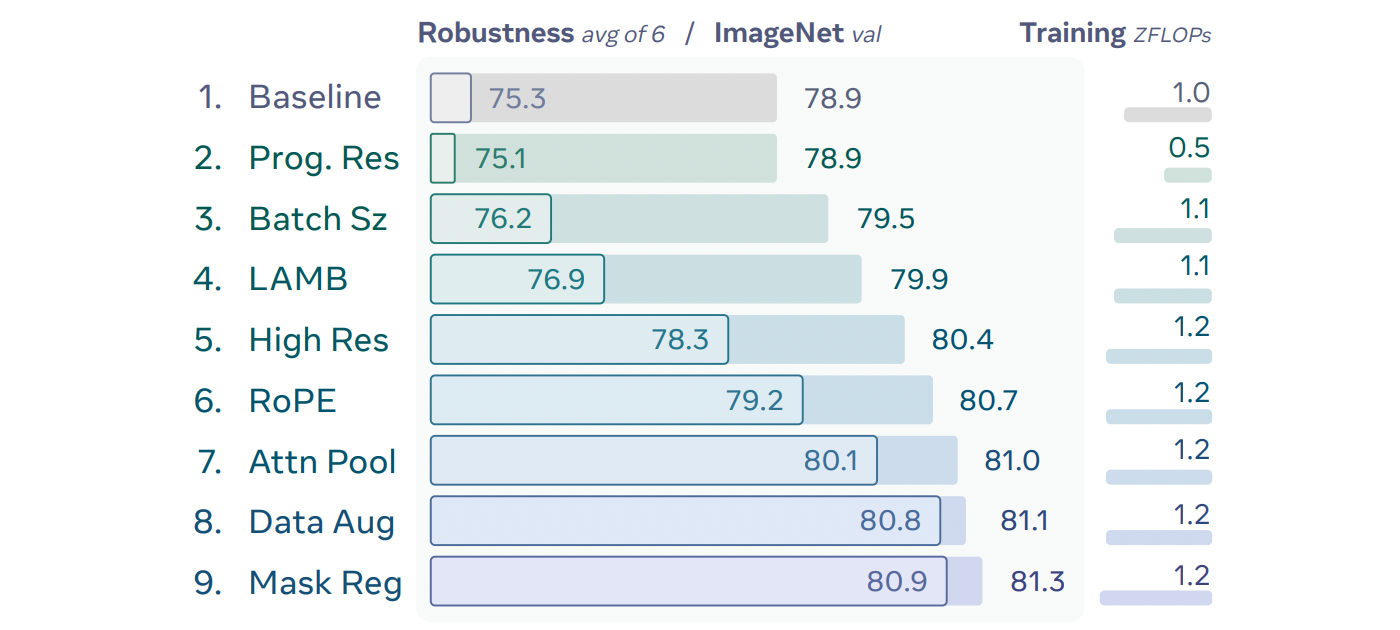
Image Pretraining: The baseline is a CLIP-style model (OpenCLIP ViT-L/14) trained on 2.3B image-text pairs. Key improvements include progressive resolution (98→154→224→336), doubled batch size (32K→64K), LAMB optimizer, 2D RoPE, attention pooling, heavy data augmentation, and MaskFeat regularization. These collectively boost ImageNet validation accuracy and robustness.
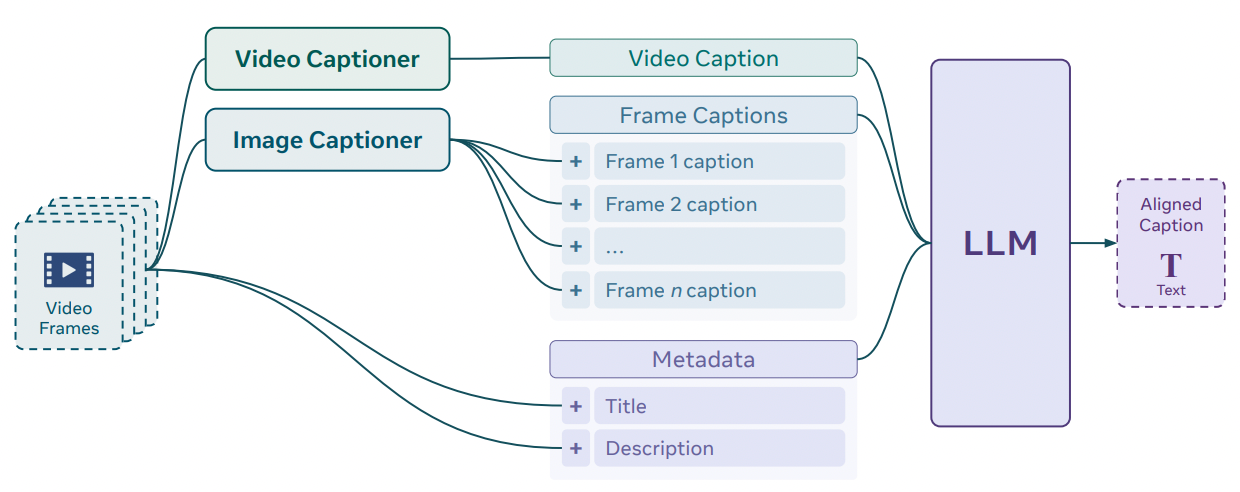
Video Data Engine: To finetune on video, the authors synthesize captions in three phases: (1) a base PLM (Perception Encoder + Llama) trained on 64.7M images/videos; (2) human refinement of 265K video captions; (3) LLM summarization using Llama 3.3 70B to blend PLM captions, frame captions, and metadata. This produces 22M high-quality video-text pairs for contrastive finetuning.
Unified Encoder: The largest model (PEcoreG, 2B parameters) is trained with 86B samples seen. Smaller models (B and L) are distilled from the G-scale teacher. Training proceeds in three stages: image pretraining, image+video finetuning, and distillation.

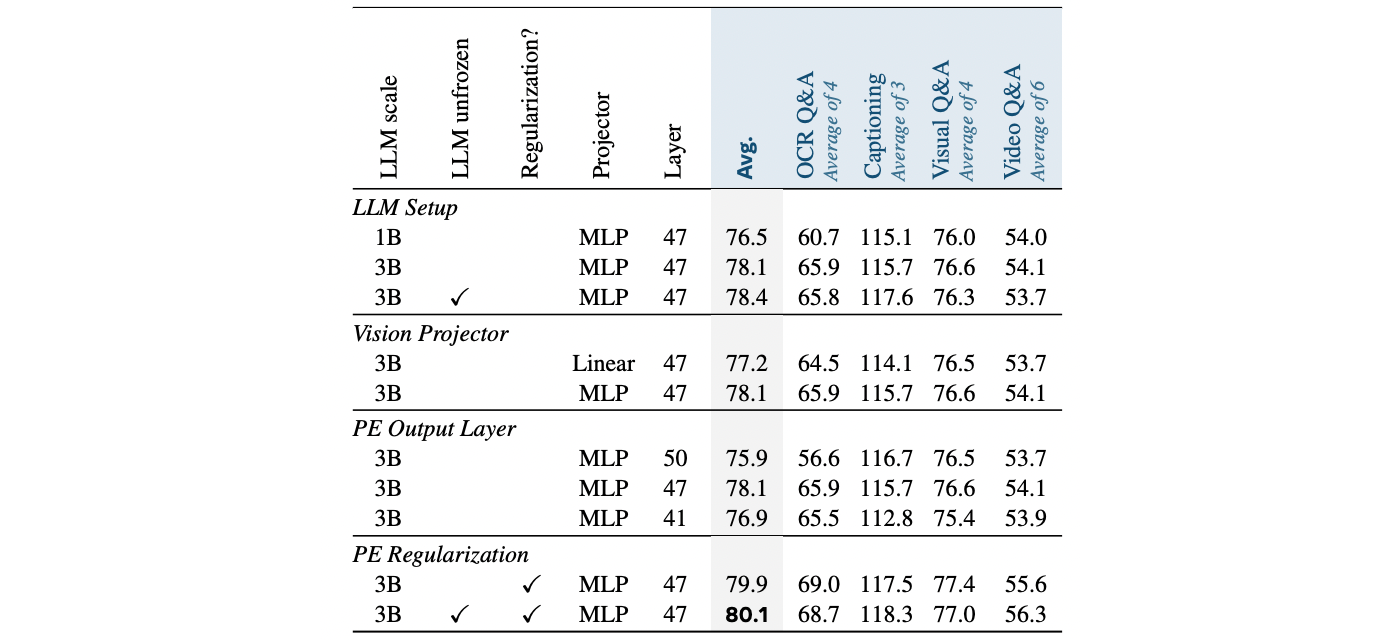
Language Alignment: PElang is created by aligning PEcoreG features with a Llama3.2 3B decoder. Optimal configuration uses a 2-layer MLP projector on layer 47, with LayerScale and DropPath regularization. Training on 70M samples yields a +2.1 point average improvement across OCR, captioning, VQA, and video Q&A.
Spatial Alignment: To handle tasks like detection and depth estimation, the authors use SAM 2.1 to enforce local correspondence while retaining semantic features via self-distillation from layer 41. This preserves local attention maps (critical for tracking) while maintaining global semantic information.
Perception Encoder achieves state-of-the-art on zero-shot image classification (e.g., ImageNet), video retrieval (MSR-VTT, PVD benchmark), document/image/video Q&A, and spatial tasks (detection, depth estimation). The language-aligned model (PElang) shows significant gains in OCR Q&A and grounding, even without grounding data. The spatial-aligned model improves tracking and dense prediction performance.
Perception Encoder provides a practical blueprint for building general-purpose vision encoders that can serve as the backbone for a wide range of AI applications. By decoupling image and video training and introducing alignment methods, the work reduces the engineering overhead of maintaining multiple specialized encoders. The open-source release of the PVD dataset and models will accelerate research in multimodal understanding and spatial reasoning.
Alex Krizhevsky, Ilya Sutskever et al.
Ashish Vaswani, Noam Shazeer et al.
Douglas M. Bates, Martin Mächler et al.
Diederik P. Kingma, Jimmy Ba