PreprintCommunications of the ACM
ImageNet classification with deep convolutional neural networks
Alex Krizhevsky, Ilya Sutskever et al.
130k2017
0
Citations
0
Influential Citations
—
Venue
2023
Year
A multilingual vision and language model with scaled-up components, specifically ViT-22 B and UL2 32B, exhibits emergent properties such as complex counting and multilingual object detection, and demonstrates improved performance across various tasks.
The PaLI-X paper is a landmark in the scaling of vision-language models (VLMs). By pushing parameters to 55 billion—a 22B ViT encoder paired with a 32B UL2 encoder-decoder—the authors show that sheer scale yields qualitatively new behaviors. These include complex counting (e.g., accurately counting objects in cluttered scenes) and multilingual object detection, capabilities that smaller models struggle with. The model achieves state-of-the-art results on over 25 diverse benchmarks, spanning image captioning, visual question answering, video understanding, object detection, and image classification. This work provides strong evidence that scaling laws apply to multimodal models, and that emergent abilities appear at sufficient scale, much like in large language models.
The architecture follows a classic encoder-decoder design. Images are processed by a Vision Transformer (ViT) with 22B parameters, producing visual embeddings. These are projected and concatenated with text token embeddings (e.g., questions or prompts) before being fed into the UL2-based encoder-decoder backbone (32B parameters). The model can handle multiple images as input, enabling few-shot and video tasks.
Vision Model: The ViT-22B is pre-trained on JFT-3B for classification and further trained on WebLI data with OCR annotations from Google Cloud Vision API. A novel OCR-based classification task (predicting whether a token appears in the image) equips the model with strong text-reading abilities.
Language Model: The encoder-decoder is initialized from UL2 32B, a powerful multilingual model. This provides a strong foundation for language understanding and generation.
Pre-training Data: The training mixture is exceptionally diverse, including:
Training Stages:
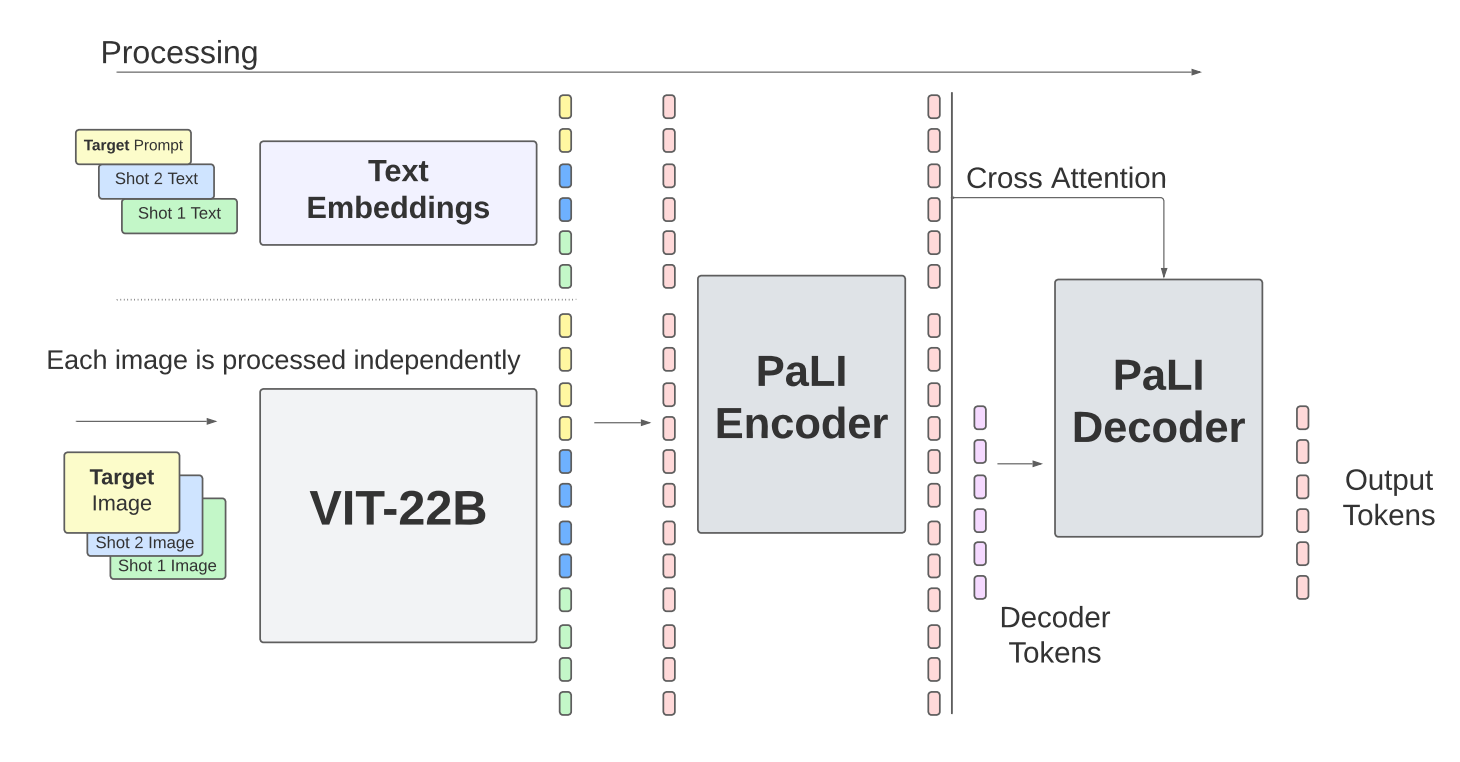
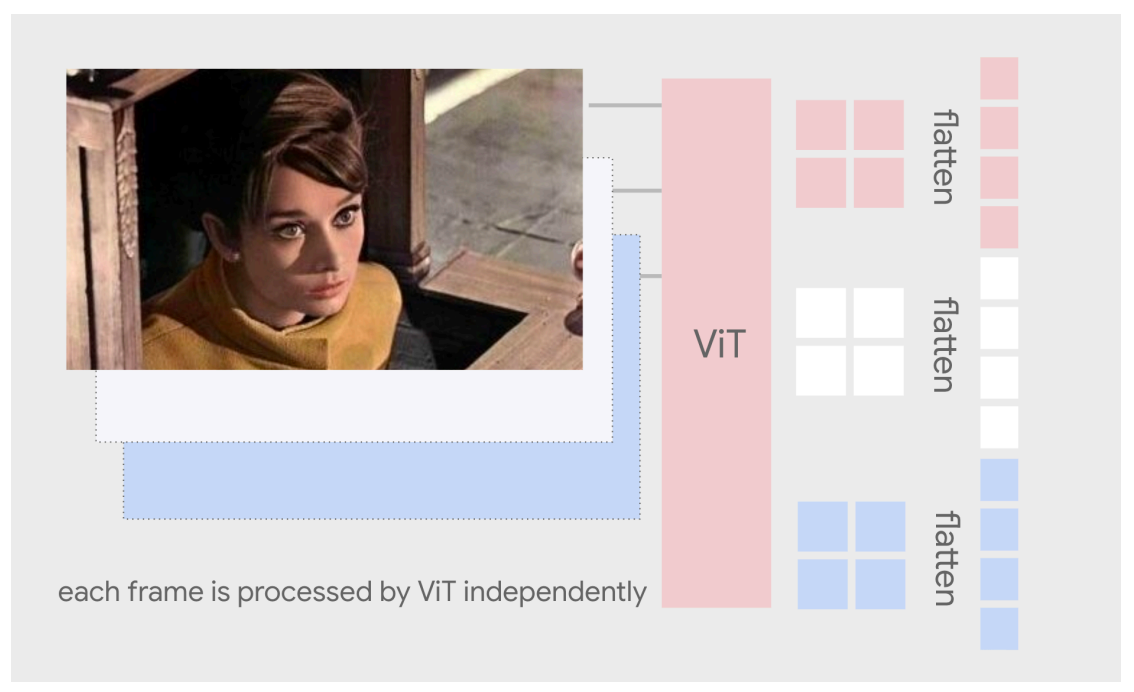
Few-shot Formulation: For few-shot tasks, all images (support and query) are independently encoded by the ViT. Their patch embeddings are flattened, concatenated, projected, and combined with text embeddings to form the multimodal input sequence.
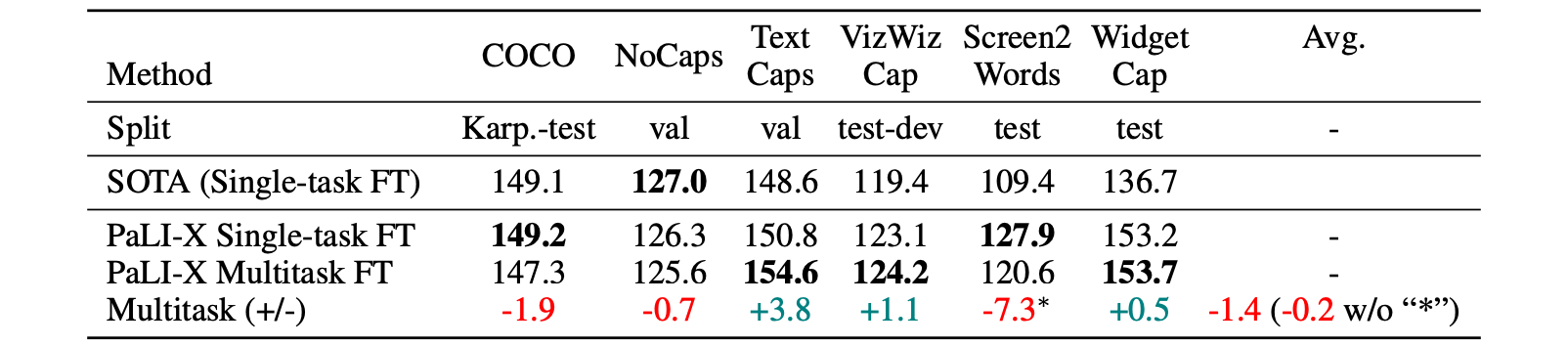
Image Captioning and VQA:
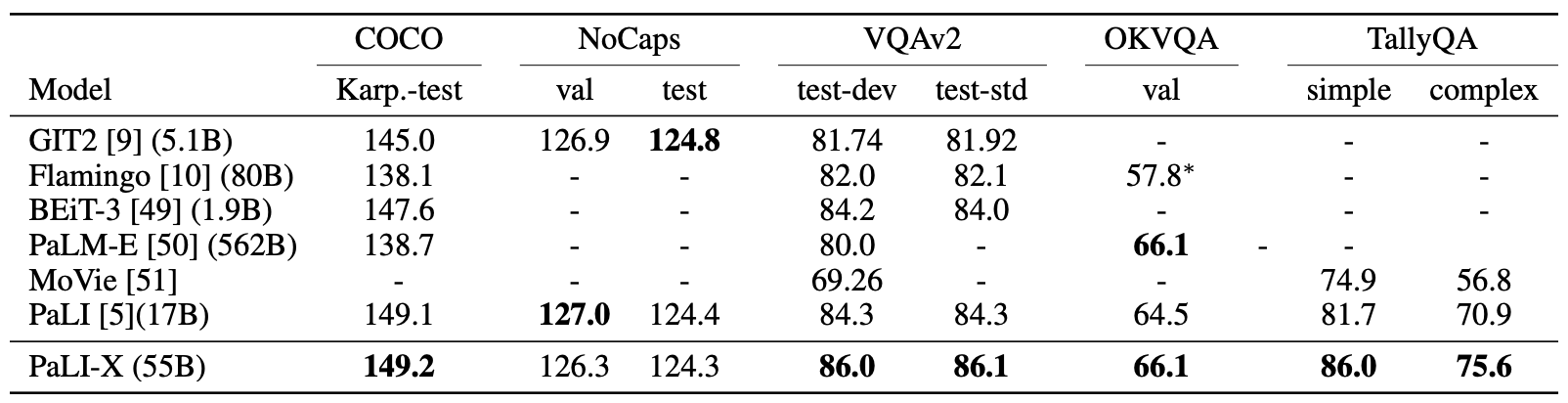
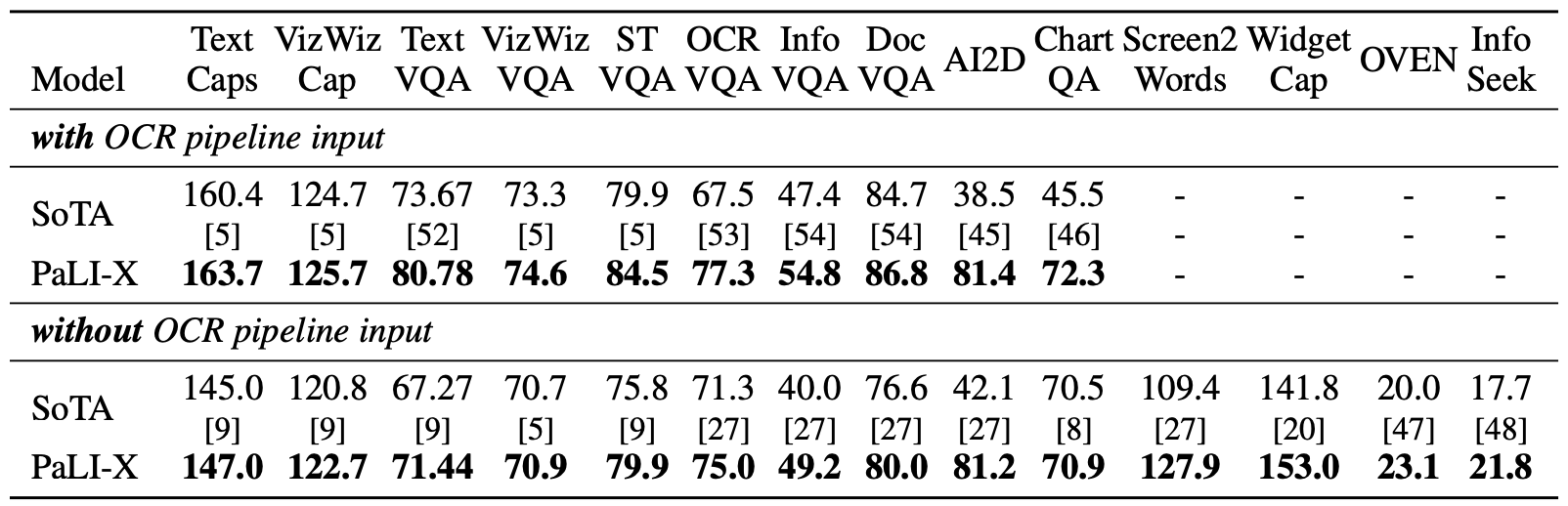
PaLI-X outperforms prior SOTA by large margins on challenging scene-text and document understanding tasks. Multitask fine-tuning achieves performance on par with single-task fine-tuning, demonstrating the model's versatility.
Few-shot Learning:

PaLI-X achieves SOTA on COCO captioning with only 4 or 32 shots, and shows strong multilingual captioning on XM3600.
Video Understanding:
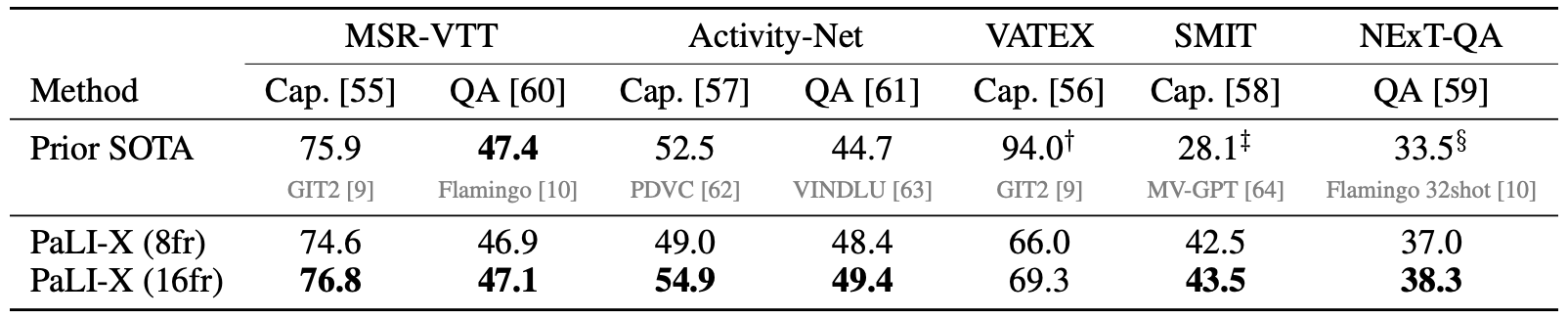
Using 16 frames yields significant gains (e.g., +6 CIDEr on ActivityNet Captions). PaLI-X sets new SOTA on 5 of 7 video tasks.
Image Classification:

PaLI-X achieves SOTA for generative models on ImageNet, competitive with discriminative models.
Object Detection:
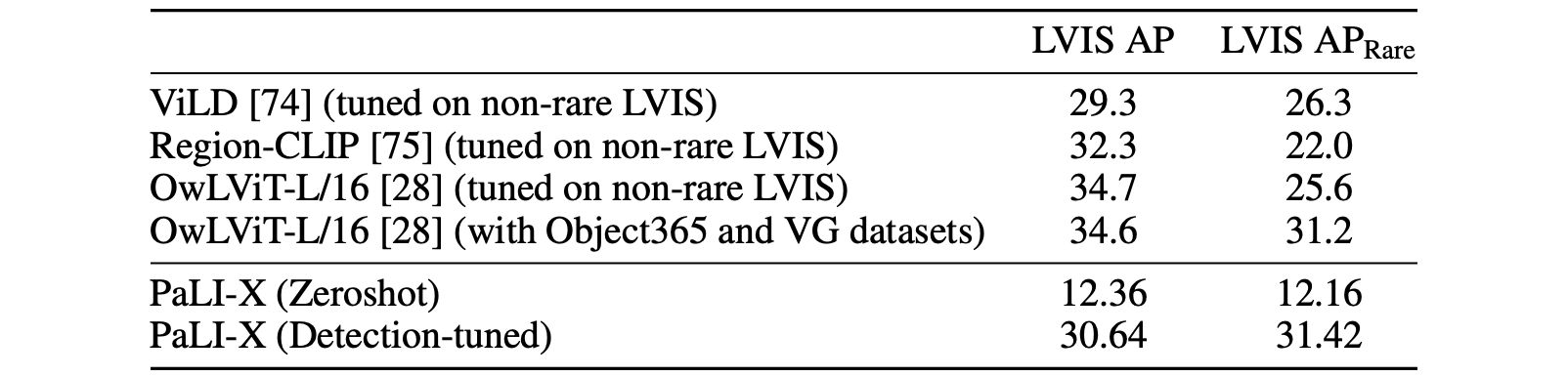
On LVIS, the detection-tuned model achieves 31 mAP overall and 31.4 on rare classes. Zero-shot mAP is ~12 for both common and rare classes, showing balanced performance without complex sampling.
PaLI-X demonstrates that scaling VLMs to 55B parameters unlocks emergent abilities and sets new standards across a wide range of multimodal tasks. The two-stage training with progressive resolution is a practical recipe for training large models efficiently. The model's strong few-shot and multilingual performance suggests that scale can reduce the need for task-specific data. However, the enormous computational cost limits accessibility. Future work may focus on distillation, efficient architectures, or data curation to democratize such capabilities. PaLI-X solidifies the trend that bigger models, trained on diverse data, are the path to generalist vision-language AI.
Alex Krizhevsky, Ilya Sutskever et al.
Ashish Vaswani, Noam Shazeer et al.
Douglas M. Bates, Martin Mächler et al.
Diederik P. Kingma, Jimmy Ba