PreprintCommunications of the ACM
ImageNet classification with deep convolutional neural networks
Alex Krizhevsky, Ilya Sutskever et al.
130k2017
0
Citations
0
Influential Citations
—
Venue
2022
Year
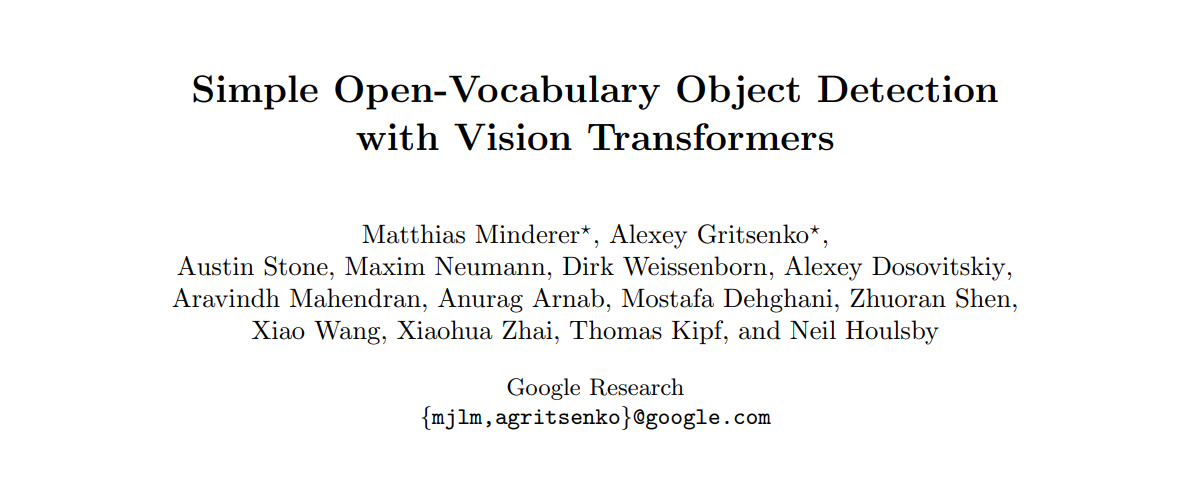
Employs Vision Transformers, CLIP-based contrastive pre-training, and bipartite matching loss for open-vocabulary detection, utilizing image-level pre-training, multihead attention pooling, and mosaic image augmentation.
OWL ViT addresses a critical gap in object detection: the ability to recognize objects not seen during training. Traditional detectors are limited to fixed vocabularies, but OWL ViT leverages vision-language pre-training to generalize to arbitrary categories. This is especially valuable for real-world applications where object classes are diverse and constantly evolving.
The method follows a two-stage pipeline. First, a Vision Transformer (ViT) image encoder and a Transformer text encoder are contrastively pre-trained on large-scale image-text pairs, similar to CLIP. This stage uses multihead attention pooling (MAP) to aggregate image token representations and the EOS token for text. The second stage adds detection heads on top of the image encoder and fine-tunes on medium-sized detection datasets like LVIS.
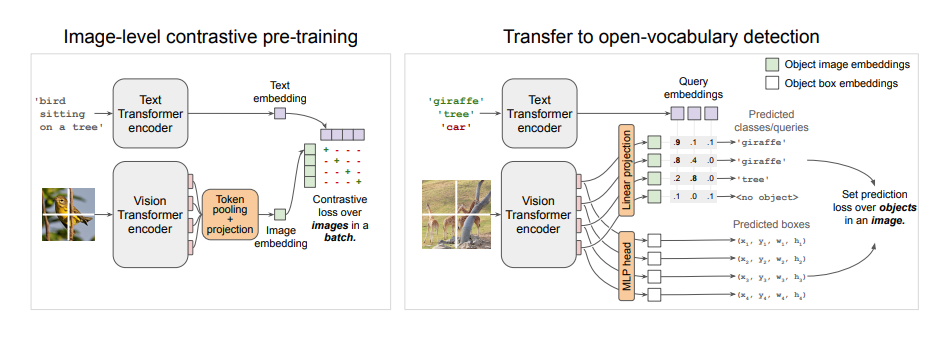
For detection, the model removes the token pooling and final projection layer from the ViT. Each output token is linearly projected to produce per-object image embeddings for classification, and a small MLP predicts bounding box coordinates. This design resembles DETR but eliminates the decoder, simplifying the architecture. The maximum number of predicted objects equals the number of image tokens.
Open-vocabulary classification is achieved by using text embeddings (queries) from the text encoder instead of fixed class embeddings. For each image, category names are passed through the text encoder to generate queries. The model then predicts, for each object, a bounding box and a probability for each query. Notably, there is no fusion between image and text encoders, which avoids repeated forward passes for each query-image pair.
For one-shot detection, the model can accept image-derived embeddings as queries. By using embeddings of prototypical object images, it performs image-conditioned detection without any architectural changes. This enables efficient processing of thousands of query embeddings simultaneously.
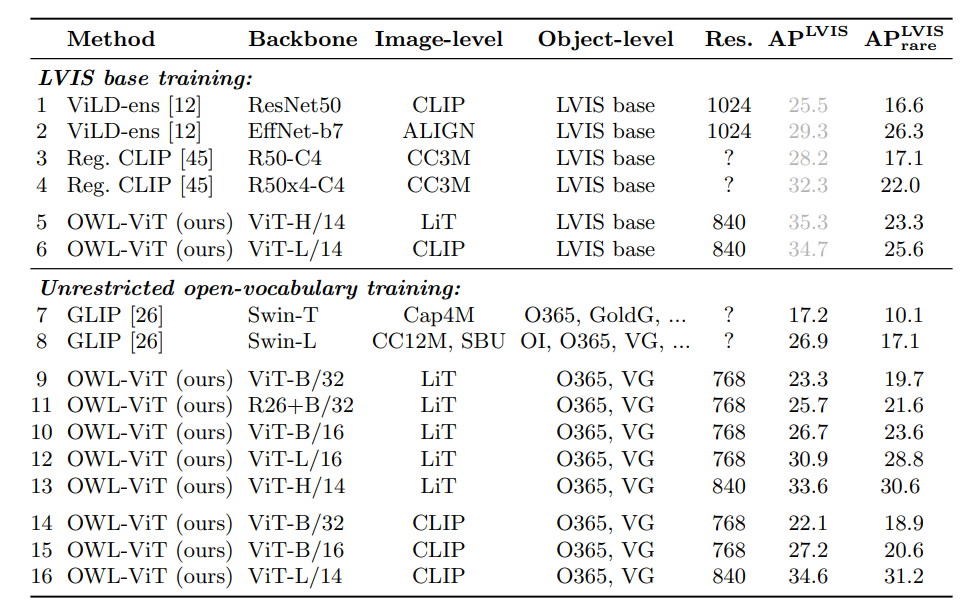
On LVIS v1.0, using all 1203 category names as queries per image, the best model achieves 31.2% AP on rare categories (zero-shot) and strong overall AP. On MS-COCO 2017, it reaches 43.5% AP, demonstrating effective open-vocabulary transfer. The method significantly outperforms prior work in one-shot detection, with a 72% improvement across COCO splits.
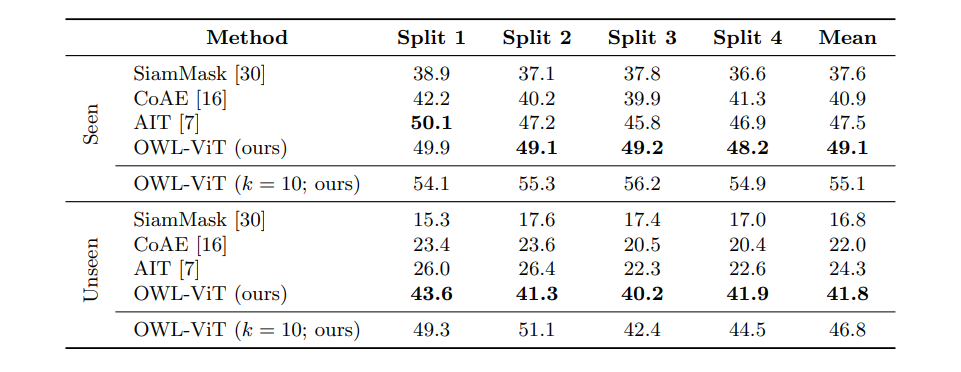
Few-shot predictions, obtained by averaging image embeddings for multiple query examples, yield further gains. The model's efficiency stems from not entangling query and target image features during inference.
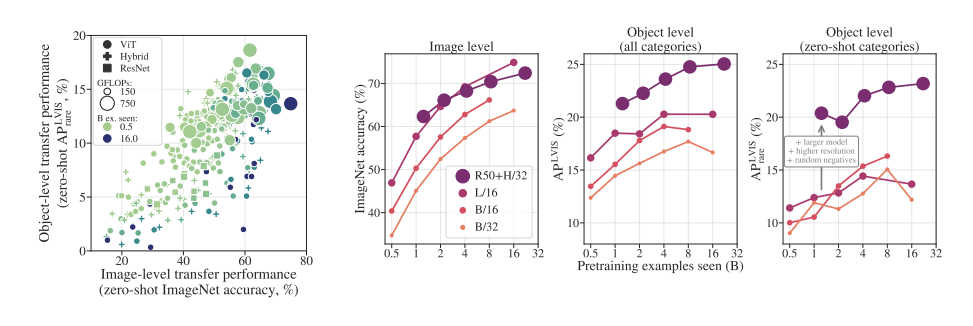
Scaling analysis shows that high image-level pre-training performance is necessary but not sufficient for strong detection transfer. Detection performance peaks after a certain pre-training duration, while image-level performance continues to rise. Increasing model size and improving fine-tuning can extend this trend.
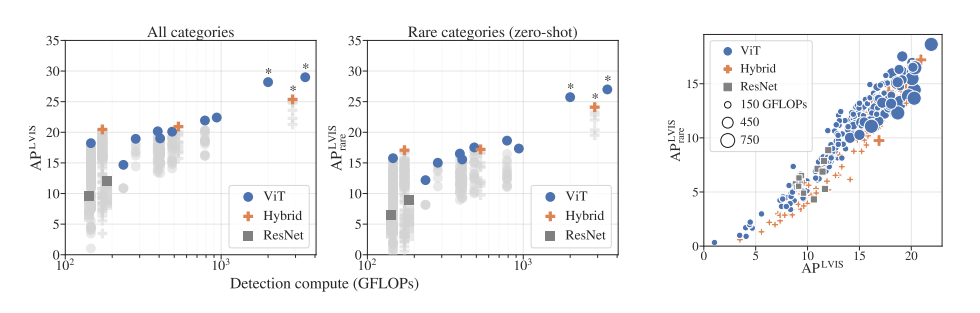
Hybrid ResNet-Transformer architectures are more efficient at small scales, but pure ViTs outperform them as model size increases. Pure ViTs also show a clear advantage in zero-shot detection, suggesting they learn better semantic generalization, making them preferable for large-scale pre-training.
OWL ViT provides a simple yet powerful framework for open-vocabulary object detection, bridging the gap between image-text pre-training and detection tasks. Its minimal architectural modifications make it easy to adopt and scale. The ability to perform one-shot detection with image queries opens up practical applications in domains where textual descriptions are unavailable. The findings also guide future scaling efforts toward pure Transformer architectures.
Alex Krizhevsky, Ilya Sutskever et al.
Ashish Vaswani, Noam Shazeer et al.
Douglas M. Bates, Martin Mächler et al.
Diederik P. Kingma, Jimmy Ba