PreprintCommunications of the ACM
ImageNet classification with deep convolutional neural networks
Alex Krizhevsky, Ilya Sutskever et al.
130k2017
0
Citations
0
Influential Citations
—
Venue
2024
Year
A foundation model for Named Entity Recognition (NER) created by further pre-training RoBERTa, using contrastive training on a large dataset annotated by GPT-3.5, derived from a subset of C4.
Named Entity Recognition (NER) is a cornerstone of information extraction, but traditional approaches require large, carefully annotated datasets for each new domain or entity type. Large language models (LLMs) like GPT-4 can perform NER zero-shot, but their size and cost make them impractical for many production systems. NuNER bridges this gap by showing that a compact encoder model (125M parameters) can match or exceed the few-shot performance of models 56 times larger, using synthetic annotations from GPT-3.5. This matters because it offers a practical, data-efficient path to deploy high-quality NER without massive compute budgets or extensive human annotation.
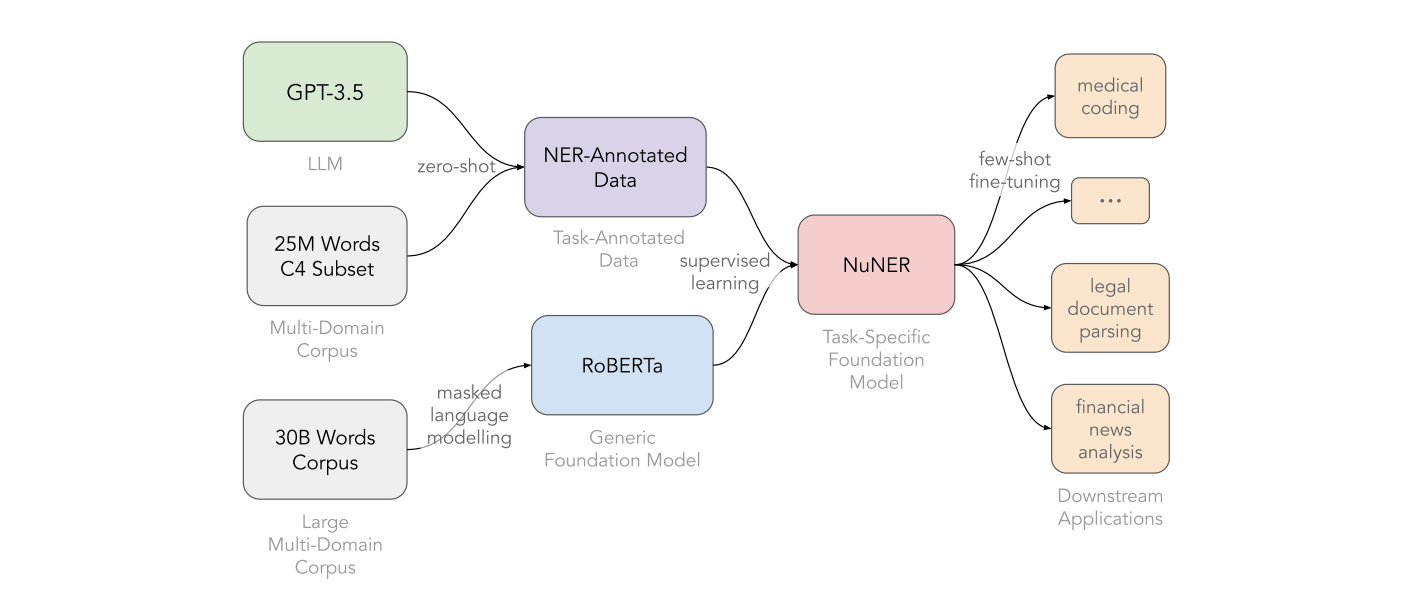
NuNER's innovation lies in its pre-training data and contrastive learning objective. The authors start with a random sample of C4, a diverse English web corpus, and annotate it using GPT-3.5-turbo with a prompt that encourages extracting any entity, concept, or idea—not just traditional NER types like person or organization. This yields 1 million sentences with 4.38 million entity annotations across 200,000 unique concepts, ranging from concrete entities to abstract topics.
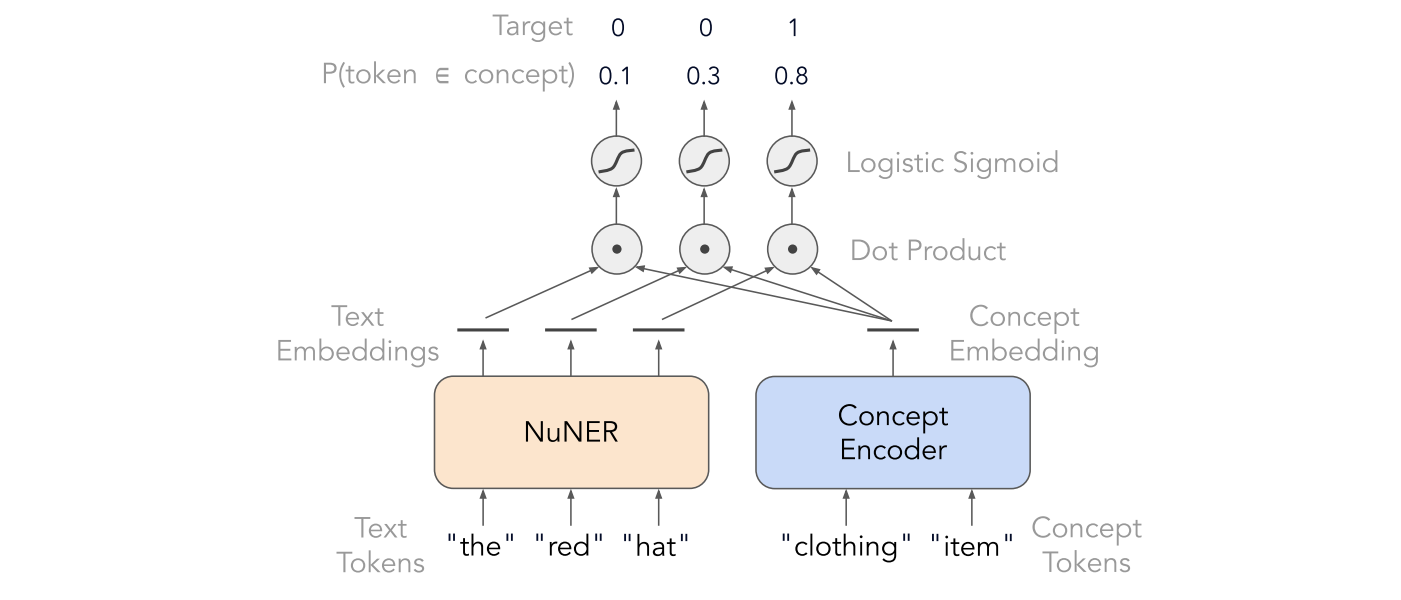
Because the concept set is large and imbalanced, standard token classification over a fixed label set is impractical. Instead, NuNER uses a contrastive learning framework with two encoders: a text encoder (RoBERTa-base) that produces token embeddings, and a concept encoder that embeds concept names. During training, each token's embedding is pushed toward the embedding of its annotated concept and away from others via a logistic sigmoid on the dot product. This encourages the text encoder to learn a representation space where entity tokens cluster by semantic concept.
After pre-training, the concept encoder is discarded, and the text encoder (NuNER) can be fine-tuned on downstream NER tasks by adding a simple classification head. The bottom six layers of RoBERTa are frozen during pre-training for stability, and the model is trained for 10 epochs.
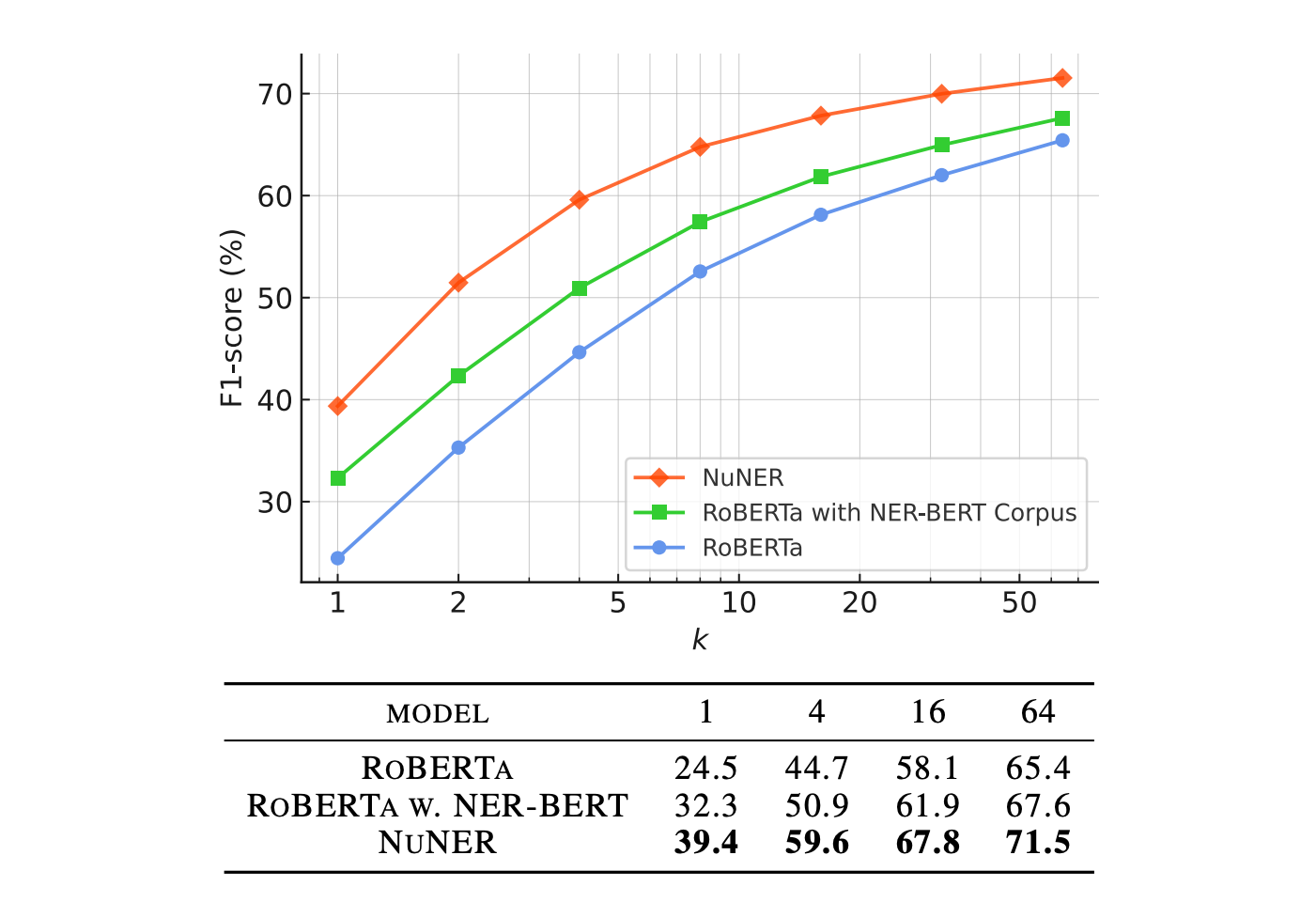
In few-shot experiments with frozen backbones, NuNER significantly outperforms RoBERTa pre-trained on the NER-BERT dataset across all training sizes and datasets. When integrated into the TadNER framework for Few-NERD, NuNER sets a new state-of-the-art.

Comparing directly with generative LLMs, NuNER starts lower than GPT-3.5 and GPT-4 in zero-shot but quickly catches up. With more than 8 examples per entity type, it surpasses GPT-3.5 and matches UniversalNER, despite being 56 times smaller.
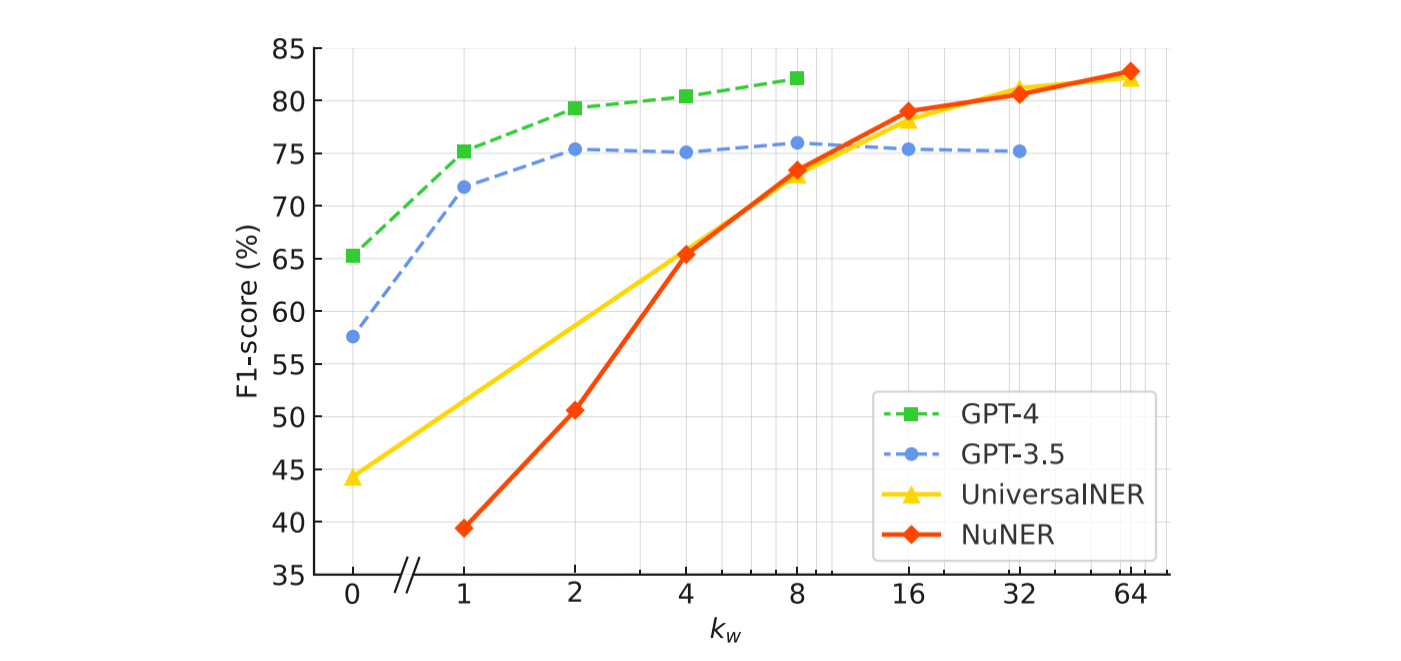
In the standard k∼2k few-shot setting, NuNER and UniversalNER achieve similar entity-level F1 scores, suggesting that encoder models have an inherent advantage for NER tasks due to their token-level representations.

NuNER demonstrates that synthetic data from LLMs can be effectively distilled into compact encoder models for NER, achieving strong few-shot performance without the computational overhead of generative models. This opens the door for practical, low-cost NER systems that can be quickly adapted to new domains with minimal labeled examples. The contrastive pre-training approach also provides a template for leveraging LLM-generated annotations in other token-level tasks. However, the reliance on exact string matching for entity positions and the noisy, imbalanced concept set highlight areas for future improvement. Overall, NuNER is a step toward democratizing high-quality NER for real-world applications.
Alex Krizhevsky, Ilya Sutskever et al.
Ashish Vaswani, Noam Shazeer et al.
Douglas M. Bates, Martin Mächler et al.
Diederik P. Kingma, Jimmy Ba