PreprintCommunications of the ACM
ImageNet classification with deep convolutional neural networks
Alex Krizhevsky, Ilya Sutskever et al.
130k2017
0
Citations
0
Influential Citations
—
Venue
2024
Year
A multimodal llm that combines a ViT-H image encoder with 378x378px resolution, pretrained on a data mix of image-text documents and text-only documents, scaled up to 3B, 7B, and 30B parameters for enhanced performance across various tasks.
The MM1 paper addresses a fundamental question in multimodal AI: how to effectively combine vision and language at scale. While many recent models rely on proprietary data or massive compute, MM1 provides a systematic, reproducible recipe for building state-of-the-art multimodal LLMs. Its key insight—that a careful mix of image-caption, interleaved image-text, and text-only data is more important than architectural innovations—offers practical guidance for practitioners. The paper's thorough ablation studies across architecture, data, and training procedures make it a valuable reference for anyone building or fine-tuning multimodal models.
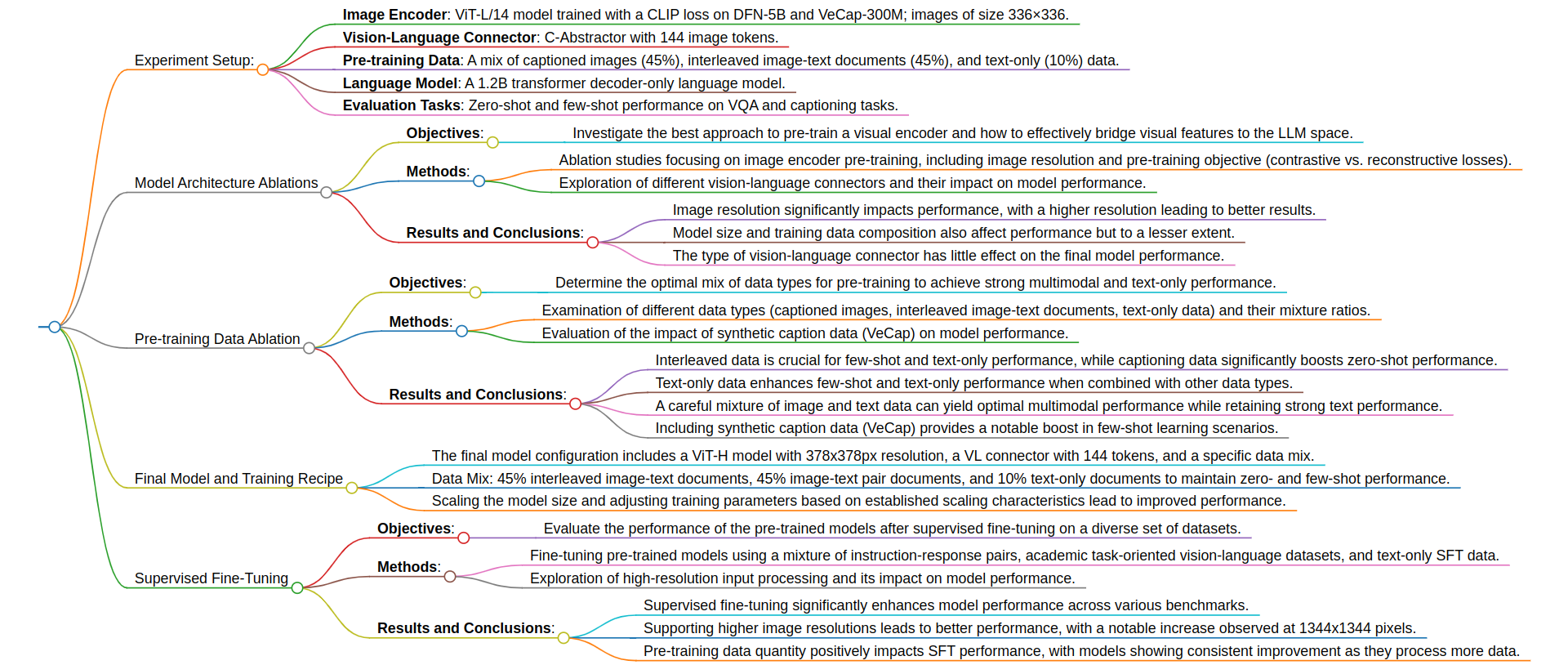
The authors start with a base configuration: a ViT-L/14 image encoder (336x336 resolution), a C-Abstractor vision-language connector producing 144 image tokens, a 1.2B transformer decoder LLM, and a data mix of 45% captioned images, 45% interleaved image-text documents, and 10% text-only data. They then systematically vary one component at a time to measure its impact.
Architecture Ablations:
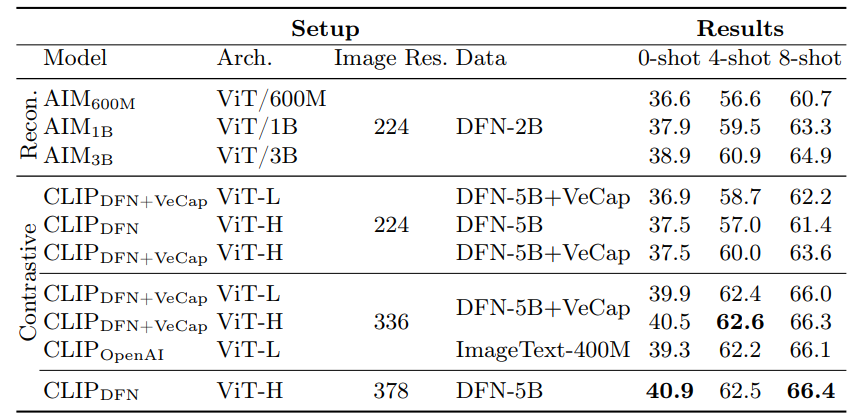
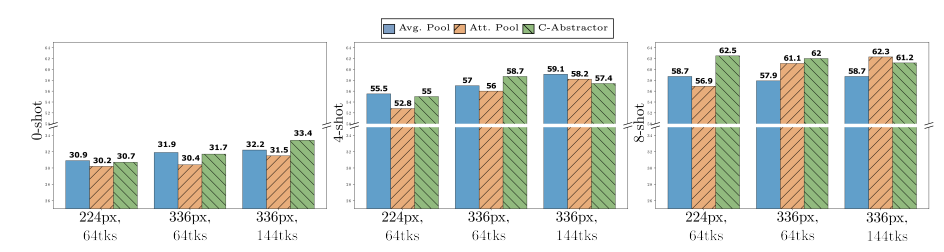
Data Ablations:
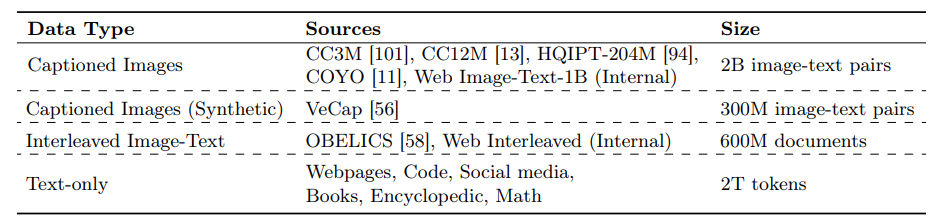
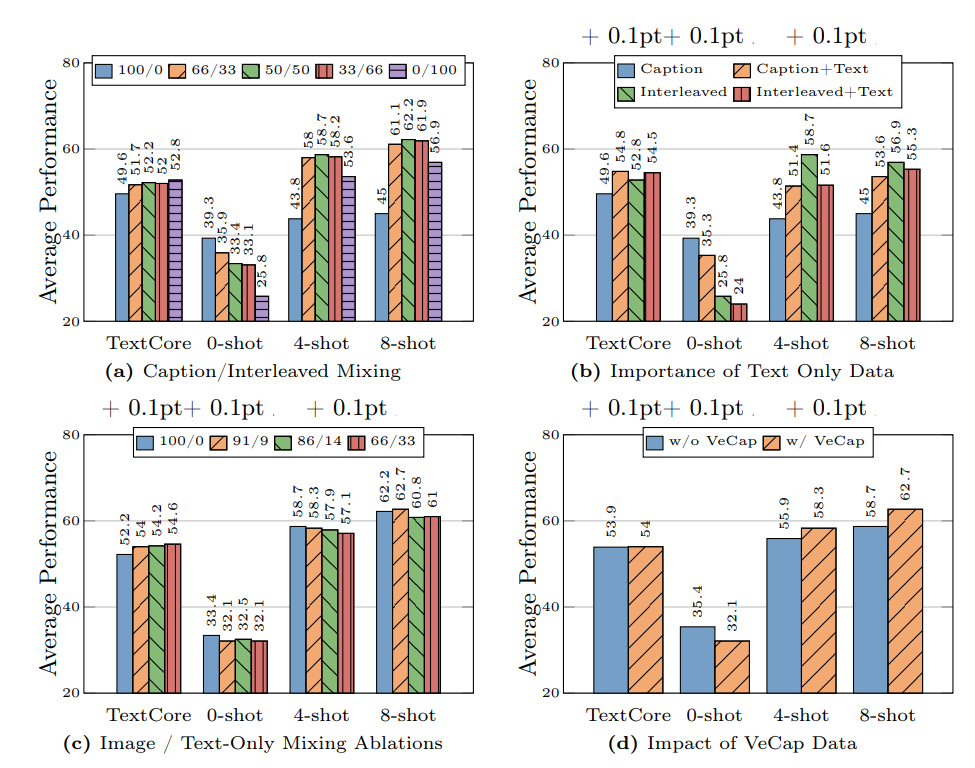
Final Recipe:
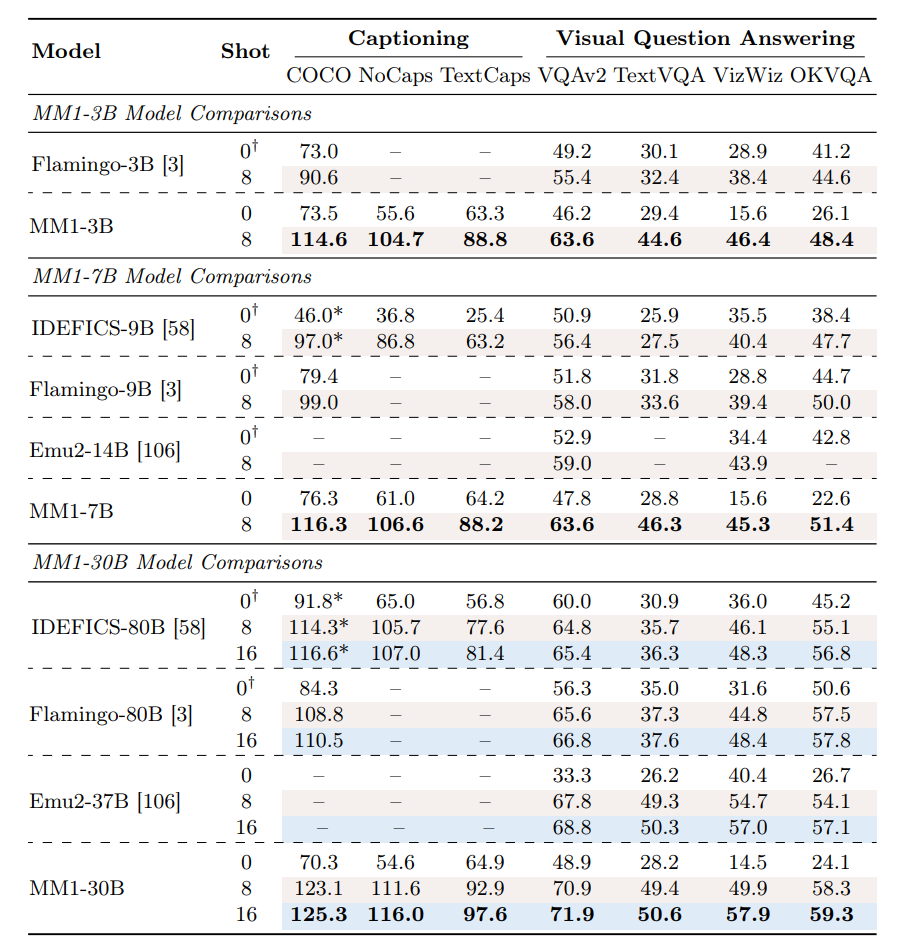
MM1 models achieve SOTA few-shot performance on captioning and VQA tasks at 30B scale, outperforming all published prior work in few-shot settings without instruction fine-tuning. Zero-shot performance is competitive, especially on TextCaps.
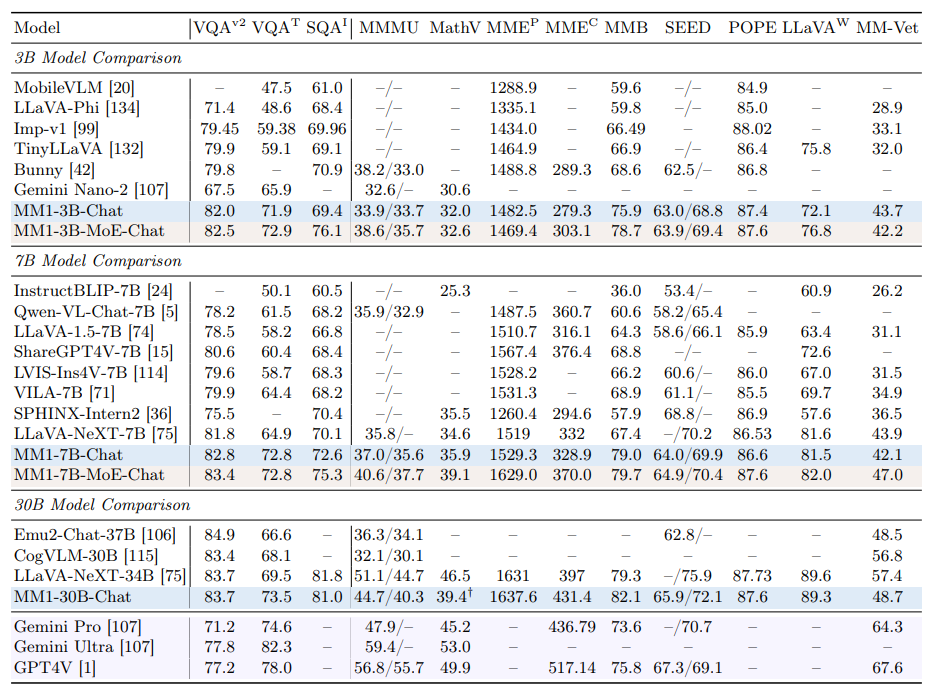
After supervised fine-tuning (SFT) with ~1M examples, MM1-30B-Chat sets new benchmarks for its size, outperforming all listed models of the same size. MoE variants show uniformly better performance, indicating further scaling potential.
Higher image resolution significantly improves SFT performance (15% relative increase at 1344x1344), though performance slightly drops at 1792x1792 due to resizing artifacts. Pre-training scale consistently improves final model performance.
MM1's main contribution is providing a clear, empirically validated recipe for building high-performing multimodal LLMs. The finding that data composition matters more than architectural choices is a practical insight for practitioners. The paper's thorough ablations and scaling studies make it a foundational reference for future work in multimodal pre-training. While the model has limitations in multi-image reasoning and few-shot prompting, the methodology and insights will likely influence both research and commercial multimodal systems.
Alex Krizhevsky, Ilya Sutskever et al.
Ashish Vaswani, Noam Shazeer et al.
Douglas M. Bates, Martin Mächler et al.
Diederik P. Kingma, Jimmy Ba