PreprintCommunications of the ACM
ImageNet classification with deep convolutional neural networks
Alex Krizhevsky, Ilya Sutskever et al.
130k2017
1.0k
Citations
118
Influential Citations
Annual Meeting of the Association for Computational Linguistics
Venue
2023
Year
A process reward model that automatically scores the correctness of each step in a math problem solution, using this to rerank LLM outputs and to reinforce LLMs via step-by-step PPO, without human annotations or external tools. It leverages a Monte Carlo Tree Search inspired approach where an LLM decodes multiple subsequent paths from each step and the step's score reflects how many lead to the correct final answer.
Large language models (LLMs) have shown impressive capabilities in mathematical reasoning, but verifying the correctness of their step-by-step solutions remains a challenge. Traditional outcome reward models (ORMs) only check the final answer, missing reasoning errors that happen to lead to the correct result. Process reward models (PRMs) offer finer-grained feedback by scoring each step, but they typically require expensive human annotations. Math Shepherd breaks this bottleneck by automatically generating step-level supervision data, making process reward models practical and scalable. This matters because it enables both better verification of LLM outputs and more effective reinforcement learning through step-by-step rewards, directly addressing a key limitation in current LLM training pipelines.
Math Shepherd's core idea is to define the quality of a reasoning step by its potential to lead to the correct final answer. This is inspired by Monte Carlo Tree Search (MCTS): for each intermediate step in a candidate solution, the system generates multiple complete solutions starting from that step. By analyzing how many of these completions reach the correct answer, it assigns a score to the original step.
Task Formulation
Given a math problem, the system samples N candidate solutions from a generator. Each solution is scored by a reward model, and the highest-scoring solution is selected. The paper compares two types of reward models:


Automatic Process Annotation
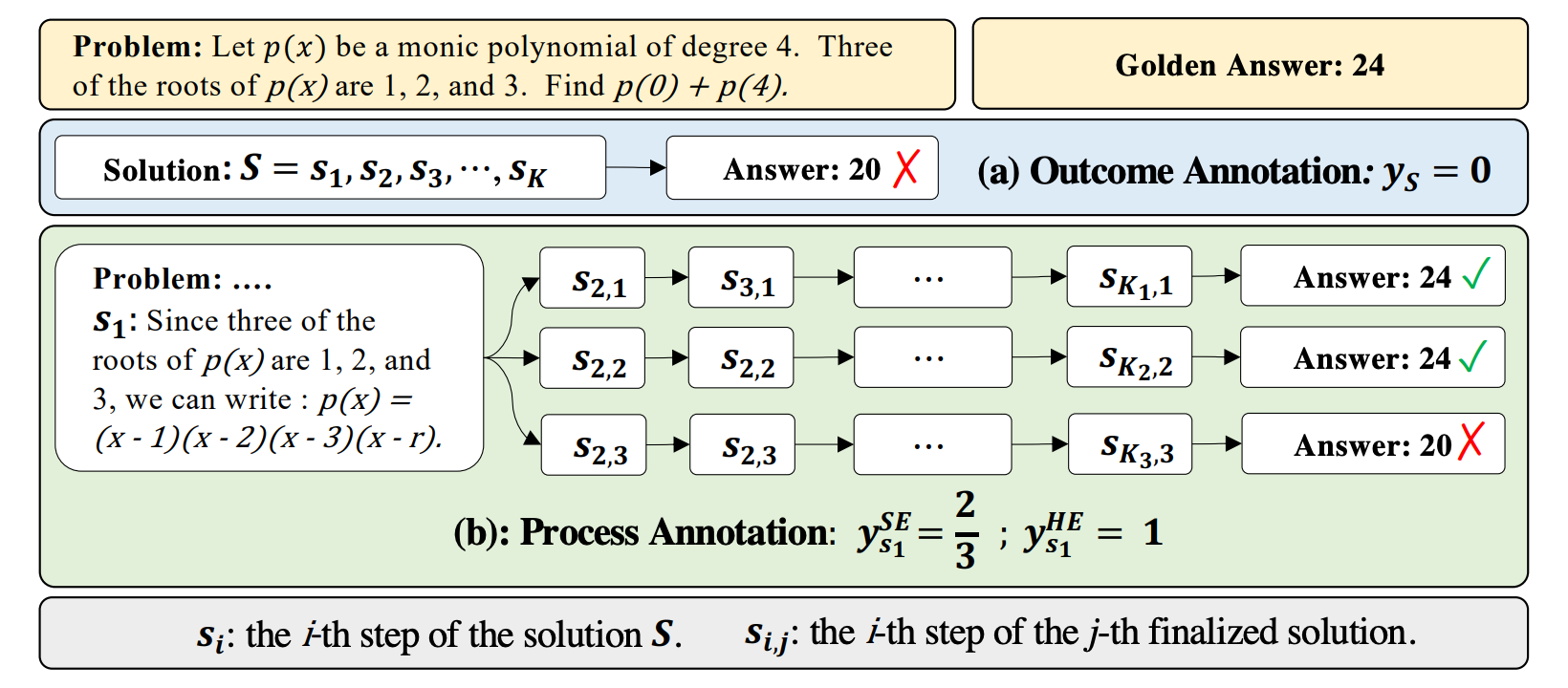
For each step s_i in a solution, the system uses a "completer" LLM to generate N complete solutions from that step onward. This yields a set of completions with their final answers. Two estimation methods are used to score the step:


These scores are used to train a PRM via cross-entropy loss, learning to predict step quality from the step itself.
Ranking for Verification
For verification, the overall score of a solution is taken as the minimum PRM score across all its steps (the weakest link). Solutions are grouped by their final answer, and the group with the highest combined score (from self-consistency and the reward model) is selected.

Reinforcement Learning with Process Supervision
Instead of providing a single reward at the end of a solution (as in standard PPO with ORM), Math Shepherd provides a reward after each reasoning step, derived from the trained PRM. This step-by-step PPO gives the model more granular feedback, helping it learn which steps are correct and which are not, leading to more efficient policy updates.
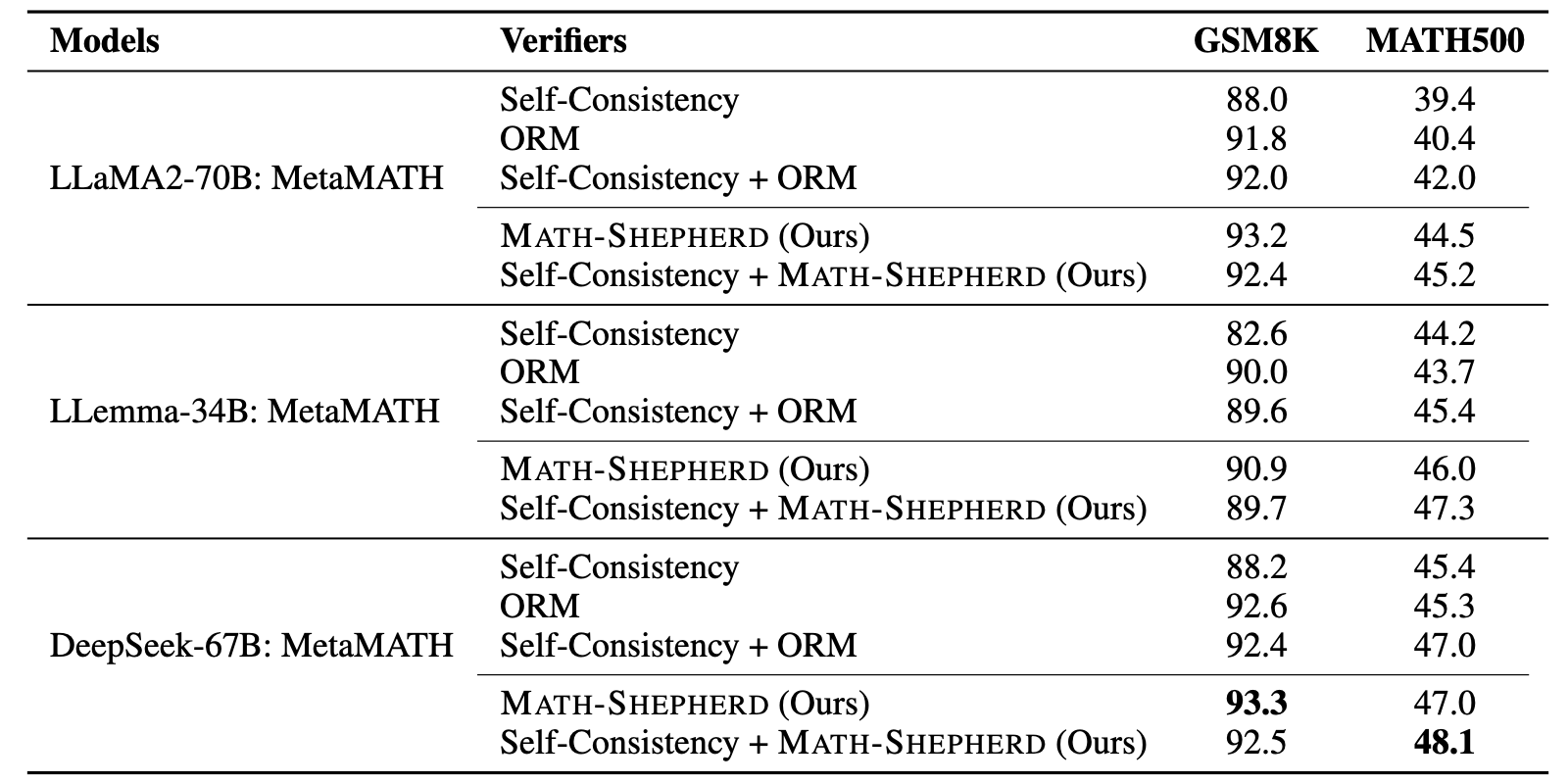
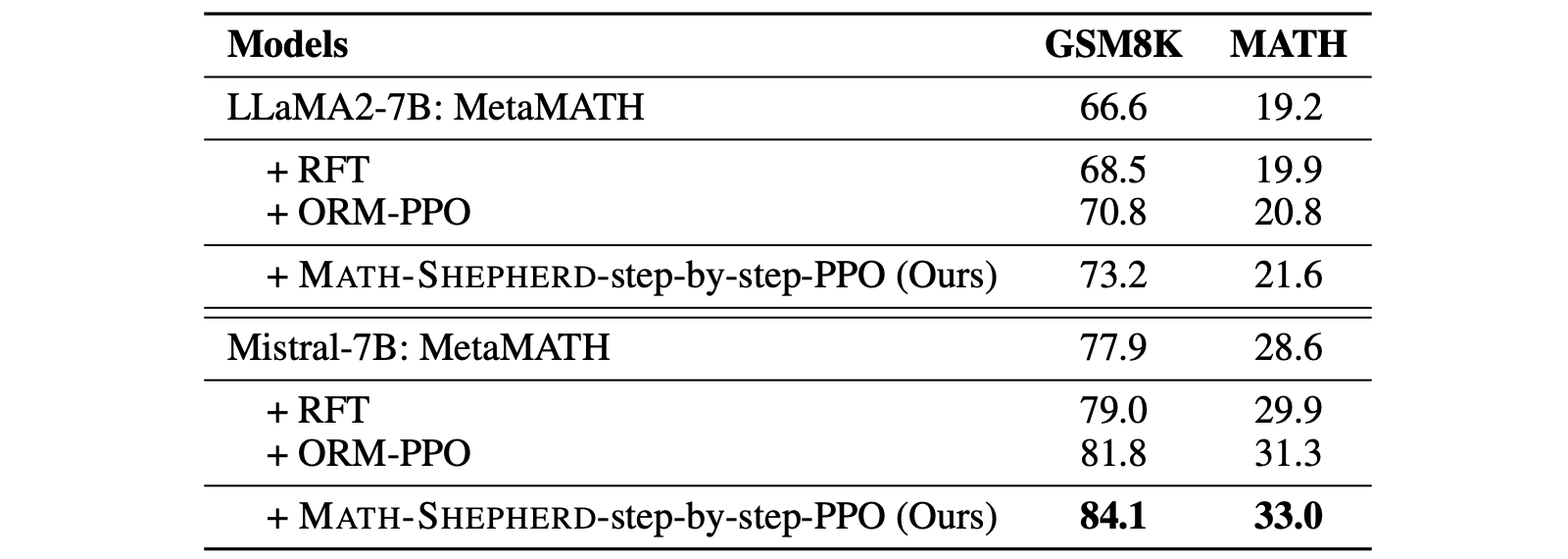
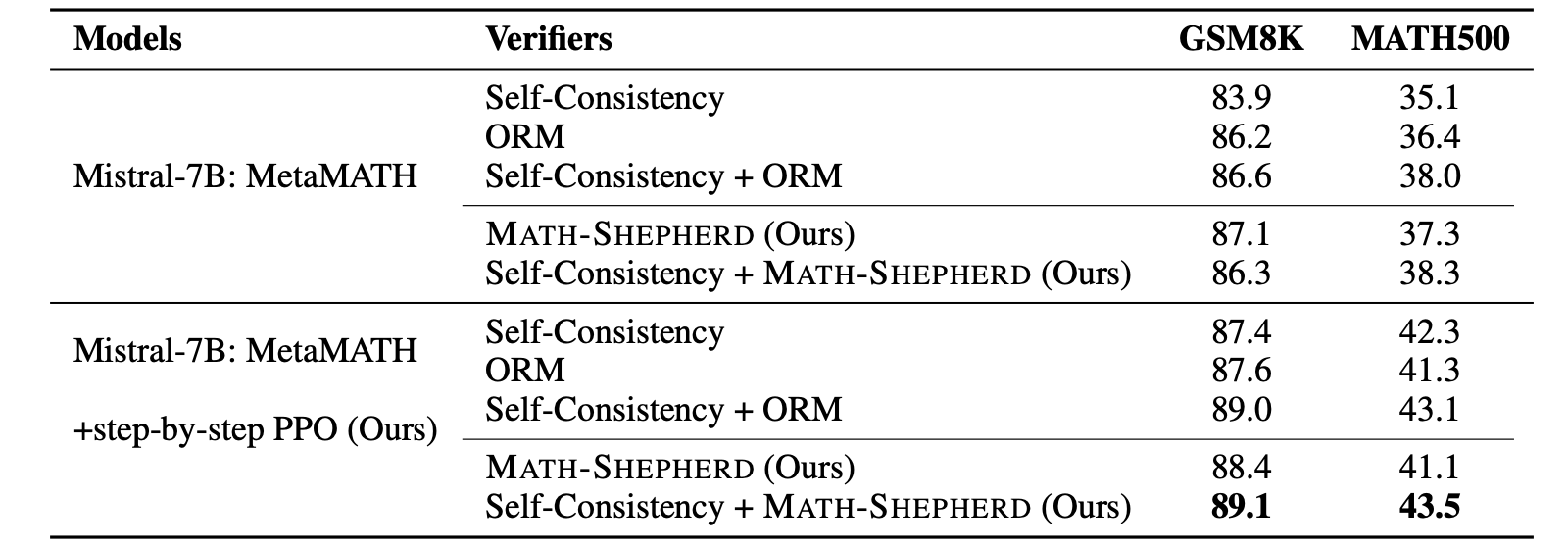
Math Shepherd offers a practical, annotation-free path to process-level supervision for LLMs. By automating the creation of step-level training data, it removes a major bottleneck in developing process reward models. The dual use of these models—for both verification and reinforcement learning—demonstrates a unified framework that improves LLM reasoning at multiple stages. This approach is not limited to math; it can be extended to any domain where multi-step reasoning can be evaluated by the correctness of final outcomes. The paper's findings also caution against naive combinations of verification methods, providing guidance for future work. As LLMs are increasingly deployed in tasks requiring rigorous reasoning, Math Shepherd's methodology could become a standard component in training and inference pipelines.
Alex Krizhevsky, Ilya Sutskever et al.
Ashish Vaswani, Noam Shazeer et al.
Douglas M. Bates, Martin Mächler et al.
Diederik P. Kingma, Jimmy Ba