PreprintCommunications of the ACM
ImageNet classification with deep convolutional neural networks
Alex Krizhevsky, Ilya Sutskever et al.
130k2017
0
Citations
0
Influential Citations
—
Venue
2024
Year
Curated a large-scale, multimodal instruction-tuning dataset with 12M instruction-response pairs using a cost-effective method involving open-source data collection and categorization, task-specific data augmentation and rewriting using open models (Llama-3-70B-Instruct for caption-based data and InternVL2-Llama3-76B for other data types), and self-filtering with InternVL2-Llama3-76B to remove hallucinations and ensure data quality.
Multimodal large language models (MLLMs) have made impressive strides, but their reasoning capabilities are often bottlenecked by the quality of instruction-tuning data. Existing datasets tend to focus on simplistic tasks with phrase-level answers, lacking the intermediate rationales that foster chain-of-thought (CoT) reasoning. MAmmoTH-VL tackles this head-on by introducing a scalable, cost-effective pipeline that generates a massive 12M instruction-response dataset rich in detailed reasoning. What makes this work particularly impactful is its commitment to open-source principles: the entire pipeline uses only open models and publicly available data, making it accessible to researchers and practitioners without massive budgets. The resulting model, MAmmoTH-VL-8B, achieves state-of-the-art performance among open-source MLLMs, especially in mathematical reasoning, demonstrating that high-quality data curation can rival the benefits of scaling model size.
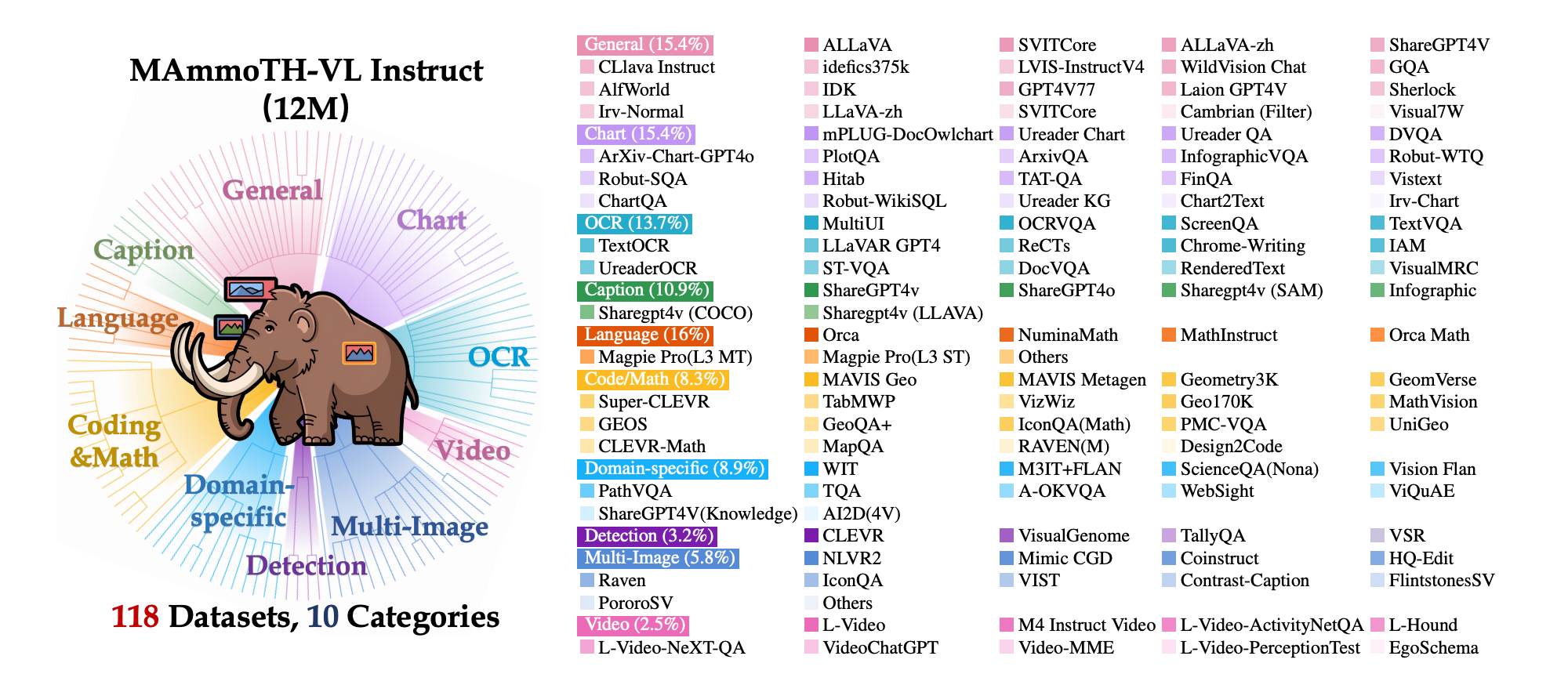
The MAmmoTH-VL pipeline consists of three key stages: data collection and categorization, task-specific rewriting, and self-filtering. First, the authors source raw image-text pairs from 153 publicly available multimodal datasets, covering a wide range of domains like OCR, charts, captions, and medical images. To manage this diversity, they reorganize the data into 10 major categories (e.g., General, OCR, Chart, Code&Math) and three quality groups (A, B, C) based on the informativeness and structure of existing responses. Group A datasets with high-quality responses are kept as-is, while Group B datasets with brief but improvable responses are targeted for rewriting. Group C datasets, deemed too vague, are discarded.

The rewriting step is where the magic happens. For caption-based data, the authors use a text-only model (Llama-3-70B-Instruct) to generate task-oriented Q&A pairs, leveraging its strength in creating diverse and complex instructions from rich textual descriptions. For all other data types, they employ a multimodal model (InternVL2-Llama3-76B) to ensure strong alignment between visual content and generated instructions. Customized prompts are designed for each data category to elicit the desired reasoning format.
A critical innovation is the self-data filtering step. Manual inspection of rewritten data revealed hallucinations, especially in OCR and chart tasks. To address this, the authors use the same multimodal model (InternVL2-Llama3-76B) as a judge to evaluate the logical consistency of each Q&A pair against the corresponding image. The insight is that while the model may generate inaccuracies, it is more reliable at verification. This "Model-as-Judge" approach efficiently filters out hallucinated or irrelevant content, ensuring high data quality.
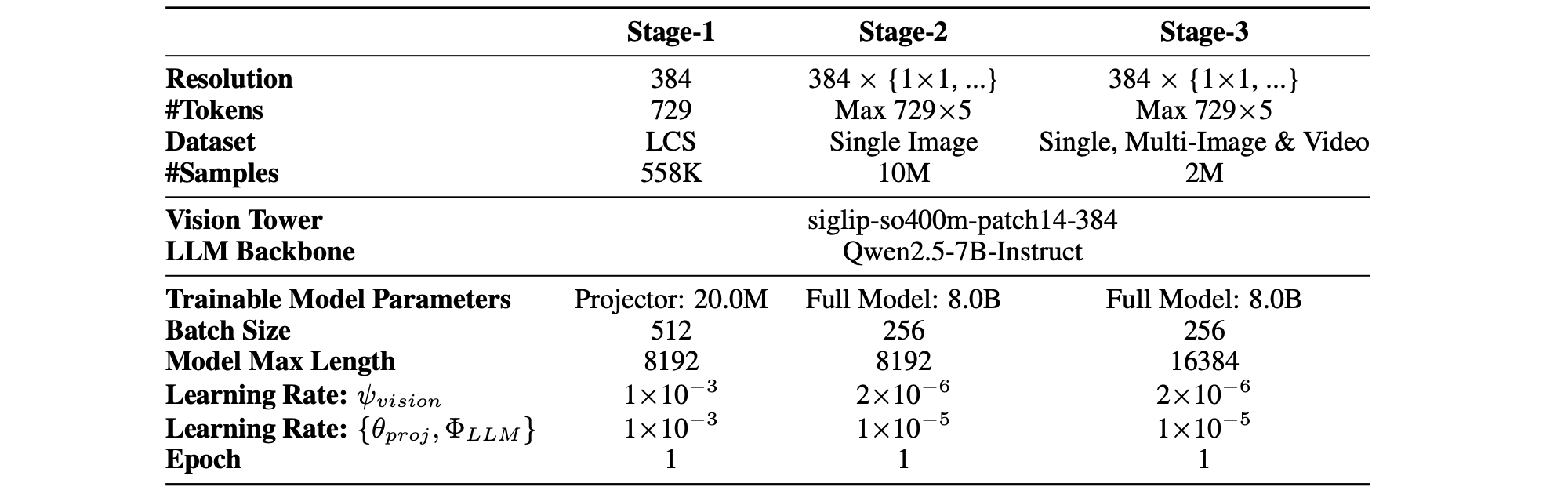
The model architecture follows LLaVA-OneVision, with Qwen2.5-7B-Instruct as the language backbone, Siglip-so400m-patch14-384 as the vision encoder, and a two-layer MLP projector. Training proceeds in three stages: language-image alignment (using the LLaVA pre-training corpus), visual instruction tuning on 10M single-image samples from MAmmoTH-VL-12M, and finally one-vision tuning on a mixture of single-image, multi-image, and video data (2M samples).
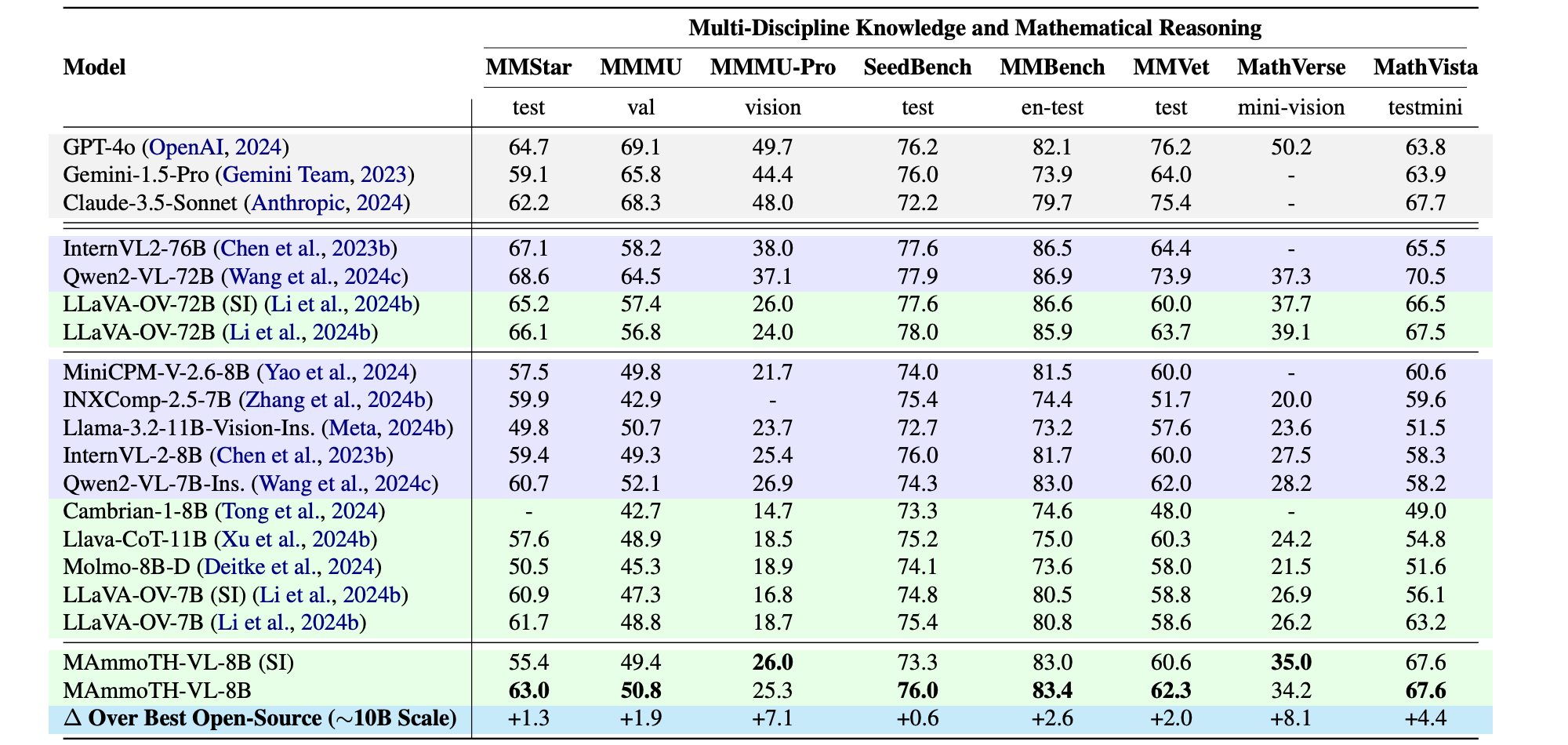
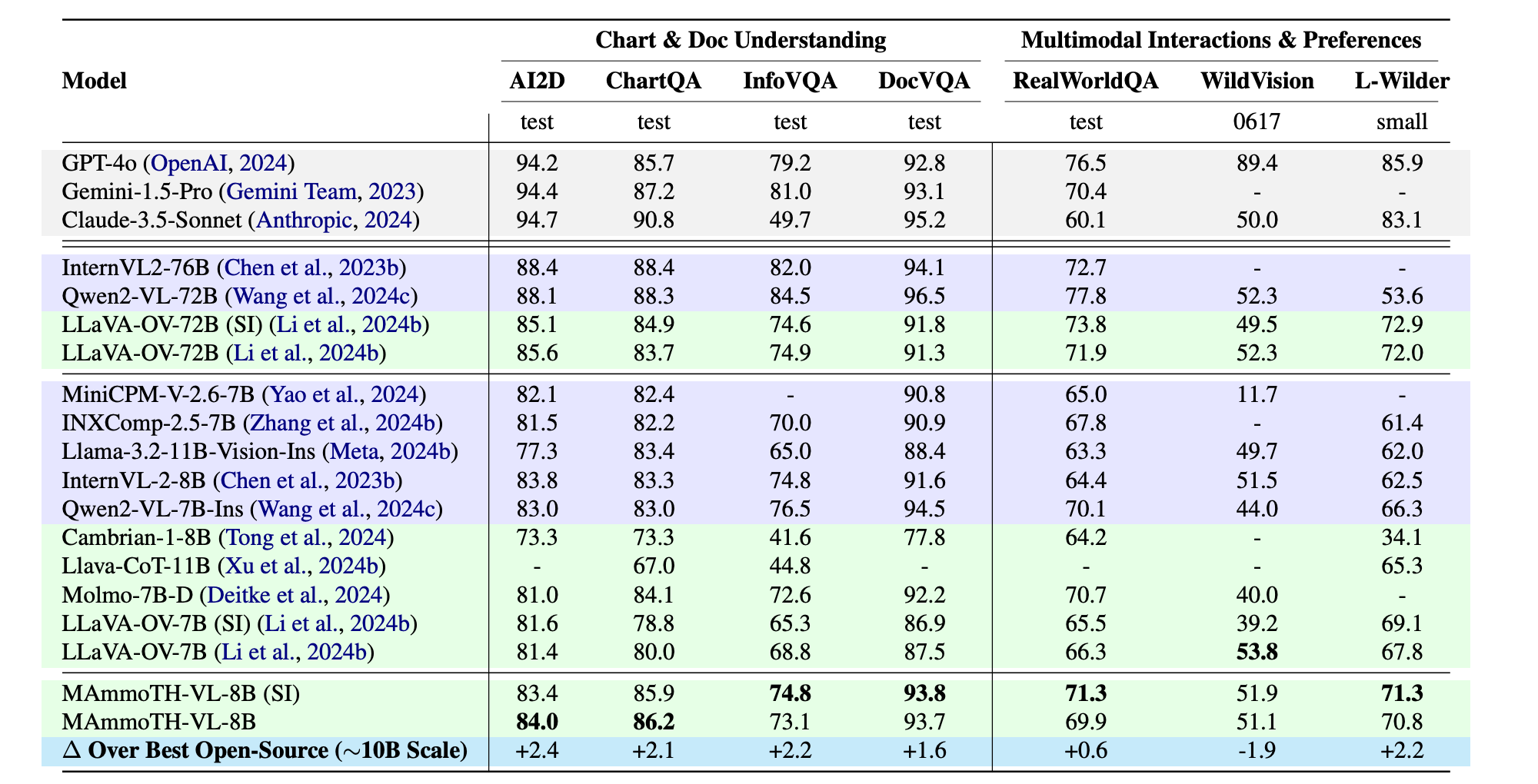
MAmmoTH-VL-8B achieves state-of-the-art performance among open-source MLLMs across a wide range of benchmarks. It particularly shines in mathematical reasoning, outperforming both open-source and some open-weight models on 9 benchmarks. The single-image variant (SI) shows the strongest results, while the multi-image/video version maintains robust performance with only slight decreases on certain tasks.
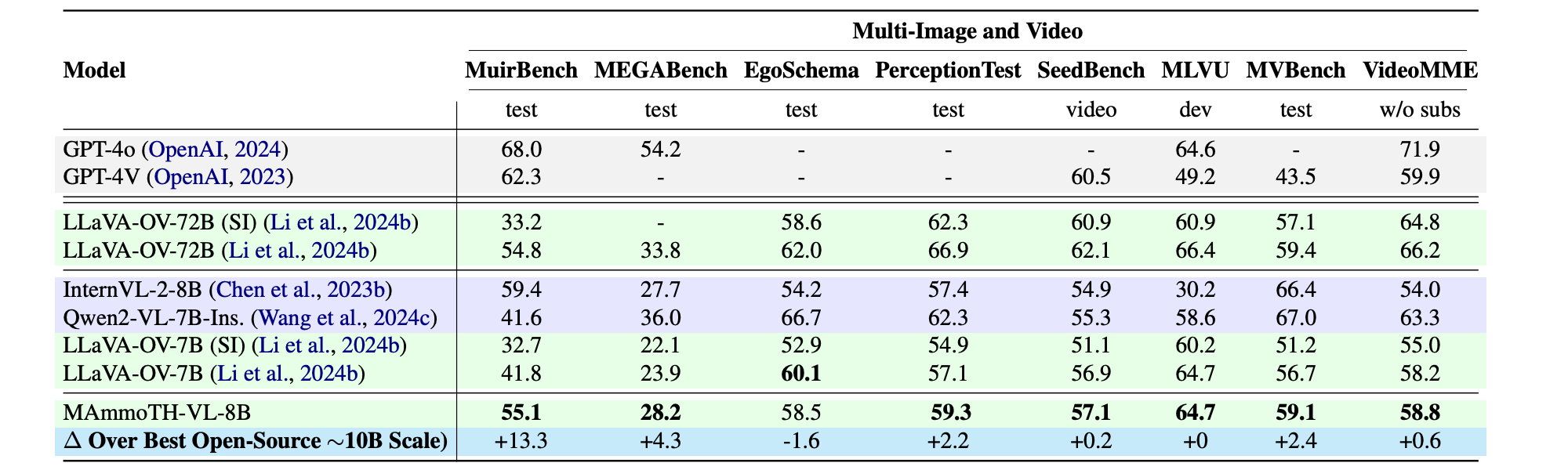
For multi-image and video tasks, MAmmoTH-VL-8B significantly outperforms prior open-source models like LLaVA-One-Vision-7B, achieving a 13-point improvement on MuirBench. However, it still lags behind Qwen2-VL-7B, which the authors attribute to the limited size of the multi-image/video training dataset (only 1M samples) due to computational constraints. This suggests that further scaling of multi-image/video data could yield additional gains.
MAmmoTH-VL demonstrates that high-quality, reasoning-rich instruction data can be generated at scale using only open models, democratizing access to advanced MLLM training. The pipeline's cost-effectiveness and reliance on open-source tools make it a valuable blueprint for the research community. By showing that careful data curation can unlock strong reasoning capabilities in a relatively small 8B model, the paper challenges the notion that massive model sizes are necessary for state-of-the-art performance. The work also highlights the importance of self-filtering to mitigate hallucinations, a persistent challenge in synthetic data generation. As the field moves toward more capable and trustworthy MLLMs, MAmmoTH-VL provides both a practical dataset and a methodological framework that can be adapted and extended for future research.
Alex Krizhevsky, Ilya Sutskever et al.
Ashish Vaswani, Noam Shazeer et al.
Douglas M. Bates, Martin Mächler et al.
Diederik P. Kingma, Jimmy Ba