PreprintCommunications of the ACM
ImageNet classification with deep convolutional neural networks
Alex Krizhevsky, Ilya Sutskever et al.
130k2017
175
Citations
7
Influential Citations
arXiv.org
Venue
2024
Year
A text embedding model with 570 million parameters that supports long-context retrieval tasks up to 8192 tokens, includes LoRA adapters for various NLP tasks, and allows flexible output dimension reduction from 1024 down to 32 using Matryoshka Representation Learning.
Text embeddings are the backbone of modern retrieval-augmented generation (RAG) systems, semantic search, and clustering. Yet most high-performing models are either monolingual, limited in context length, or require massive computational resources. Jina Embeddings v3 tackles all three constraints simultaneously: it supports 8192 tokens, works across 89 languages, and uses lightweight LoRA adapters to specialize for different tasks without retraining the entire model. This makes it a practical choice for production systems that need flexibility without sacrificing quality.
The architecture builds on XLM-RoBERTa but introduces three key innovations. First, absolute positional embeddings are replaced with Rotary Position Embeddings (RoPE), which encode both absolute and relative positions directly into the attention mechanism. This is critical for handling long sequences up to 8192 tokens without the degradation seen in fixed-position models.
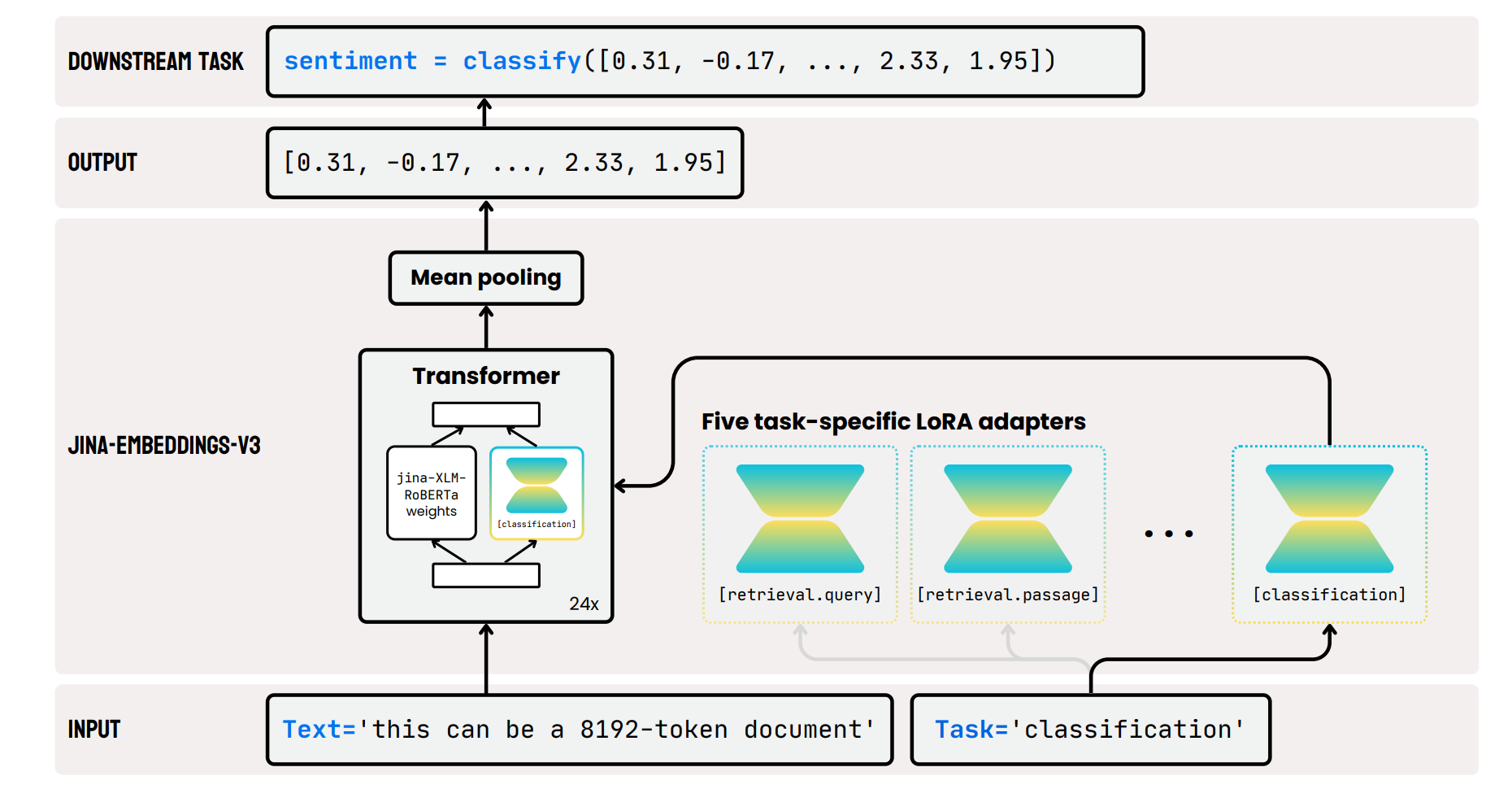
Second, the model incorporates low-rank decomposition matrices (rank 4) into the embedding and linear layers of multi-head attention. These are the LoRA adapters—task-specific modules that are loaded alongside the base weights and selected dynamically based on the input task type. The adapters account for less than 3% of total parameters, so switching between tasks adds minimal overhead.

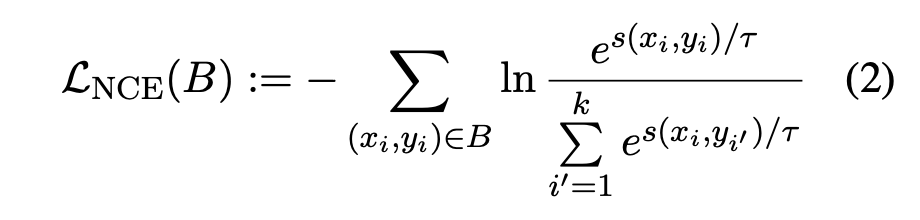
Training happens in three stages. First, the model is pre-trained with masked language modeling (MLM) using whole word masking on the CulturaX corpus (89 languages, 20% English). It starts with 512-token sequences for 100k steps, then extends to 8192 tokens for another 60k steps. Second, it is fine-tuned for embedding tasks using a bi-directional InfoNCE loss on over one billion text pairs from 300+ datasets. A filtering step removes pairs where 80% of the shorter text is a substring of the longer one.

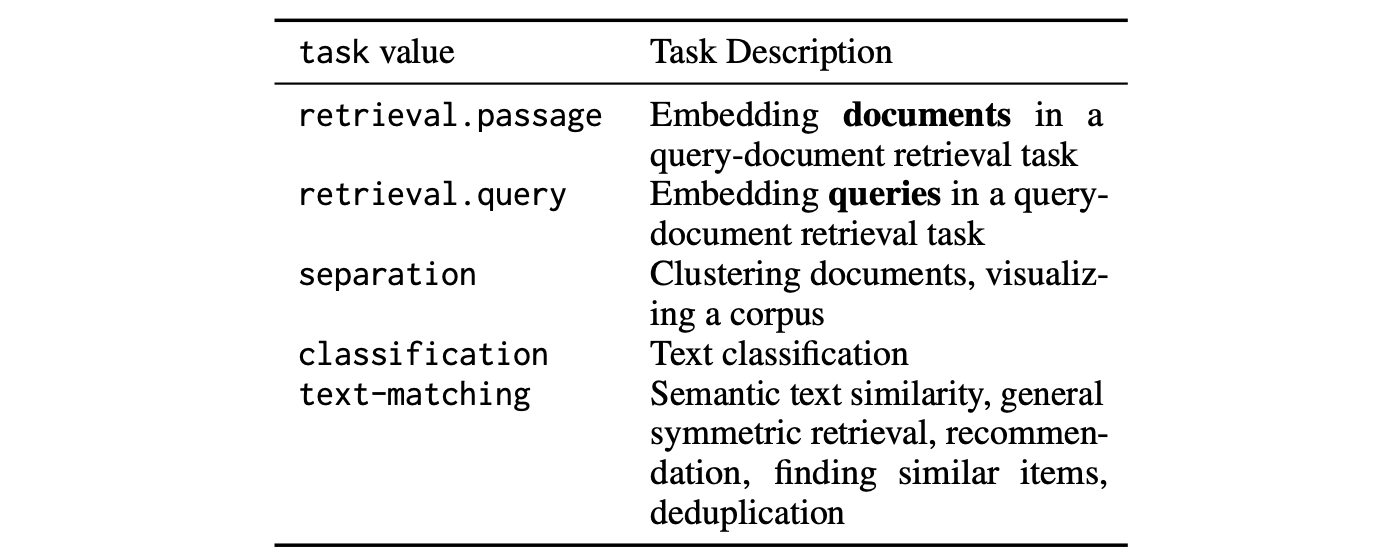
Third, five LoRA adapters are trained independently with the base model frozen:
A failure analysis of the previous v2 model identified four issues: misleading syntactic similarities, named entity misinterpretation, poor handling of polar questions, and preference for low-quality documents. The authors mitigated these by generating synthetic examples for F1-F3 and using preference learning datasets (Open Assistant) for F4.
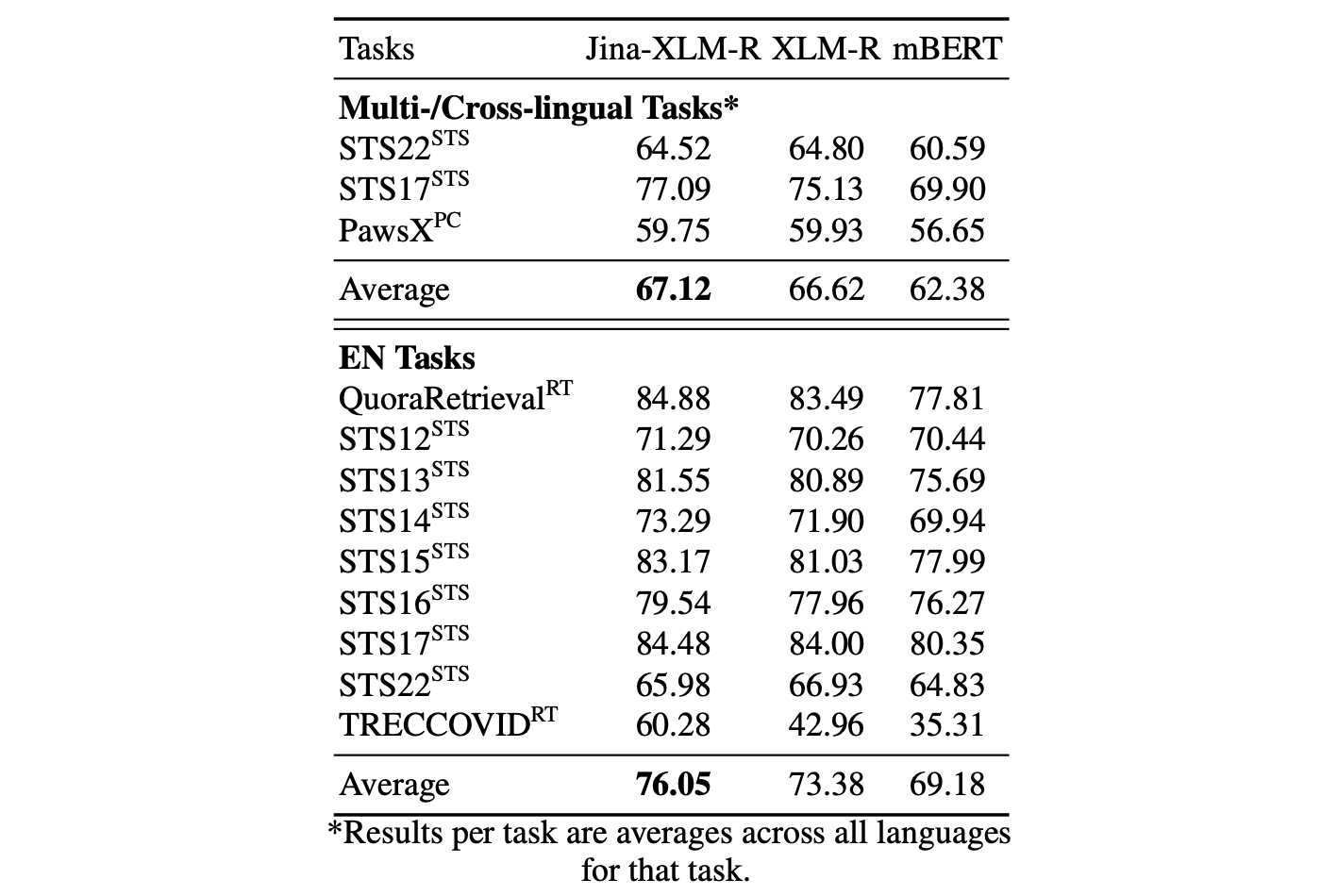
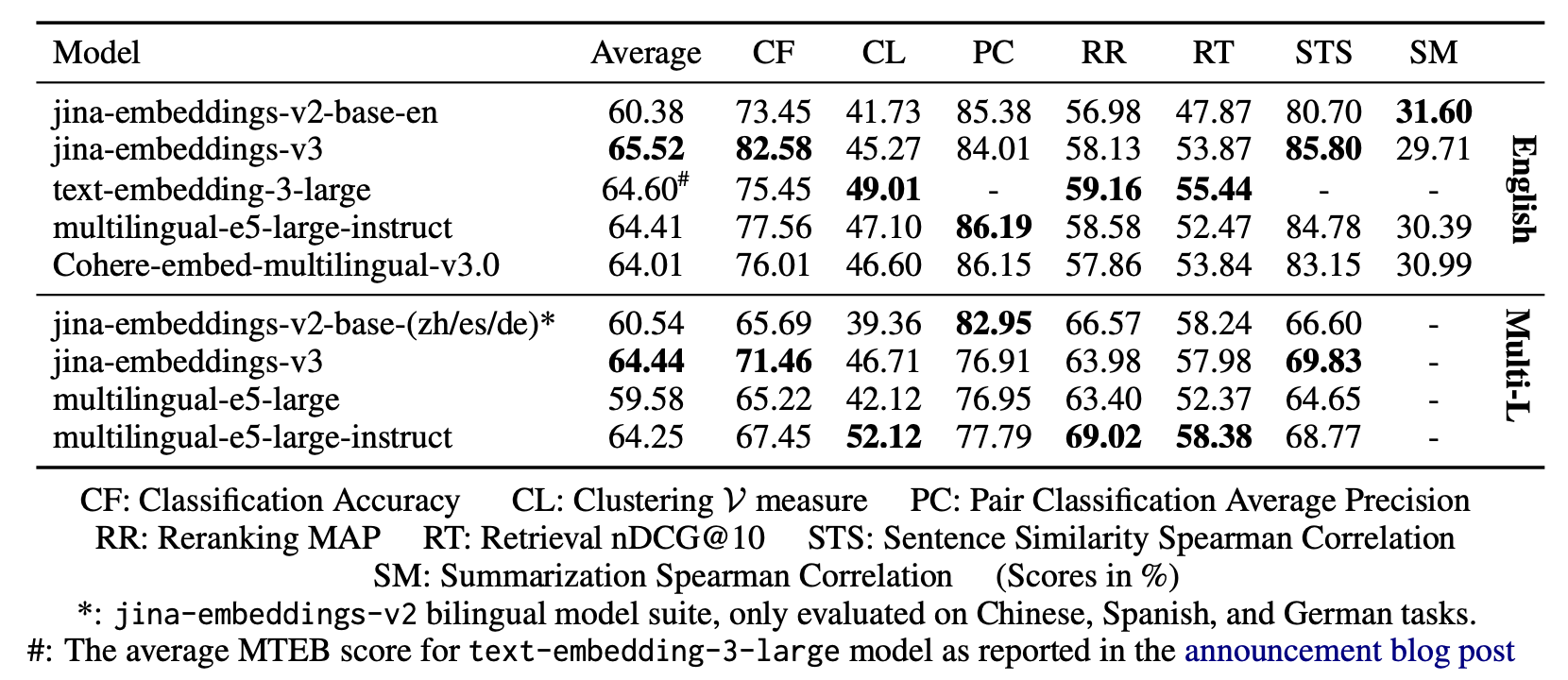
On MTEB, jina-embeddings-v3 achieves an average score of 65.52, outperforming text-embedding-3-large, multilingual-e5-large-instruct, and Cohere-embed-multilingual-v3.0. It leads in classification (82.58) and STS (85.80) among multilingual models. On LongEmbed tasks, the text-matching adapter achieves the highest average nDCG@10, thanks to RoPE-based positional embeddings.
![Evaluation of nDCG@10 [%] on MTEB LongEmbed Tasks.](https://miro.medium.com/v2/1*WbQn_Lxz7xwqiitb76pPWg.png)
In the failure case analysis, the model handles F1, F3, and F4 effectively but still struggles with named entity misinterpretation (F2), even after synthetic data training.
Jina Embeddings v3 shows that you don't need a massive LLM to get state-of-the-art embeddings. By combining a moderately sized backbone with lightweight, task-specific adapters, the model achieves competitive or superior results while being far more efficient. The Matryoshka learning capability allows users to trade off dimension size for speed without retraining, making it highly practical for deployment. This work sets a new standard for multilingual, long-context embeddings and demonstrates that careful architectural choices—like RoPE and LoRA—can bridge the gap between efficiency and performance.
Alex Krizhevsky, Ilya Sutskever et al.
Ashish Vaswani, Noam Shazeer et al.
Douglas M. Bates, Martin Mächler et al.
Diederik P. Kingma, Jimmy Ba