PreprintCommunications of the ACM
ImageNet classification with deep convolutional neural networks
Alex Krizhevsky, Ilya Sutskever et al.
130k2017
0
Citations
0
Influential Citations
—
Venue
2025
Year
Addresses the challenge of retrieving accurate, domain-specific information in enterprise search systems, by dynamically selecting semantically challenging but contextually irrelevant documents to improve re-ranking models. The method integrates diverse embedding models, performs dimensionality reduction, and employs a unique hard negative selection process to ensure computational efficiency and semantic precision.
Enterprise search systems face a unique challenge: they must retrieve highly relevant documents from specialized domains where terminology overlaps, abbreviations abound, and concepts are nuanced. Standard retrieval pipelines often struggle because they treat all irrelevant documents equally, missing the opportunity to learn from documents that are semantically close but contextually wrong. This paper tackles that gap head-on by introducing a principled method for mining hard negatives—documents that look deceptively relevant but are actually irrelevant. By dynamically selecting such examples, the approach sharpens reranker models, making them far better at distinguishing subtle differences in meaning. This matters because in enterprise settings—legal, medical, financial—a single mis-retrieved document can have serious consequences. The method is both computationally efficient and domain-agnostic, which makes it highly practical for real-world deployment.
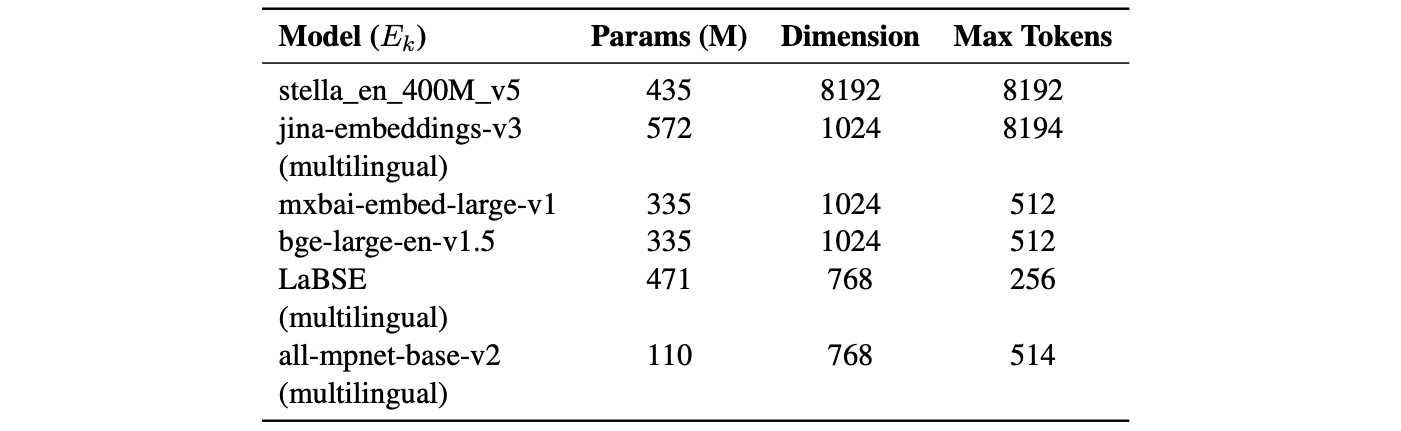
The methodology begins by encoding every query and document into a rich vector space using an ensemble of state-of-the-art bi-encoder embedding models. These models are chosen for their complementary strengths: multilingual support, embedding quality, training data diversity, context length handling, and overall performance. The resulting embeddings are concatenated, then projected onto a lower-dimensional space using Principal Component Analysis (PCA) while retaining 95% of the original variance. This step is critical for computational efficiency, as it reduces the dimensionality of the feature space without losing semantic fidelity.
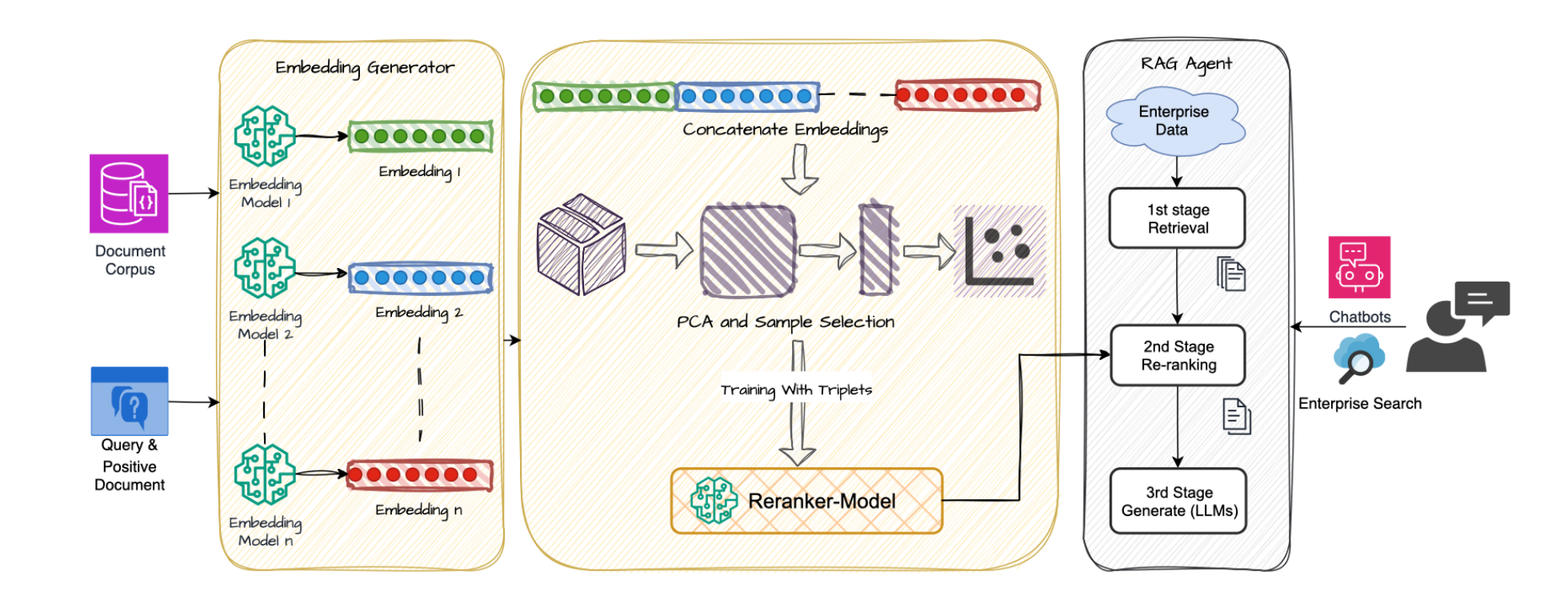
The core innovation lies in the hard negative selection process. For each query-positive document pair (Q, PD), the system evaluates all candidate documents D from the corpus using cosine distances: d(Q, PD), d(Q, D), and d(PD, D). A document D is selected as a hard negative only if it satisfies two conditions:
This dual-condition approach ensures that the hard negatives are both confusing (semantically close to the query) and clean (not accidentally relevant). The authors argue that this dynamic selection is superior to static or random negative sampling because it directly targets the most informative examples for the reranker to learn from.
The experiments were conducted on a proprietary enterprise corpus of 36,871 unannotated documents and 5,250 annotated query-positive pairs, as well as three public benchmarks: FiQA (finance), Climate-FEVER (climate science), and TechQA (technology).

Fine-tuning the in-house cross-encoder reranker with the proposed hard negatives yielded a 15% improvement in MRR@3 and 19% in MRR@10 over the baseline (the same reranker without fine-tuning) on the internal dataset. The method also consistently improved retrieval across all three public datasets, demonstrating domain independence.
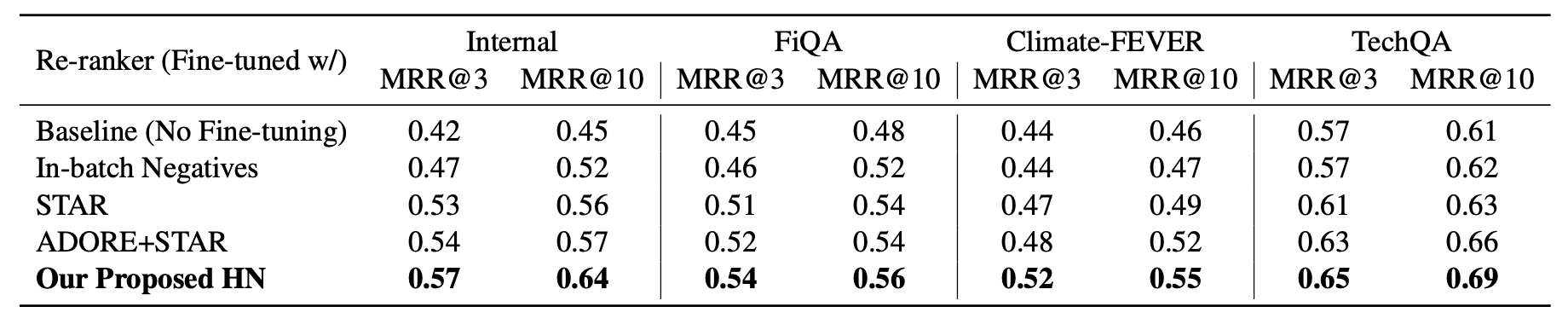
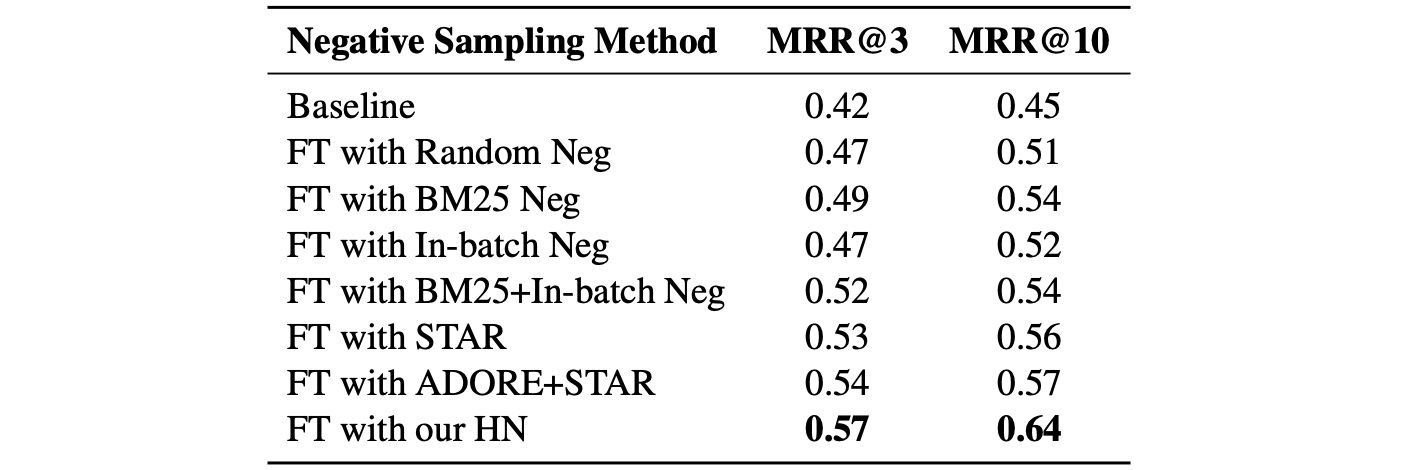
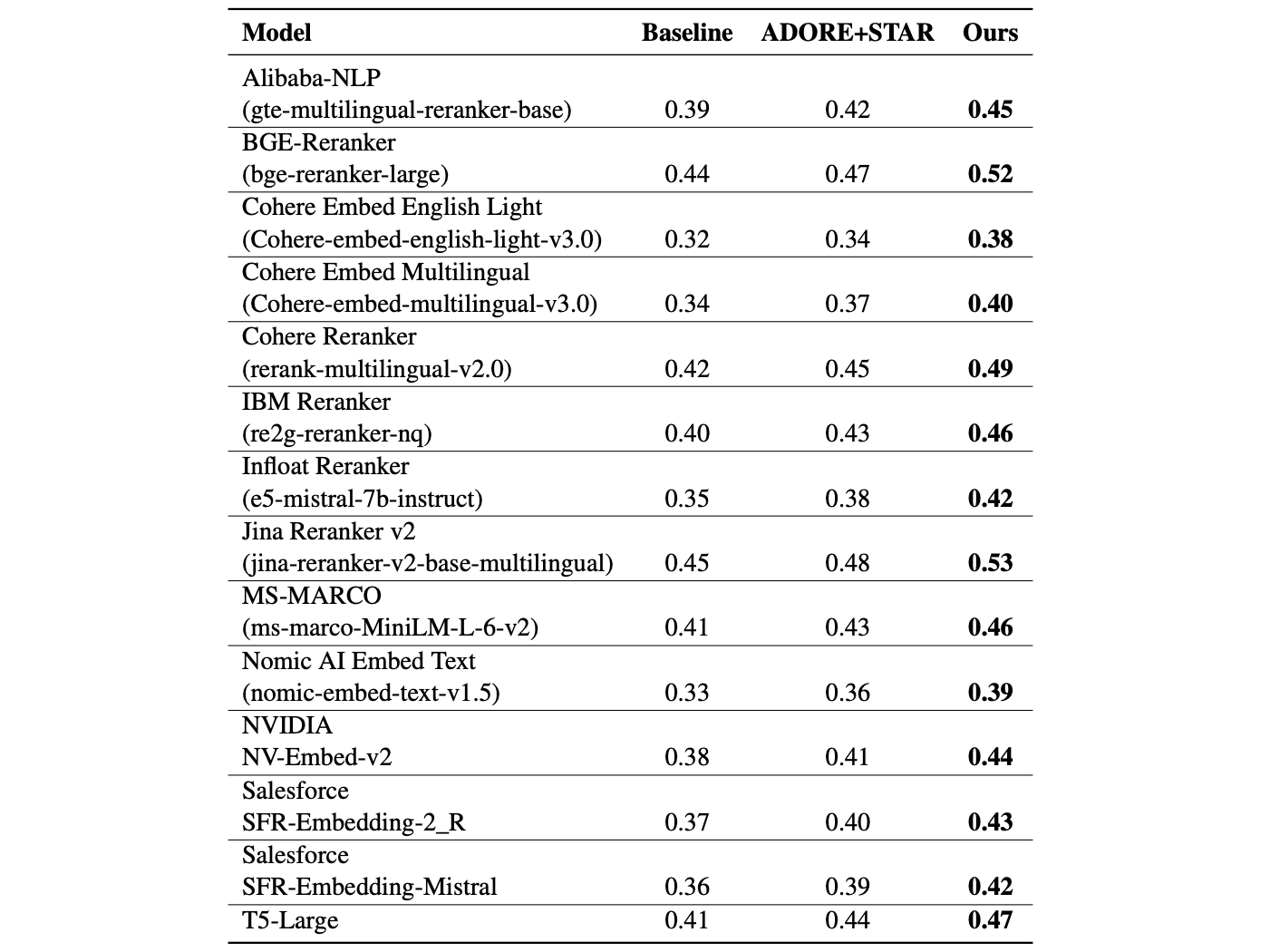
When applied to various open-source embedding and reranker models, the framework outperformed both the ADORE+STAR baseline and the base models without fine-tuning. Notably, rerankers with multilingual capabilities and larger model sizes showed the largest gains, suggesting that the embedding ensemble’s multilingual richness and the models’ capacity to exploit subtle semantic differences are key enablers.

Short documents benefited the most, likely because they have minimal semantic redundancy and are less affected by tokenization truncation. Long documents showed more modest improvements, attributed to embedding truncation and higher semantic complexity.
This paper offers a practical, theoretically grounded solution to a persistent problem in enterprise search: how to train rerankers that can handle domain-specific language with high precision. The dynamic hard negative mining approach is computationally lightweight (thanks to PCA) and domain-agnostic, making it easy to integrate into existing retrieval pipelines. The consistent gains across multiple domains and model architectures suggest that the method captures a fundamental principle of effective negative sampling. For practitioners, this means that with relatively little effort—just an ensemble of embeddings and a smart selection rule—they can significantly boost retrieval accuracy in specialized fields. The work also opens the door to further research on adaptive negative sampling strategies that could evolve with the corpus or query distribution over time.
Alex Krizhevsky, Ilya Sutskever et al.
Ashish Vaswani, Noam Shazeer et al.
Douglas M. Bates, Martin Mächler et al.
Diederik P. Kingma, Jimmy Ba