PreprintCommunications of the ACM
ImageNet classification with deep convolutional neural networks
Alex Krizhevsky, Ilya Sutskever et al.
130k2017
0
Citations
0
Influential Citations
—
Venue
2025
Year
A research preview model representing an advancement in scaling unsupervised learning through increased compute, data, architecture, and optimization innovations, resulting in broader knowledge, deeper understanding, reduced hallucinations, and increased reliability. It excels in tasks requiring natural conversation, creativity, and understanding human intent due to new scalable training techniques derived from smaller models.
The release of GPT-4.5 and the GPT-4.1 family marks a pivotal moment in the evolution of large language models. While GPT-4.5 focuses on scaling unsupervised learning to achieve broader knowledge and more natural interaction, the GPT-4.1 models are engineered for practical, high-performance applications—especially in coding, instruction following, and long-context tasks. This dual approach highlights a strategic divergence: one path emphasizes general-purpose conversational AI with reduced hallucinations, while the other prioritizes specialized, cost-effective, and low-latency solutions for developers and enterprises. The introduction of up to 1 million token context windows and new evaluation benchmarks further underscores the industry's push toward handling increasingly complex and lengthy inputs.
GPT-4.5 builds on the foundation of GPT-4o by scaling pre-training with new supervision techniques alongside traditional methods like supervised fine-tuning (SFT) and reinforcement learning from human feedback (RLHF). These innovations allow the model to better understand human intent, nuance, and emotional context, resulting in more natural conversations and fewer hallucinations. The key insight is that scaling unsupervised learning improves the model's world model accuracy and associative thinking, complementing the chain-of-thought reasoning used in STEM-focused models.

In contrast, the GPT-4.1 family consists of three models—GPT-4.1, GPT-4.1 mini, and GPT-4.1 nano—each optimized for different use cases. They support a massive context window of up to 1 million tokens, enabling processing of entire codebases or lengthy documents. The models are trained with a focus on coding and instruction following, achieving a 21.4% improvement on SWE-bench Verified over GPT-4o. They also feature a refreshed knowledge cutoff of June 2024 and an increased output token limit of 32,768 tokens.
OpenAI introduced two new evaluations for long-context understanding: OpenAI-MRCR (Multi-Round Coreference) tests the model's ability to find and differentiate between multiple identical requests within a large context, while Graphwalks evaluates multi-hop reasoning by requiring a breadth-first search within an embedded graph. GPT-4.1 achieves 61.7% accuracy on Graphwalks, matching o1 and surpassing GPT-4o.
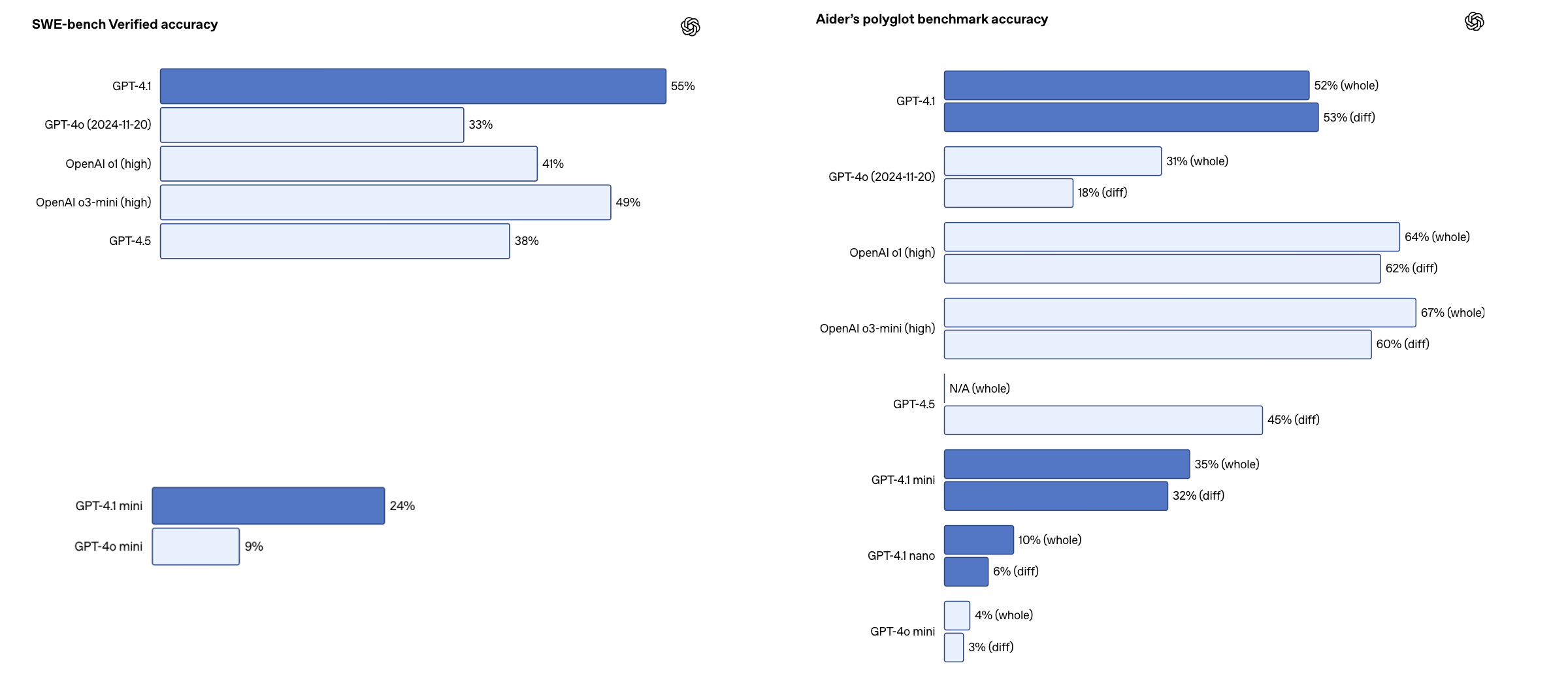
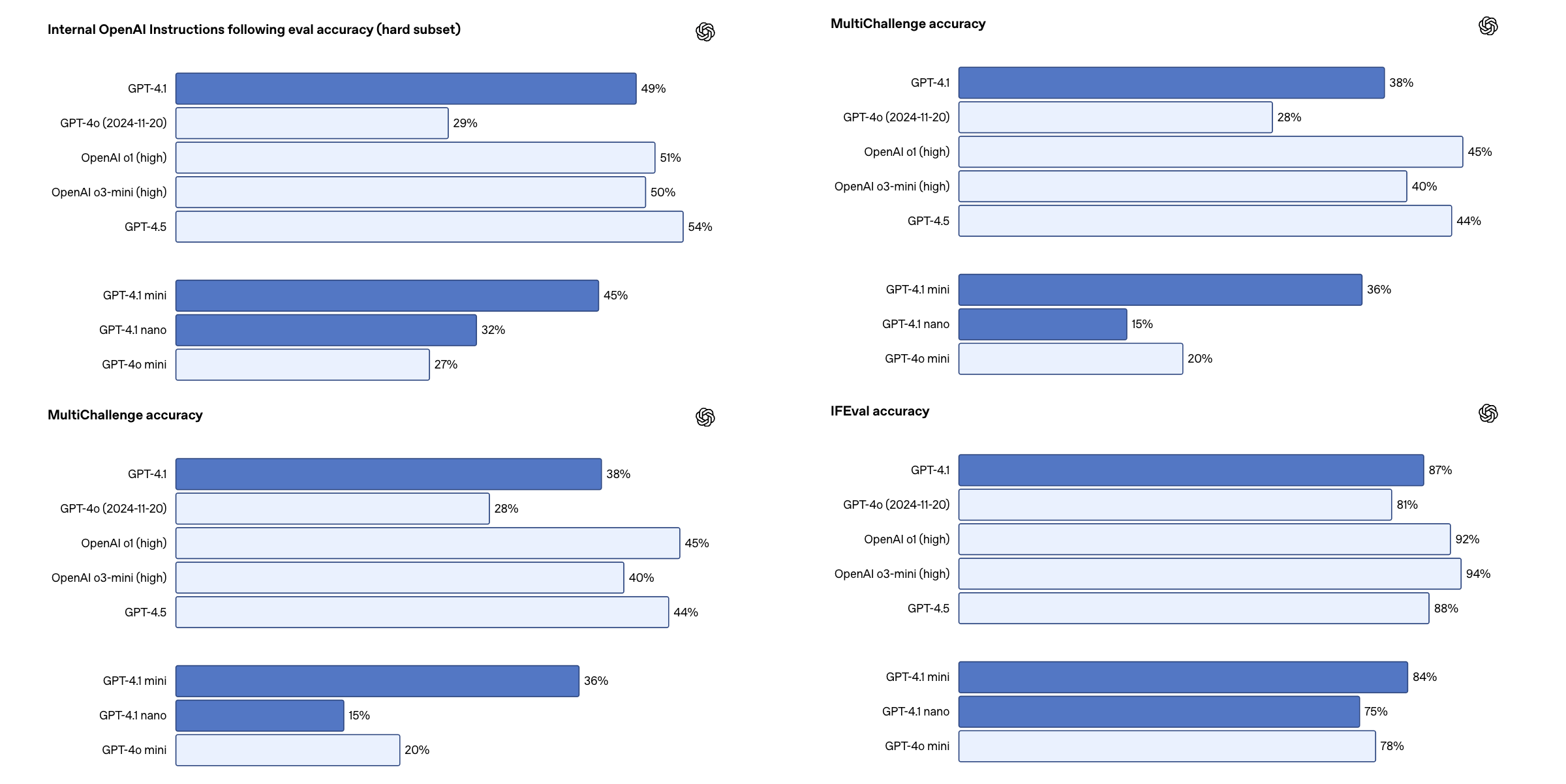
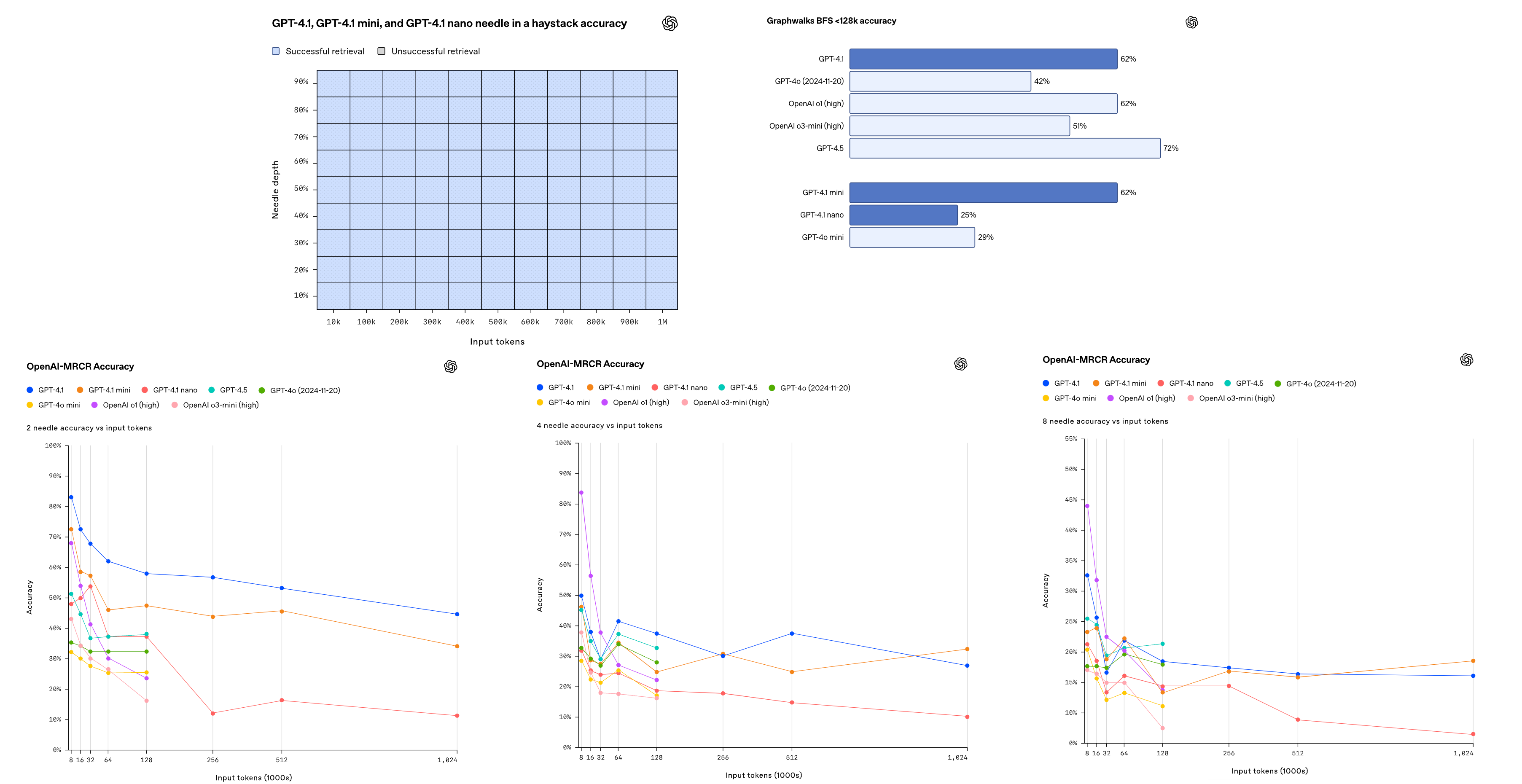
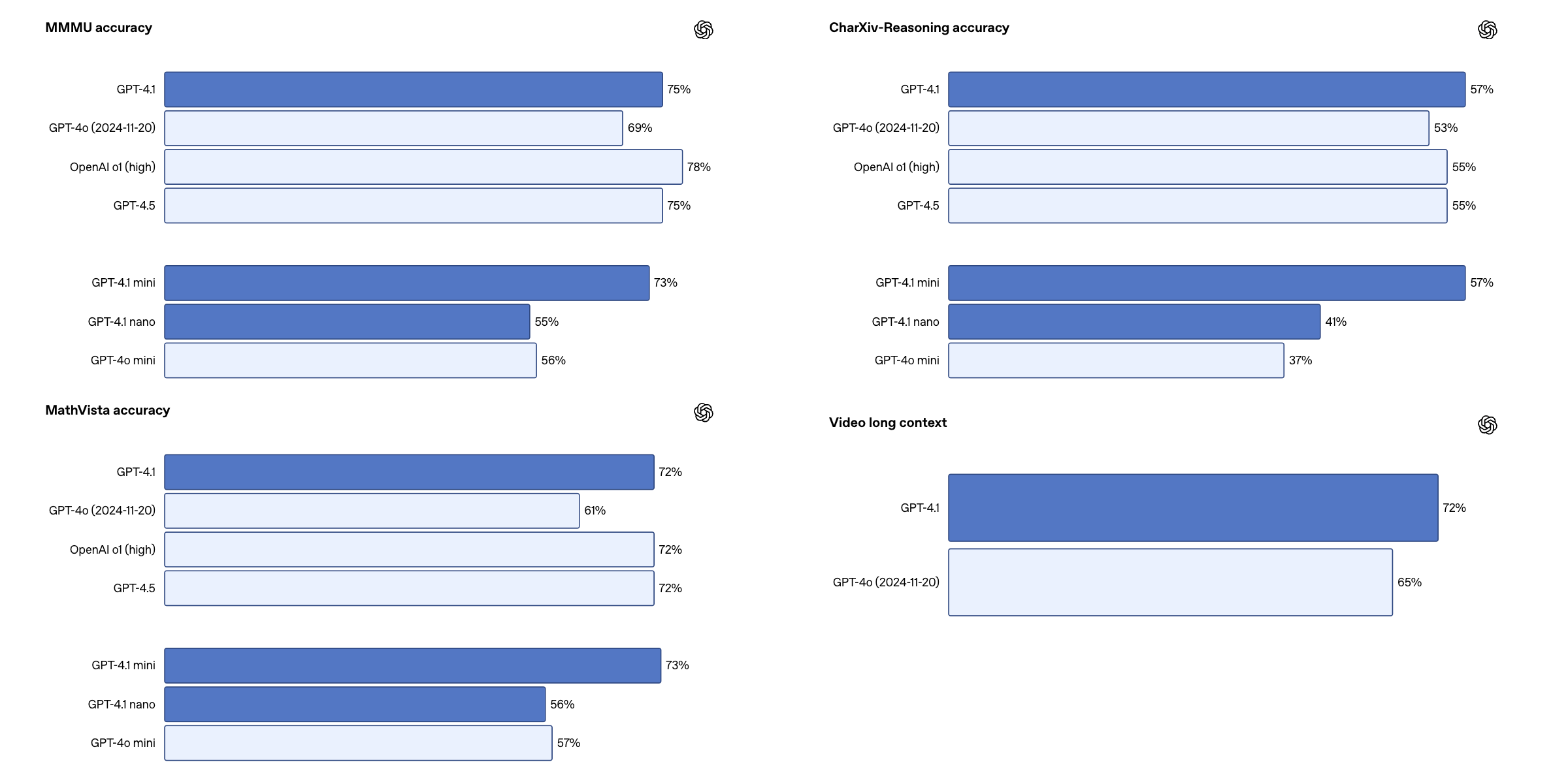
GPT-4.5 demonstrates significant improvements in natural conversation, emotional intelligence, and reduced hallucinations, making it ideal for writing, programming, and practical problem-solving. The GPT-4.1 family shows remarkable performance gains: GPT-4.1 scores 54.6% on SWE-bench Verified (21.4% better than GPT-4o), 38.3% on Scale's MultiChallenge (10.5% increase), and 72.0% on Video-MME long without subtitles (new state-of-the-art). GPT-4.1 mini offers 83% cost reduction compared to GPT-4o while exceeding its performance on many benchmarks, and GPT-4.1 nano provides low-latency responses for classification tasks. Real-world alpha tests show 60% higher coding scores for Windsurf, 53% more accurate tax scenarios for Blue J, and 50% better financial data extraction for Carlyle.
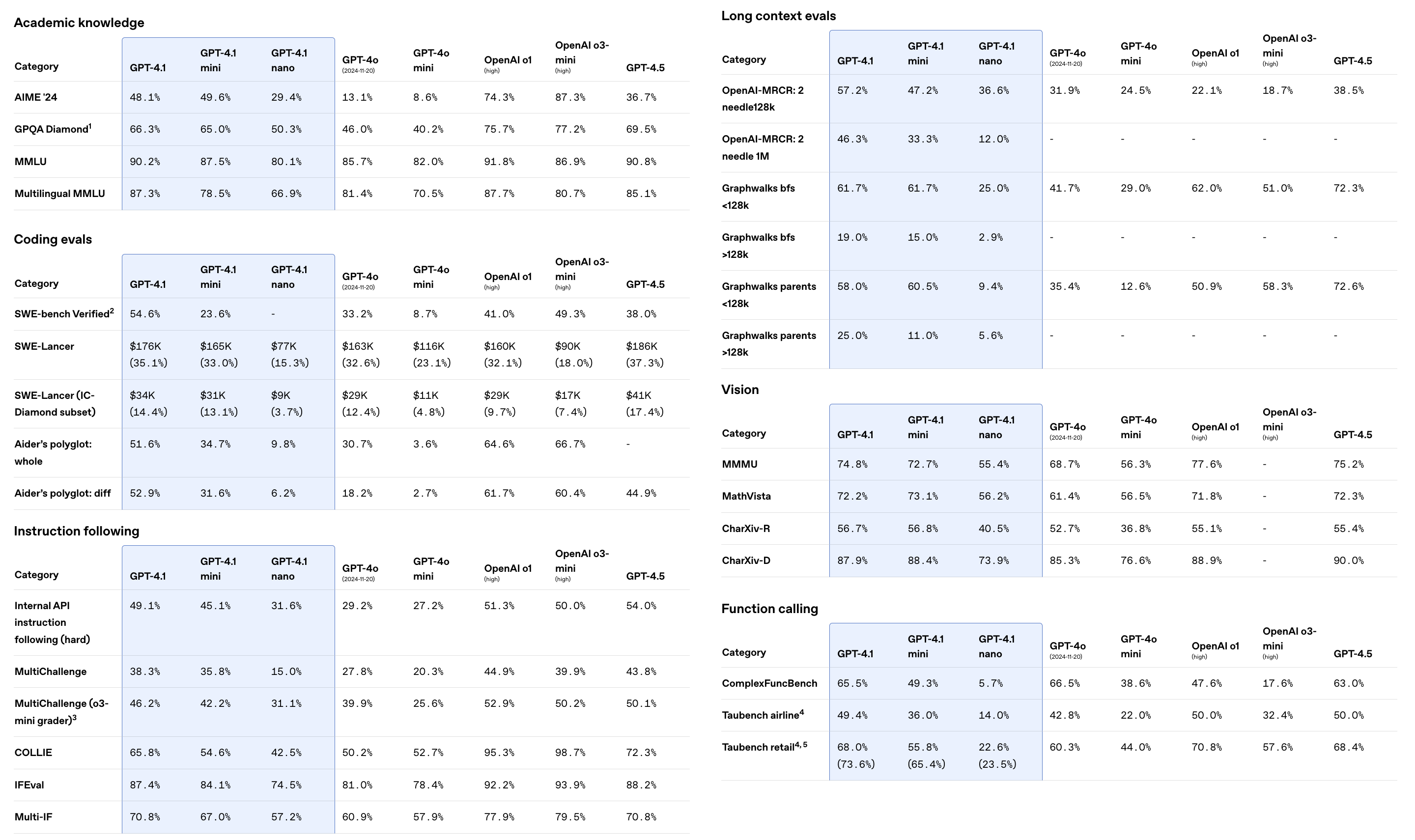
The GPT-4.5 and GPT-4.1 releases represent a strategic bifurcation in AI development: one model prioritizes general-purpose conversational ability with reduced hallucinations, while the other focuses on specialized, cost-effective, and high-performance applications. The GPT-4.1 family's 1 million token context window and new long-context benchmarks set a new standard for handling extensive inputs, while its coding and instruction-following improvements directly benefit developers and enterprises. The deprecation of GPT-4.5 preview in favor of GPT-4.1 signals a shift toward more practical, scalable, and affordable AI solutions. These advancements collectively push the boundaries of what large language models can achieve, making them more reliable, efficient, and accessible for a wide range of real-world tasks.
Alex Krizhevsky, Ilya Sutskever et al.
Ashish Vaswani, Noam Shazeer et al.
Douglas M. Bates, Martin Mächler et al.
Diederik P. Kingma, Jimmy Ba