PreprintCommunications of the ACM
ImageNet classification with deep convolutional neural networks
Alex Krizhevsky, Ilya Sutskever et al.
130k2017
0
Citations
0
Influential Citations
—
Venue
2021
Year
Provides a comprehensive analysis of the performance of various Transformer models across different scales upto 280B on 152 tasks.
The Gopher paper is a landmark study in the scaling of language models, systematically evaluating how performance changes as models grow from tens of millions to 280 billion parameters. It provides one of the most comprehensive analyses of scaling laws across 152 diverse tasks, revealing that while larger models excel at reading comprehension, fact-checking, and toxicity detection, they show only marginal gains in logical and mathematical reasoning. This finding is crucial for AI practitioners: it suggests that simply increasing model size is not a silver bullet for all cognitive capabilities, and that future work must address reasoning bottlenecks.
The Gopher family consists of six autoregressive Transformer models ranging from 44 million to 280 billion parameters. The architecture uses two key modifications over the original Transformer: RMSNorm instead of LayerNorm for improved training stability, and relative positional encodings instead of absolute ones, which allows the model to handle longer sequences than it was trained on.
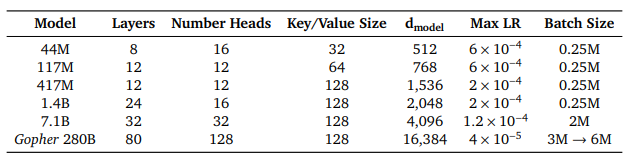
All models are trained on 300 billion tokens with a context window of 2048 tokens using the Adam optimizer. The learning rate is warmed up from 1e-7 to a maximum over 1500 steps, then decayed with a cosine schedule. As model size increases, the maximum learning rate is decreased and batch size is increased. For the largest models, gradient clipping is tightened from 1.0 to 0.25 to maintain stability. The authors use bfloat16 numerical format to reduce memory and increase throughput, with stochastic rounding for parameter updates in the largest models, though they note this does not fully recover mixed-precision training performance.
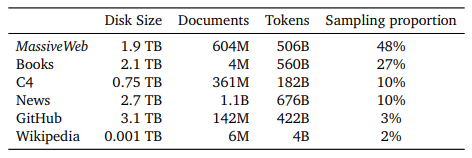
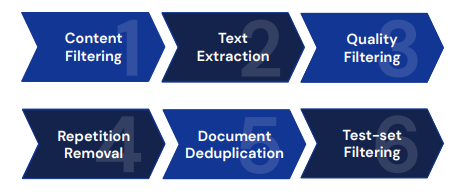
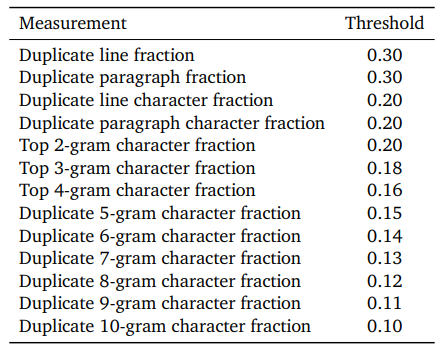
The training data comes from MassiveText, a large curated English-language corpus comprising web pages, books, news articles, and code. The data pipeline includes multiple quality stages: non-English filtering, text extraction from HTML, quality filtering based on heuristics (word count, symbol usage, bullet points), removal of repetitious text, exact and near-duplicate deduplication using MinHash, and test-set filtering to prevent data leakage.
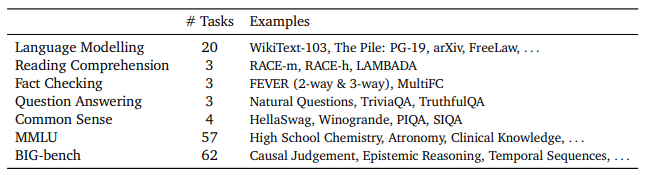
Gopher is evaluated on 152 tasks spanning language modeling, reading comprehension, question answering, and multitask understanding. It achieves state-of-the-art performance on 100 out of 124 tasks compared to prior models like GPT-3, Jurassic-1, and Megatron-Turing NLG. The largest improvements are seen in reading comprehension (e.g., RACE) and language modeling on books and articles. On the Massive Multitask Language Understanding (MMLU) benchmark, Gopher improves over prior supervised SOTA by over 30%, but still falls far short of human expert performance.
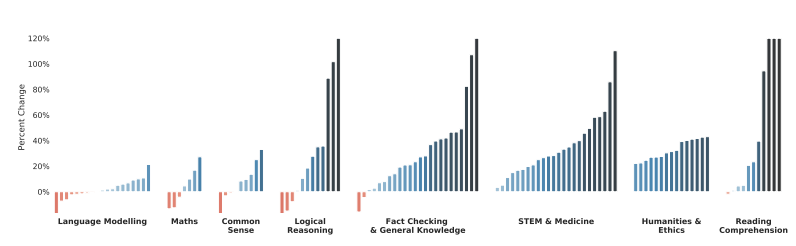

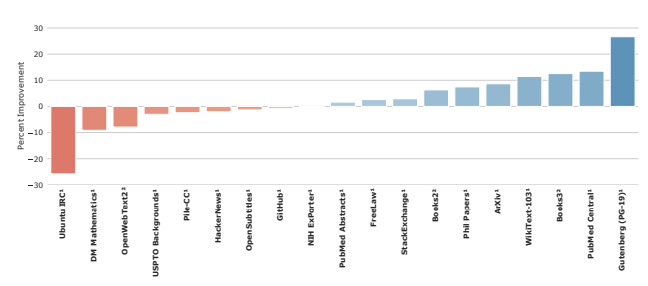
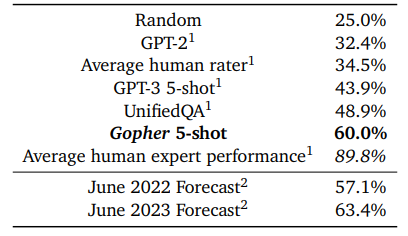
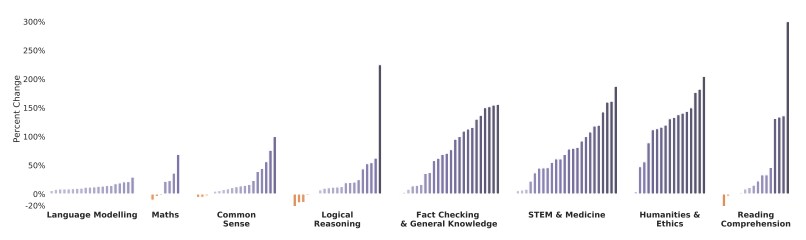
Gopher's key insight is that scaling benefits are uneven across task types. While reading comprehension and fact-checking improve dramatically, logical and mathematical reasoning see only modest gains. This suggests that future progress in AI may require not just larger models but also new architectures, training objectives, or data strategies that specifically target reasoning capabilities. The paper also underscores the importance of data quality: the multi-stage filtering pipeline in MassiveText was critical to achieving strong downstream performance. For practitioners, Gopher provides a benchmark for what scale can and cannot achieve, guiding resource allocation and research directions.
Alex Krizhevsky, Ilya Sutskever et al.
Ashish Vaswani, Noam Shazeer et al.
Douglas M. Bates, Martin Mächler et al.
Diederik P. Kingma, Jimmy Ba