PreprintCommunications of the ACM
ImageNet classification with deep convolutional neural networks
Alex Krizhevsky, Ilya Sutskever et al.
130k2017
0
Citations
0
Influential Citations
—
Venue
2021
Year
Couples an aggressive residual compression mechanism with a denoised supervision strategy to simultaneously improve the quality and space footprint of late interaction.
Late-interaction models like ColBERT have shown that decomposing relevance into token-level computations can significantly improve retrieval quality over single-vector approaches. However, this granularity comes at a steep cost: storing a multi-vector representation for every passage inflates the space footprint by an order of magnitude. ColBERTv2 tackles this head-on by introducing a lightweight compression scheme that reduces storage by over 85% while simultaneously boosting retrieval accuracy through denoised supervision. This makes late-interaction retrieval practical for real-world applications where both quality and efficiency are critical.
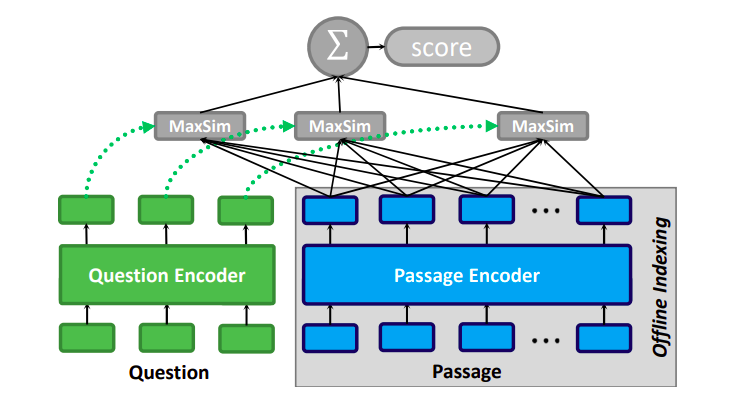
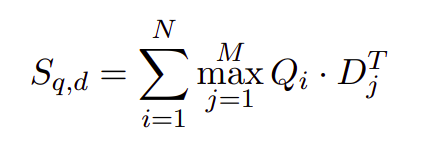
ColBERTv2 retains the core late-interaction architecture from ColBERT: queries and passages are independently encoded by BERT, and each token embedding is projected to a lower dimension. At search time, the similarity between a query and a passage is computed as the sum over query tokens of the maximum cosine similarity with any passage token (MaxSim). This allows each query token to align with the most contextually relevant passage token.
The key innovation is in representation compression. The authors observe that ColBERT vectors naturally cluster into regions corresponding to specific token semantics, with only minor contextual variation. They exploit this by encoding each vector v as the index of its nearest centroid C_t plus a quantized residual r̃ approximating v - C_t. Each dimension of the residual is quantized to one or two bits. With 128-dimensional vectors, this yields 20 bytes (1-bit residual) or 36 bytes (2-bit residual) per vector, compared to ColBERT's 256 bytes at 16-bit precision.
For supervision, ColBERTv2 uses a denoised distillation strategy. A ColBERT model first indexes training passages with the new compression. For each training query, top-k passages are retrieved and scored by a 23M MiniLM cross-encoder reranker. Then, w-way tuples (w=64) are formed containing a query, a highly-ranked passage, and lower-ranked passages. KL-divergence loss distills the cross-encoder's scores into ColBERT, accounting for the restricted score scale of late interaction.
Indexing proceeds in three stages: centroid selection (with |C| proportional to sqrt of number of embeddings), passage encoding (BERT encoding plus compression), and index inversion (grouping embedding IDs by centroid). At retrieval, candidate generation finds nearest centroids for each query vector, decompresses associated passage embeddings, computes approximate MaxSim scores, selects top candidates, and reranks using full embeddings.
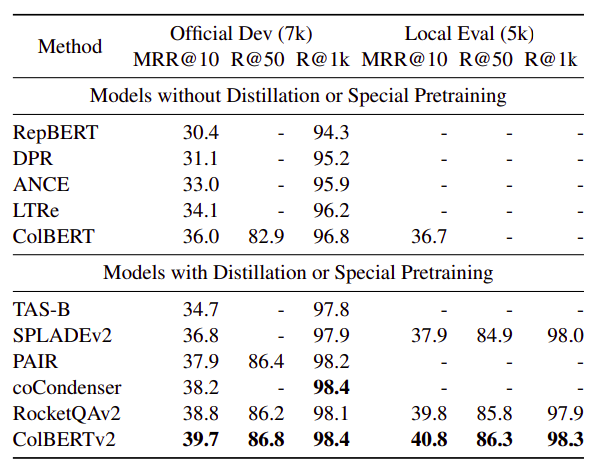
On MS MARCO, ColBERTv2 achieves the highest MRR@10 on both the development set and the Local Eval test set (40.8% MRR@10), outperforming strong baselines like RocketQAv2 even though RocketQAv2 uses document titles. The compression does not hurt quality; in fact, denoised supervision improves it.
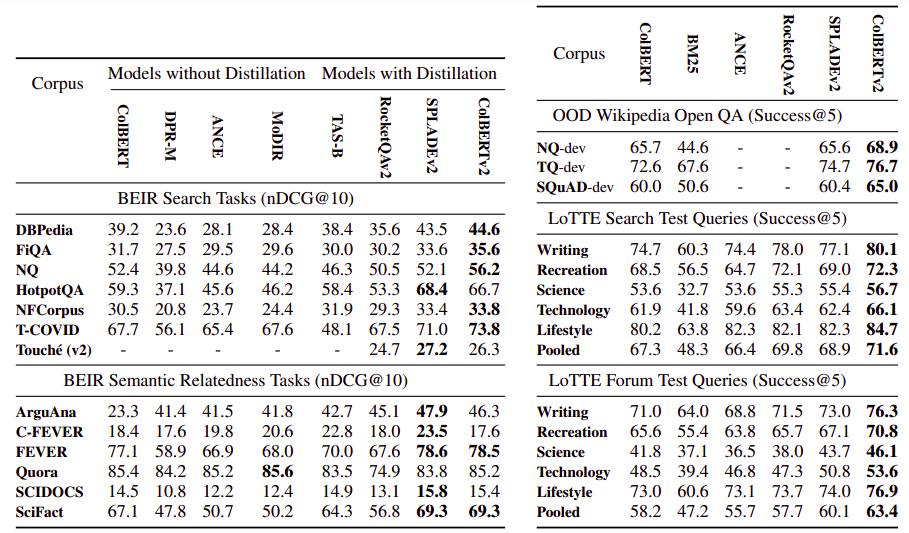
On BEIR, ColBERTv2 outperforms or ties with SPLADEv2 on six of eleven benchmarks, with notable gains on NQ, TREC-COVID, and FiQA-2018. On Wikipedia Open QA, it surpasses BM25, vanilla ColBERT, and SPLADEv2 by up to 4.6 points.
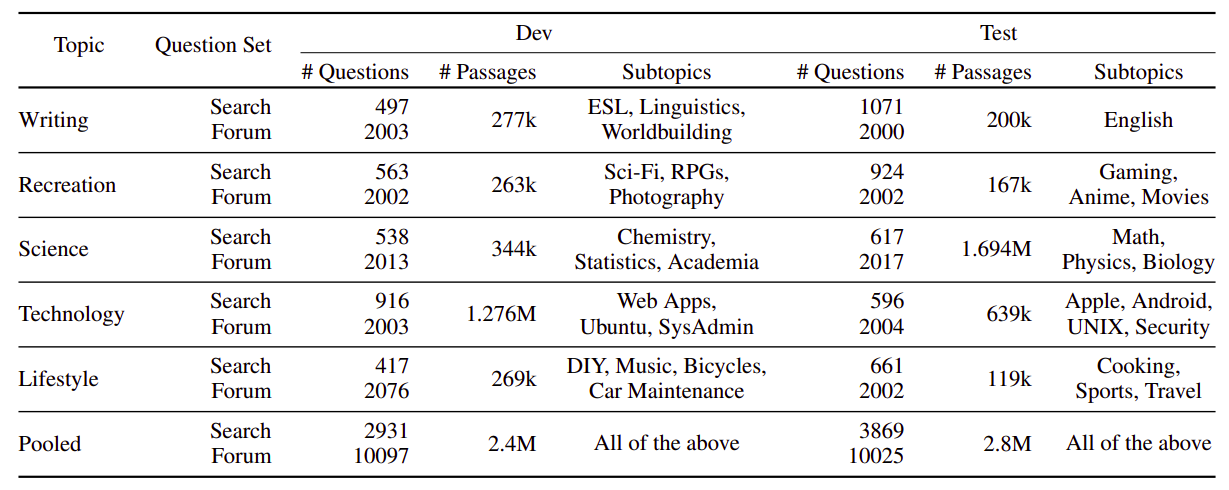
On the new LoTTE benchmark, which focuses on long-tail topics, ColBERTv2 outperforms all baselines across all topics for both search and forum query types, improving upon SPLADEv2 by up to 3.7 points and RocketQAv2 by up to 8.1 points.
ColBERTv2 demonstrates that late-interaction models can be both highly effective and storage-efficient. The residual compression reduces the space footprint by an order of magnitude without architectural changes, making it feasible to deploy multi-vector retrieval at scale. The denoised supervision strategy further improves quality, showing that careful distillation from cross-encoders can compensate for the lossy compression. The introduction of LoTTE provides a valuable benchmark for evaluating retrieval on long-tail, cross-domain queries, addressing a gap in existing datasets. Overall, ColBERTv2 sets a new standard for practical, high-quality retrieval systems.
Alex Krizhevsky, Ilya Sutskever et al.
Ashish Vaswani, Noam Shazeer et al.
Douglas M. Bates, Martin Mächler et al.
Diederik P. Kingma, Jimmy Ba