PreprintCommunications of the ACM
ImageNet classification with deep convolutional neural networks
Alex Krizhevsky, Ilya Sutskever et al.
130k2017
0
Citations
0
Influential Citations
—
Venue
2021
Year
A vision system that learns image representations from raw text-image pairs through pre-training, enabling zero-shot transfer to various downstream tasks.
Before CLIP, computer vision models were typically trained on fixed sets of labeled categories (like ImageNet's 1,000 classes). This meant that adapting a model to a new task required collecting and labeling new data, then fine-tuning. CLIP shattered this paradigm by learning visual concepts directly from natural language descriptions found on the internet. By pre-training on 400 million (image, text) pairs, the model learns a rich, open-vocabulary representation that can be applied to new tasks without any additional training—a capability known as zero-shot transfer. This work has had a profound impact on the field, enabling applications from image search to content moderation and inspiring a wave of follow-up models like ALIGN, Florence, and SigLIP.
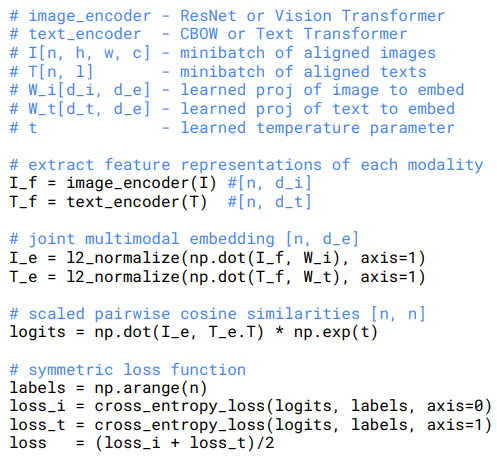
CLIP's core innovation is a contrastive learning objective. Instead of trying to predict the exact caption of an image (which is extremely hard and computationally expensive), the model is trained to identify which of the N text descriptions in a batch matches each of the N images. Given a batch of N (image, text) pairs, CLIP computes the cosine similarity between all N×N possible pairings. The loss encourages the similarity of the correct N pairs to be high and the similarity of the N²−N incorrect pairs to be low. This simple objective is surprisingly effective.
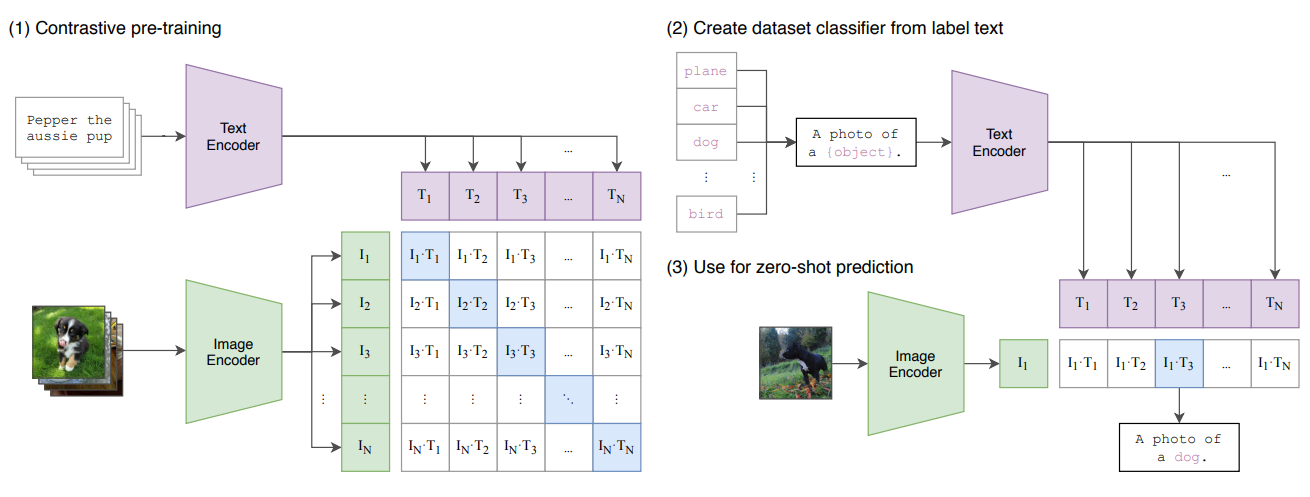
The image encoder can be either a modified ResNet (with attention pooling) or a Vision Transformer (ViT). The text encoder is a 12-layer Transformer with 63M parameters, operating on byte-pair encoded tokens with a maximum sequence length of 76. Both encoders project their outputs into a shared multimodal embedding space via a linear projection. The model is trained from scratch—no pre-trained weights for either encoder—using a large dataset called WIT (WebImageText) collected from publicly available internet sources.
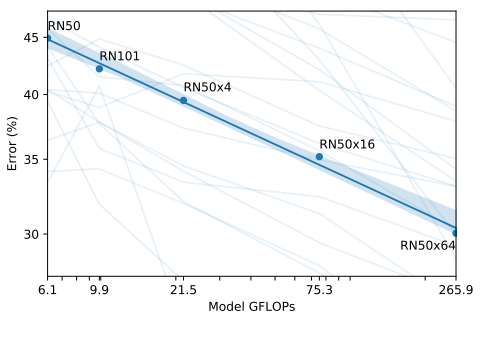
The authors trained multiple model variants: five ResNets (RN50, RN101, RN50x4, RN50x16, RN50x64) and three Vision Transformers (ViT-B/32, ViT-B/16, ViT-L/14). All models were trained for 32 epochs. The best-performing model, ViT-L/14@336px, was additionally fine-tuned at a higher resolution of 336 pixels for one epoch.
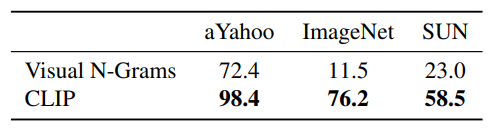
CLIP dramatically outperforms prior zero-shot methods like Visual N-Grams across all tested datasets. Prompt engineering—using descriptive templates like "a photo of a {class}" instead of just the class name—and ensembling multiple prompts boost zero-shot accuracy by nearly 5 points on average across 36 datasets.
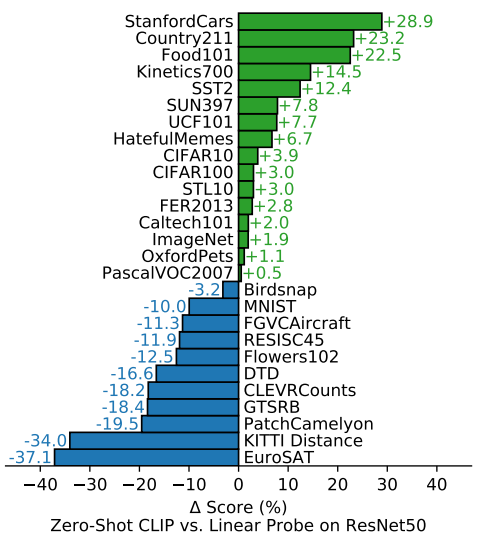
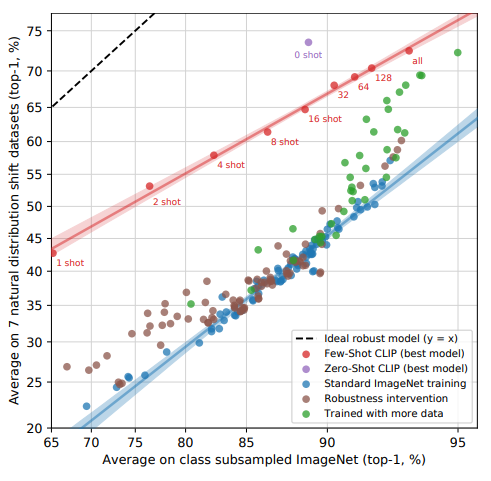
On a 27-dataset evaluation suite, zero-shot CLIP outperforms a fully supervised linear classifier on ResNet-50 features on 16 datasets, including ImageNet. It matches the average performance of a 4-shot linear classifier and nearly matches a 16-shot classifier.
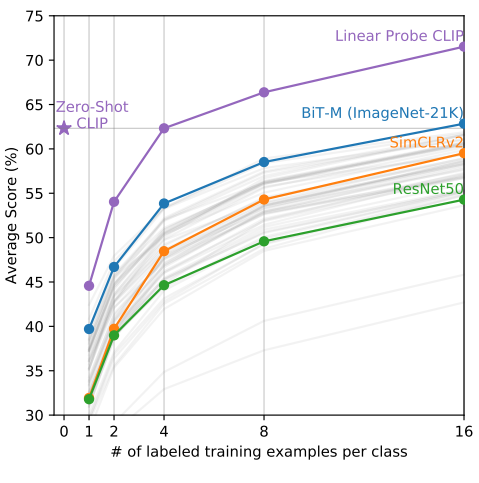
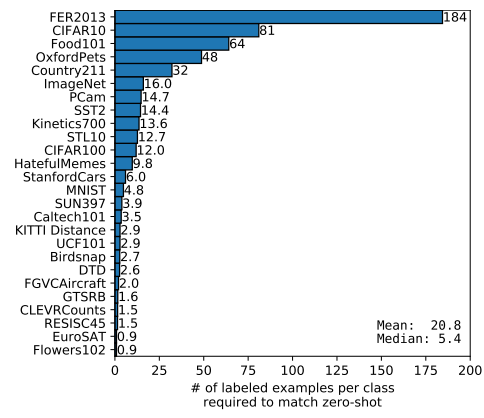
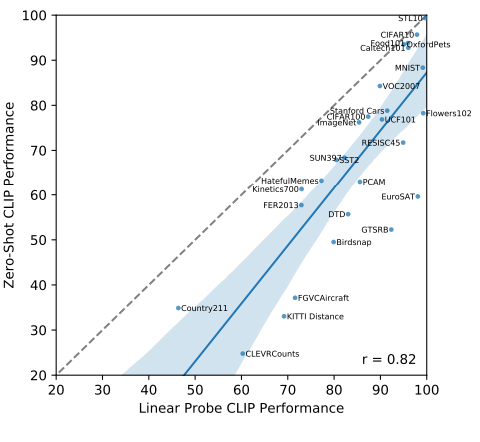
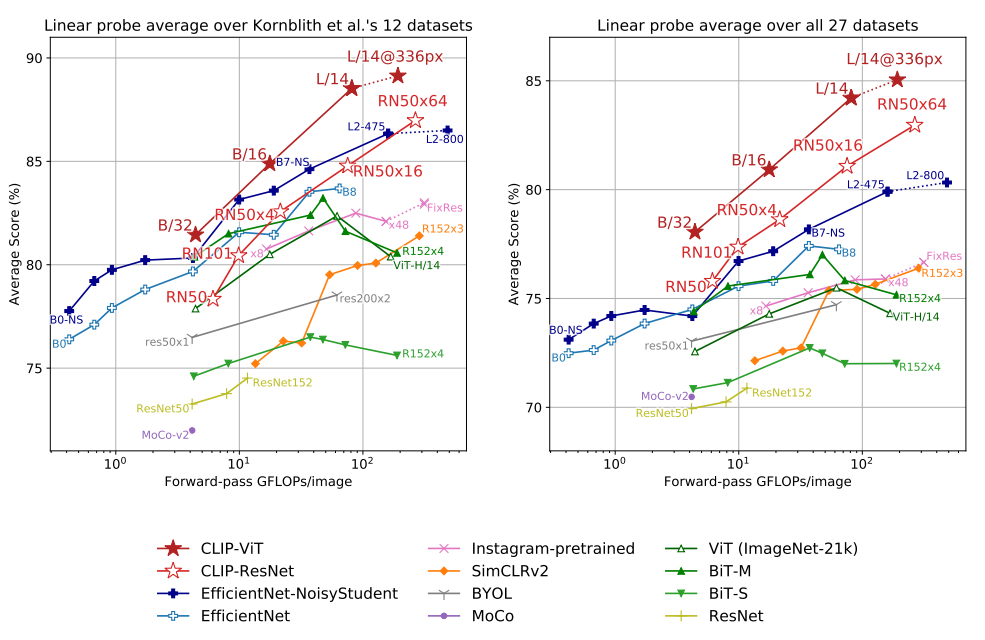
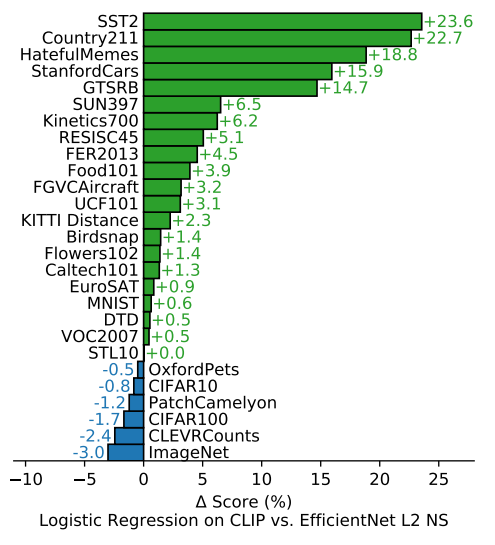
A linear classifier on CLIP features beats the Noisy Student EfficientNet-L2 on 21 out of 27 datasets. CLIP also shows remarkable robustness to natural distribution shifts—the "robustness gap" between ImageNet and other distributions shrinks by up to 75% compared to standard ImageNet models.
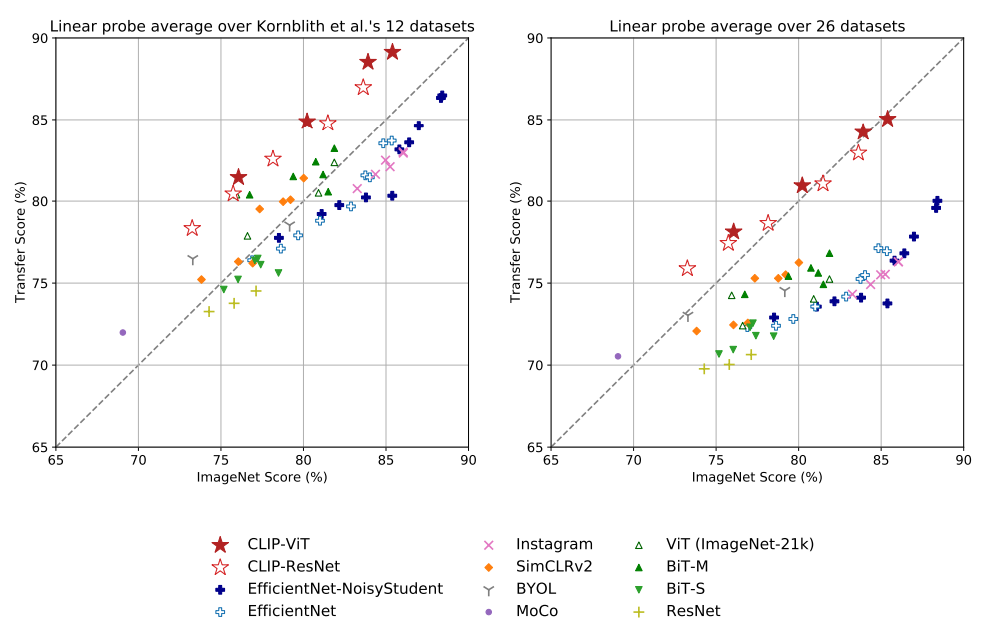
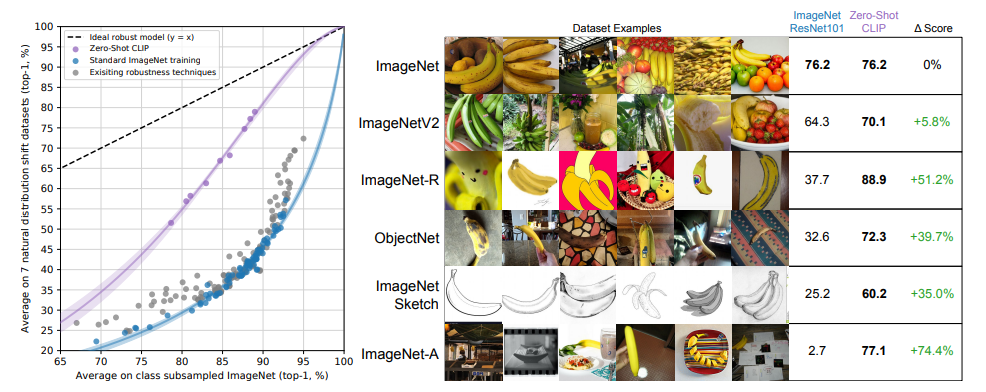
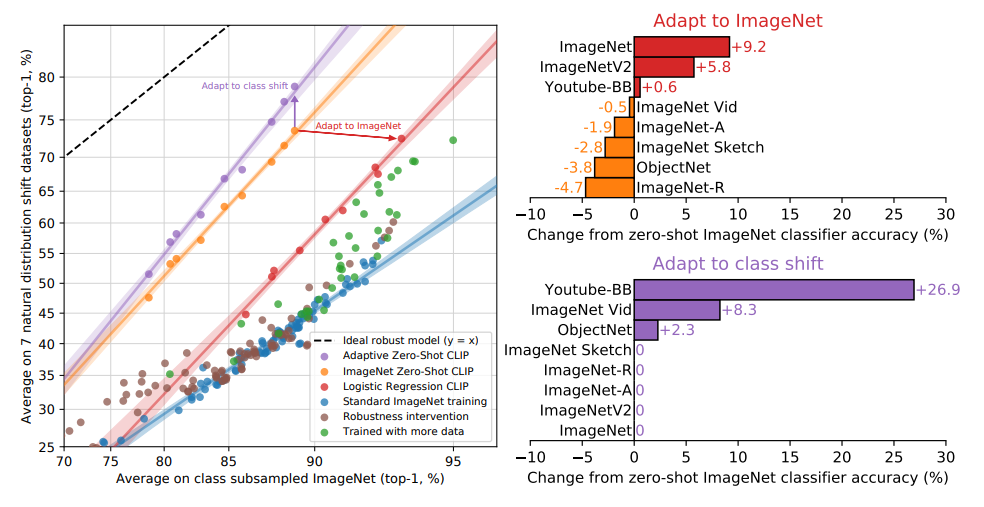
CLIP fundamentally changed how the field thinks about visual representation learning. By leveraging natural language as a flexible supervision signal, it demonstrated that models can learn broadly useful visual concepts without manual labeling. Its zero-shot capability has practical value in scenarios where labeled data is scarce or categories change frequently. The paper also highlighted the importance of robustness to distribution shifts—a critical property for real-world deployment. CLIP has become a building block for countless downstream applications, from image generation (DALL·E, Stable Diffusion) to video understanding and multimodal chatbots. Its influence continues to grow as researchers explore scaling laws, improved contrastive objectives, and integration with large language models.
Alex Krizhevsky, Ilya Sutskever et al.
Ashish Vaswani, Noam Shazeer et al.
Douglas M. Bates, Martin Mächler et al.
Diederik P. Kingma, Jimmy Ba