PreprintCommunications of the ACM
ImageNet classification with deep convolutional neural networks
Alex Krizhevsky, Ilya Sutskever et al.
130k2017
0
Citations
0
Influential Citations
—
Venue
2023
Year
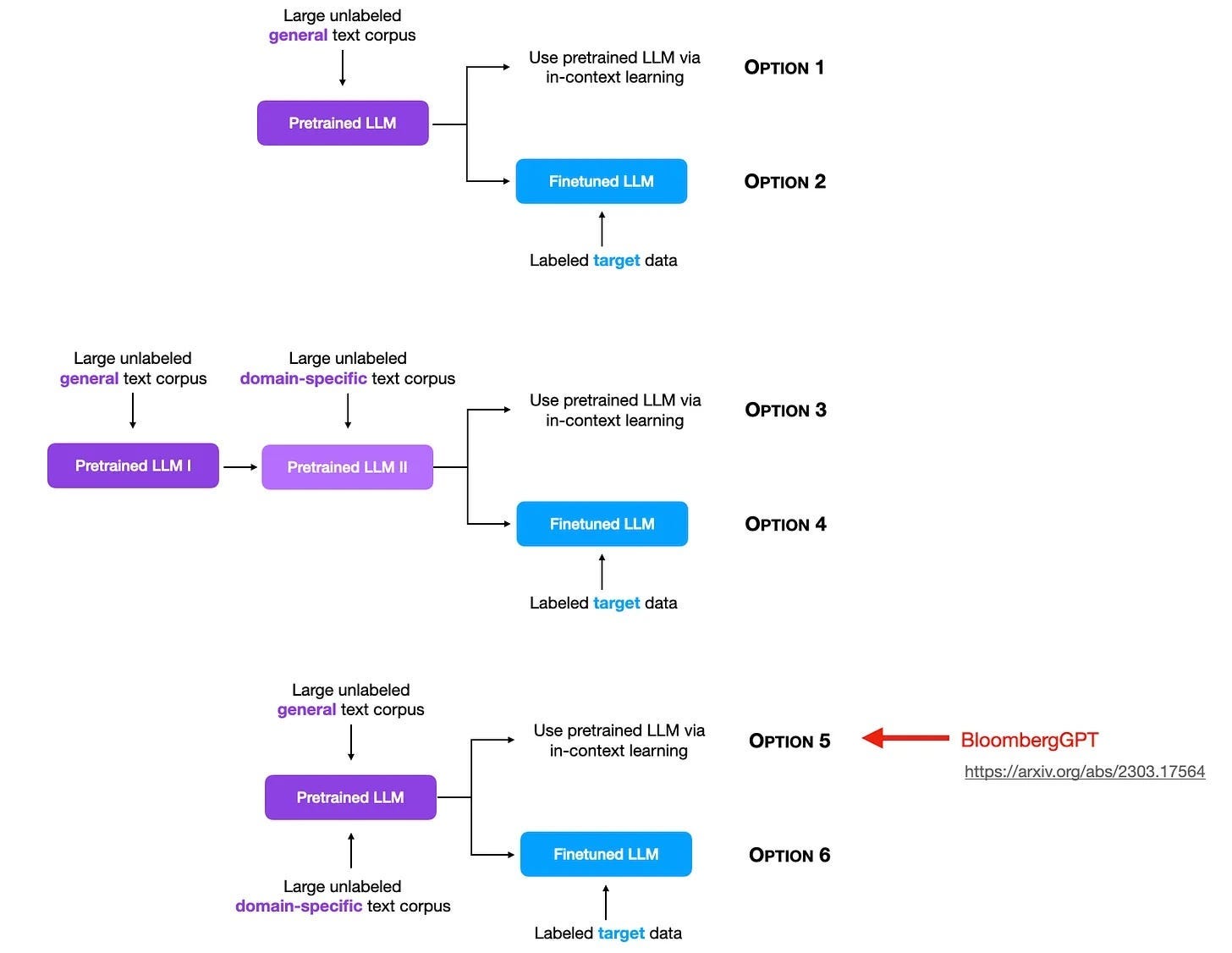
A 50B language model train on general purpose and domain specific data to support a wide range of tasks within the financial industry.
BloombergGPT addresses a critical challenge in deploying large language models for specialized industries: how to build a model that excels in domain-specific tasks without sacrificing the broad capabilities needed for diverse applications. By training a 50-billion-parameter model on a carefully curated mix of financial and general data, the authors show that a single model can serve both purposes effectively. This is particularly relevant for financial institutions like Bloomberg, which require models that can handle everything from sentiment analysis on earnings calls to general question answering.
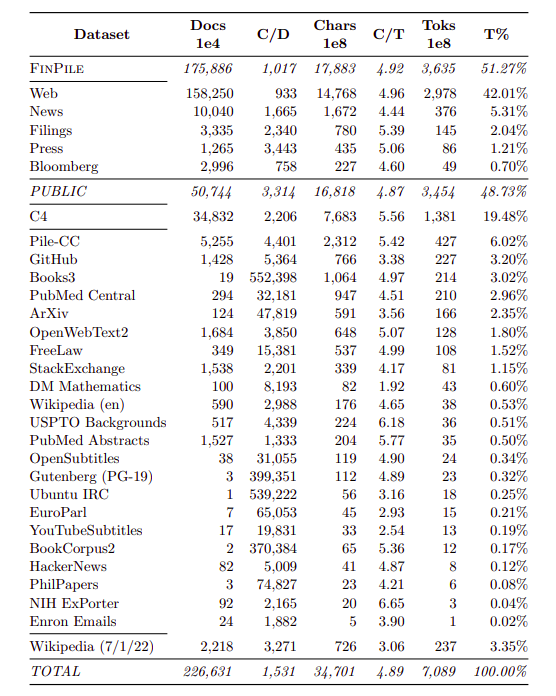
The core innovation is the training dataset, FinPile, which combines decades of Bloomberg's proprietary financial documents (news, filings, press releases, social media) with publicly available general-purpose text. This results in a roughly 50-50 split between domain-specific and general data, enabling the model to learn both financial jargon and broad language patterns.
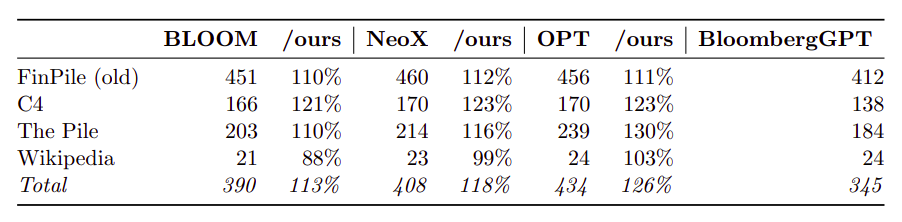
The tokenizer uses a unigram approach with byte-level encoding, following GPT-2's method of treating input as byte sequences. A pre-tokenization step splits text into chunks by character class (alphabetic, digits, others), with spaces included in alphabetic chunks to allow multi-word tokens. This increases information density and reduces context length. The vocabulary size of 131,072 (2^17) tokens was chosen by minimizing the encoded size of the C4 dataset.
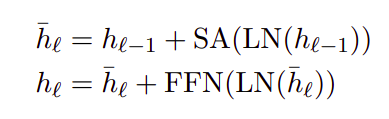
The model architecture is a decoder-only transformer based on BLOOM, with 70 layers, multi-head self-attention, GELU activations, and ALiBi positional encoding. A key addition is an extra layer normalization after the token embeddings, which stabilizes training.
BloombergGPT was evaluated on two categories: financial tasks and general-purpose benchmarks. For financial tasks, it achieved the best performance among comparable models on 4 out of 5 external benchmarks (ConvFinQA, FiQA SA, FPB, Headline) and significantly outperformed others on internal sentiment analysis tasks, often by 25-60 points. On NER tasks, it performed well but was sometimes beaten by the much larger BLOOM176B. Notably, on the combined NER+NED task, BloombergGPT outperformed all other models by a large margin.
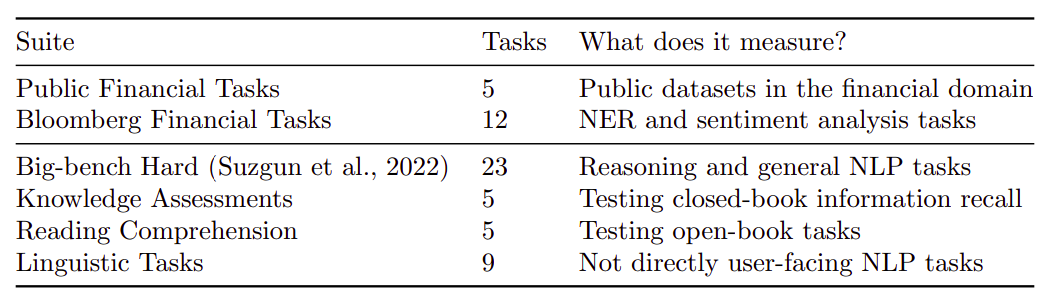
On general benchmarks, BloombergGPT matched or exceeded similarly sized models (GPT-NeoX, OPT66B) on BIG-bench Hard, MMLU, reading comprehension, and linguistic tasks. It even approached the performance of much larger models like PaLM 540B on some tasks, demonstrating that its financial focus did not compromise general capabilities.
BloombergGPT provides a practical template for building domain-specific LLMs that retain general-purpose utility. The mixed-data approach avoids the trade-off between specialization and generality, making it suitable for organizations with diverse task requirements. The paper also offers valuable insights into tokenization choices and evaluation methodologies for financial NLP. Future work could explore fine-tuning strategies and scaling to larger models, but the core contribution—a successful demonstration of mixed-domain pretraining—is already impactful for the AI community.
Alex Krizhevsky, Ilya Sutskever et al.
Ashish Vaswani, Noam Shazeer et al.
Douglas M. Bates, Martin Mächler et al.
Diederik P. Kingma, Jimmy Ba